|
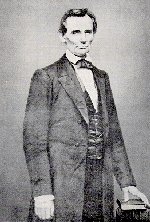
MR. LINCOLN'S SPEECH.
LADIES AND GENTLEMEN: I have had no
immediate conference with Judge Douglas, but I will venture to say that
he and I will perfectly agree that your entire silence, both when I
speak and when he speaks, will be most agreeable to us.
In
the month of May, I856, the elements in the State of Illinois, which have since been consolidated
into the Republican party, assembled together in a State Convention at Bloomington. They adopted at that time, what, in political
language, is called a platform. In June of
the same year, the elements of the Republican party in the nation
assembled together in a National Convention at Philadelphia. They
adopted what is called the National Platform. In
June, I858—the present year—the Republicans of Illinois reassembled at Springfield, in
State Convention, and adopted again their platform, as I suppose, not
differing in any essential particular from either of the former ones,
but perhaps adding something in relation to the new developments of
political progress in the country.
The
Convention that assembled in June last did me the honor, if it be one,
and I esteem it such, to nominate me as their candidate for the United
States Senate. I have supposed that, in
entering upon this canvass, I stood generally upon these platforms. We are now met together on the 13th of October
of the same year, only four months from the adoption of the last
platform, and I am unaware that in this canvass, from the beginning
until to-day, any one of our adversaries has taken hold of our
platforms, or laid his finger upon any thing that he calls wrong in
them.
In
the very first one of these joint discussions between Senator Douglas
and myself, Senator Douglas, without alluding at all to these
platforms, or any one of them, of which I have spoken, attempted to
hold me responsible for a set of resolutions passed long before the
meeting of either one of these Conventions of which I have spoken. And as a ground for holding me responsible for
these resolutions, he assumed that they had been passed at a State
Convention of the Republican party, and that I took part in that
Convention. It was discovered afterward
that this was erroneous, that the resolutions which he endeavored to
hold me responsible for, had not been passed by any State Convention
any where—had not been passed at Springfield, where he supposed they
had, or assumed that they had, and that they had been passed in no
Convention in which I had taken part. The
Judge, nevertheless, was not willing to give up the point that he was
endeavoring to make upon me, and he therefore thought to still hold me
to the point that he was endeavoring to make, by showing that the
resolutions that he read, had been passed at a local Convention in the
northern part of the State, although it was not a local Convention that
embraced my residence at all, nor one that reached, as I suppose,
nearer than one hundred and fifty or two hundred miles of where I was
when it met, nor one in which I took any part at all. He
also introduced other resolutions, passed at other meetings, and by
combining the whole, although they were all antecedent to the two State
Conventions, and the one National Convention I have mentioned, still he
insisted and now insists, as I understand, that I am in some way
responsible for them.
At
Jonesboro, on our third meeting, I insisted to the Judge that I was in
no way rightfully held responsible for the proceedings of this local
meeting or Convention in which I had taken no part, and in which I was
in no way embraced; but I insisted to him that if he thought I was
responsible for every man or every set of men every where, who happen
to be my friends, the rule ought to work both ways, and he ought to be
responsible for the acts and resolutions of all men or sets of men who
were or are now his supporters and friends, and gave him a pretty long
string of resolutions, passed by men who are now his friends, and
announcing doctrines for which he does not desire to be held
responsible.
This
still does not satisfy Judge Douglas. He
still adheres to his proposition, that I am responsible for what some
of my friends in different parts of' the State have done; but that he
is not responsible for what his have done. At
least, so I understand him. But in
addition to that, the Judge, at our meeting in Galesburgh, last week,
undertakes to establish that I am guilty of a species of double-dealing
with the public—that I make speeches of a certain sort in the north,
among the Abolitionists, which I would not make in the south, and that
I make speeches of a certain sort in the south which I would not make
in the north. I apprehend, in the course I
have marked out for myself, that I shall not have to dwell at very
great length upon this subject.
As this was done in the Judge's opening
speech at Galesburgh, I had an opportunity, as I had the middle speech
then, of saying something in answer to it. He
brought forward a quotation or two from a speech of mine, delivered at
Chicago, and then to contrast with it, he brought forward an extract
from a speech of mine at Charleston, in which he insisted that I was
greatly inconsistent, and insisted that his conclusion followed that I
was playing a double part, and speaking in one region one way, and in
another region another way. I have not
time now to dwell on this as long as I would like, and wish only now to
requote that portion of my speech at Charleston, which the Judge quoted,
and then make some comments upon it. This
he quotes from me as being delivered at Charleston, and I believe
correctly: “I will say, then, that I am not, nor ever have been, in
favor of bringing about in any way the social and political equality of
the white and black races—that I am not nor ever have been in favor of
making voters or jurors of negroes, nor of qualifying them to hold
office, nor to intermarry with white people; and I will say in addition
to this that there is a physical difference between the white and black
races which will ever forbid the two races living together on terms of
social and political equality. And
inasmuch as they cannot so live, while they do remain together, there
must be the position of superior and inferior. I
am as much as any other man in favor of having the superior position
assigned to the white race.” This, I
believe is the entire quotation from the Charleston speech, as Judge Douglas
made it. His comments are as follows:
“Yes,
here you find men who hurra for Lincoln, and say he is right when he
discards all distinction between races, or when he declares that he
discards the doctrine that there is such a thing as a superior and
inferior race; and Abolitionists are required and expected to vote for
Mr. Lincoln because he goes for the equality of races, holding that in
the Declaration of Independence the white man and negro were declared
equal, and endowed by divine law with equality. And
down south with the old line Whigs, with the Kentuckians, the
Virginians, and the Tennesseeans, he tells you that there is a physical
difference between the races, making the one superior, the other
inferior, and he is in favor of maintaining the superiority of the
white race over the negro.”
Those
are the Judge's comments. Now I wish to
show you, that a month, or, only lacking three days of a month, before
I made the speech at Charleston,
which the Judge quotes from, he had himself heard me say substantially
the same thing. It was in our first
meeting, at Ottawa—and I will say a word about where it was, and the
atmosphere it was in, after awhile—but at our first meeting, at Ottawa,
I read an extract from an old speech of mine, made nearly four years
ago, not merely to show my sentiments, but to show that my sentiments
were long entertained and openly expressed; in which extract I
expressly declared that my own feelings would not admit a social and
political equality between the white and black races, and that even if
my own feelings would admit of it, I still knew that the public
sentiment of the country would not, and that such a thing was an utter
impossibility, or substantially that. That
extract from my old speech, the reporters, by some sort of accident,
passed over, and it was not reported. I
lay no blame upon any body. I suppose they
thought that I would hand it over to them, and dropped reporting while
I was reading it, but afterward went away without getting it from me. At the end of that quotation from my old
speech, which I read at Ottawa, I made the comments which were reported
at that time, and which I will now read, and ask you to notice how very
nearly they are the same as Judge Douglas says were delivered by me,
down in Egypt. After reading I added these
words: “Now, gentlemen, I don't want to read at any great length, but
this is the true complexion of all I have ever said in regard to the
institution of slavery or the black race, and this is the whole of it;
any thing that argues me into his idea of perfect social and political
equality with the negro, is but a specious and fantastical arrangement
of words by which a man can prove a horse-chestnut to be a chestnut
horse. I will say here, while upon this
subject, that I have no purpose, directly or indirectly, to interfere
with the institution in the States where it exists.
I believe I have no right to do so. I
have no inclination to do so. I have no
purpose to introduce political and social equality between the white
and black races. There is a physical
difference between the two, which, in my judgment, will probably
forever forbid their living together on the footing of perfect
equality, and inasmuch as it becomes a necessity that there must be a
difference, I, as well as Judge Douglas, am in favor of the race to
which I belong having the superior position. I
have never said any thing to the contrary, but I hold that,
notwithstanding all this, there is no reason in the world why the negro
is not entitled to all the rights enumerated in the Declaration of
Independence—the right of life, liberty, and the pursuit of happiness. I hold that he is as much entitled to these as
the white man. I agree with Judge Douglas
that he is not my equal in many respects, certainly not in
color—perhaps not in intellectual and moral endowments; but in the
right to eat the bread without the leave of any body else which his own
hand earns, he is my equal and the equal of Judge Douglas, and the
equal of every other man.”
I
have chiefly introduced this for the purpose of meeting the Judge’s
charge that the quotation he took from my Charleston speech was what I
would say down south among the Kentuckians, the Virginians, etc., but
would not say in the regions in which was supposed to be more of the
Abolition element. I now make this
comment: That speech from which I have now read the quotation, and
which is there given correctly, perhaps too much so for good taste, was
made away up north in the Abolition District of this State par
excellence—in the Lovejoy District—in the personal presence of
Lovejoy, for he was on the stand with us when I made it.
It had been made and put in print in that region only
three days less than a month before the speech made at Charleston, the
like of which Judge Douglas thinks I would not make where there was any
Abolition element, I only refer to this matter to say that I am
altogether unconscious of having attempted any double-dealing any
where—that upon one occasion I may say one thing and leave other things
unsaid, and vice versa; but that I have said any thing
on one occasion that is inconsistent with what I have said elsewhere, I
deny—at least I deny it so far as the intention is concerned. I find that I have devoted to this topic a
larger portion of my time than I had intended. I
wished to show, but I will pass it upon this occasion, that in the
sentiment I have occasionally advanced upon the Declaration of
Independence, I am entirely borne out by the sentiments advanced by our
old Whig leader, Henry Clay, and I have the book here to show it from;
but because I have already occupied more time than I intended to do on
that topic, I pass over it.
At
Galesburgh, I tried to show that by the Dred Scott decision, pushed to
its legitimate consequences, slavery would be established in all the
States as well as in the Territories. I
did this because, upon a former occasion, I had asked Judge Douglas
whether, if the Supreme Court should make a decision declaring that the
States had not the power to exclude slavery from their limits, he would
adopt and follow that decision as a rule of political action; and
because he had not directly answered that question, but had merely
contented himself with sneering at it, I again introduced it, and tried
to show that the conclusion that I stated followed inevitably and
logically from the proposition already decided by the court. Judge Douglas had the privilege of replying to
me at Galesburgh, and again he gave me no direct answer as to whether
he would or would not sustain such a decision if made.
I give him this third chance to say yes or no. He is not obliged to do either—probably he
will not do either—but I give him the third chance. I
tried to show then that this result—this conclusion inevitably followed
from the point already decided by the court. The
Judge, in his reply, again sneers at the thought of the court making
any such decision, and in the course of his remarks upon this subject,
uses the language which I will now read. Speaking
of me the Judge says:
“He
goes on and insists that the Dred Scott decision would carry slavery
into the free States,
notwithstanding the decision itself says the contrary.” And
he adds: “Mr. Lincoln knows that there is no member of the Supreme
Court that holds that doctrine. He knows
that every one of them in their opinions held the reverse.”
I
especially introduce this subject again for the purpose of saying that
I have the Dred Scott decision here, and I will thank Judge Douglas to
lay his finger upon the place in the entire opinions of the court where
any one of them “says the contrary.” It is
very hard to affirm a negative with entire confidence.
I say, however, that I have examined that decision with a
good deal of care, as a lawyer examines a decision, and so far as I
have been able to do so, the court has no where in its opinions said
that the States have the power to exclude slavery, nor have they used
other language substantially that. I also
say, so far as I can find, not one of the concurring Judges has said
that the States can exclude slavery, nor said any thing that was
substantially that. The nearest approach
that any one of them has made to it, so far as I can find, was by Judge
Nelson, and the approach he made to it was exactly, in substance, the
Nebraska Bill—that the States had the exclusive power over the question
of slavery, so far as they are not limited by the Constitution of the
United States. I asked the question
therefore, if the non-concurring Judges, McLean or Curtis, had asked to
get an express declaration that the States could absolutely exclude
slavery from their limits, what reason have we to believe that it would
not have been voted down by the majority of the Judges, just as Chase’s
amendment was voted down by Judge Douglas and his compeers when it was
offered to the Nebraska Bill.
Also
at Galesburgh, I said something in regard to those Springfield
resolutions that Judge Douglas had attempted to use upon me at Ottawa, and
commented at some length upon the fact that they were, as presented,
not genuine. Judge Douglas in his reply to
me seemed to be somewhat exasperated. He
said he would never have believed that Abraham Lincoln, as he kindly
called me, would have attempted such a thing as I had attempted upon
that occasion; and among other expressions which he used toward me, was
that I dared to say forgery—that I had dared to say
forgery [turning to Judge Douglas]. Yes,
Judge, I did dare to say forgery. But in
this political canvass, the Judge ought to remember that I was not the
first who dared to say forgery. At
Jacksonville Judge Douglas made a speech in answer to something said by
Judge Trumbull, and at the close of what he said upon that subject, he dared to say that Trumbull had forged his evidence. He said, too, that he should not concern
himself with Trumbull any more, but
thereafter he should hold Lincoln
responsible for the slanders upon him. When
I met him at Charleston after that, although I think that I should not
have noticed the subject if he had not said he would hold me
responsible for it, I spread out before him the statements of the
evidence that Judge Trumbull had used, and I asked Judge Douglas, piece
by piece, to put his finger upon one piece of all that evidence that he
would say was a forgery! When I went
through with each and every piece, Judge Douglas did not dare
then to say that any piece of it was a forgery. So
it seems that there are some things that Judge Douglas dares to do, and
some that he dares not to do.
A voice—“It's the same thing with you.”
Mr. Lincoln—Yes,
sir, it's the same thing with me. I do
dare to say forgery when it’s true, and don't dare to say forgery when
it’s false. Now, I will say here to this
audience and to Judge Douglas, I have not dared to say he committed a
forgery,and I never shall until I know it; but I did dare to say—just
to suggest to the Judge—that a forgery had been committed, which by his
own showing had been traced to him and two of his friends.
I dared to suggest to him that he had expressly promised
in one of his public speeches to investigate that matter, and I dared
to suggest to him that there was an implied promise that when he
investigated it he would make known the result. I
dared to suggest to the Judge that he could not expect to be quite
clear of suspicion of that fraud, for since the time, that promise was
made he had been with those friends, and had not kept his promise in
regard to the investigation and the report upon it.
I am not a very daring man, but I dared that much, Judge,
and I am not much scared about it yet. When
the Judge says he wouldn’t have believed of Abraham Lincoln that he
would have made such an attempt as that, he reminds me of the fact that
he entered upon this canvass with the purpose to treat me courteously;
that touched me somewhat. It sets me to
thinking. I was aware, when it was first
agreed that Judge Douglas and I were to have these seven joint
discussions, that they were the successive acts of a drama—perhaps I
should say, to be enacted not merely in the face of audiences like
this, but in the face of the nation, and to some extent, by my relation
to him, and not from any thing in myself, in the face of the world; and
I am anxious that they should be conducted with dignity and in the good
temper which would be befitting the vast audience before which it was
conducted. But when Judge Douglas got home
from Washington and made his first
speech in Chicago,
the evening afterward I made some sort of a reply to it.
His second speech was made at Bloomington,
in which he commented upon my speech at Chicago, and said that I had used
language ingeniously contrived to conceal my intentions, or words to
that effect. Now, I understand that this
is an imputation upon my veracity and my candor. I
do not know what the Judge understood by it but in our first discussion
at Ottawa, he led off by charging a bargain, somewhat corrupt in its
character, upon Trumbull and myself—that we had entered into a bargain,
one of the terms of which was that Trumbull was to abolitionize the old
Democratic party, and I (Lincoln) was to abolitionize the old Whig
party—I pretending to be as good an old line Whig as ever.
Judge Douglas may not understand that he implicated my
truthfulness and my honor, when he said I was doing one thing and
pretending another; and I misunderstood him if he thought he was
treating me in a dignified way, as a man of honor and truth, as he now
claims he was disposed to treat me. Even
after that time, at Galesburgh, when he brings forward an extract from
a speech made at Chicago, and an extract from a speech made at
Charleston, to prove that I was trying to play a double part—that I was
trying to cheat the public, and get votes upon one set of principles at
one place and upon another set of principles at another place—I do not
understand but what he impeaches my honor, my veracity and my candor,
and because he does this, I do not understand that I
am bound, if I see a truthful ground for it, to keep my hands off of
him. As soon as I learned that Judge
Douglas was disposed to treat me in this way, I signified in one of my
speeches that I should be driven to draw upon whatever of humble
resources I might have—to adopt a new course with him.
I was not entirely sure that I should be able to hold my
own with him, but I at least had the purpose made to do as well as I
could upon him; and now I say that I will not be the first to cry
“hold.” I think it originated with the
Judge, and when he quits, I probably will. But
I shall not ask any favors at all. He asks
me, or he asks the audience, if I wish to push this matter to the point
of personal difficulty. I tell him, no. He did not make a mistake, in one of his early
speeches, when he called me an “amiable” man, though perhaps he did
when he called me an “intelligent” man. It
really hurts me very much to suppose that I have wronged any body on
earth. I again tell him, no!
I very much prefer, when this canvass shall be over,
however it may result, that we at least part without any bitter
recollections of personal difficulties.
The
Judge, in his concluding speech at Galesburgh, says that I was pushing
this matter to a personal difficulty, to avoid the responsibility for
the enormity of my principles. I say to
the Judge and this audience now, that I will again state our principles
as well as I hastily can in all their enormity, and if the Judge
hereafter chooses to confine himself to a war upon these principles, he
will probably not find me departing from the same course.
We
have in this nation this element of domestic slavery.
It is a matter of absolute certainty that it is a
disturbing element. It is the opinion of
all the great men who have expressed an opinion upon it, that it is a
dangerous element. We keep up a
controversy in regard to it. That
controversy necessarily springs from difference of opinion, and if we
can learn exactly—can reduce to the lowest elements—what that
difference of opinion is, we perhaps shall be better prepared for
discussing the different systems of policy that we would propose in
regard to that disturbing element. I
suggest that the difference of opinion, reduced to its lowest terms, is
no other than the difference between the men who think slavery a wrong
and those who do not think it wrong. The
Republican party think it wrong—we think it is a moral, a social and a
political wrong. We think it as a wrong
not confining itself merely to the persons or the States where it
exists, but that it is a wrong in its tendency, to say the least, that
extends itself to the existence of the whole nation.
Because
we think it wrong, we propose a course of policy that shall deal with
it as a wrong. We deal with it as with any
other wrong, in so far as we can prevent its growing any larger, and so
deal with it that in the run of time there may he some promise of an
end to it. We have a due regard to the
actual presence of it amongst us and the difficulties of getting rid of
it in any satisfactory way, and all the Constitutional obligations
thrown about it. I suppose that in
reference both to its actual existence in the nation, and to our
Constitutional obligations, we have no right at all to disturb it in
the States where it exists, and we profess that we have no more
inclination to disturb it than we have the right to do it.
We go further than that; we don't propose to disturb it
where, in one instance, we think the Constitution would permit us. We think the Constitution would permit us to
disturb it in the District
of Columbia. Still
we do not propose to do that, unless it should be in terms which I
don't suppose the nation is very likely soon to agree to—the terms of
making the emancipation gradual and compensating the unwilling owners. Where we suppose we have the Constitutional
right, we restrain ourselves in reference to the actual existence of
the institution and the difficulties thrown about it.
We also oppose it as an evil so far as it seeks to spread
itself. We insist on the policy that shall
restrict it to its present limits. We
don't suppose that in doing this we violate any thing due to the actual
presence of the institution, or any thing due to the Constitutional
guaranties thrown around it.
We
oppose the Dred Scott decision in a certain way, upon which I ought
perhaps to address you a few words. We do
not propose that when Dred Scott has been decided to be a slave by the
court, we, as a mob, will decide him to be free. We
do not propose that, when any other one, or one thousand, shall be
decided by that court to be slaves, we will in any violent way disturb
the rights of property thus settled but we nevertheless do oppose that
decision as a political rule, which shall be binding on the voter to
vote for nobody who thinks it wrong, which shall be binding on the
members, of Congress or the President to favor no measure that does not
actually concur with the principles of that decision.
We do not propose to be bound by it as a political rule in
that way, because we think it lays the foundation not merely of
enlarging and spreading out what we consider an evil, but it lays the
foundation for spreading that evil into the States themselves. We propose so resisting it as to have it
reversed if we can, and a new judicial rule established upon this
subject.
I
will add this, that if there be any man who does not believe that
slavery is wrong in the three aspects which I have mentioned, or in any
one of them, that man is misplaced, and ought to leave us.
While, on the other hand, if there be any man in the
Republican party who is impatient over the necessity springing from its
actual presence, and is impatient of the Constitutional guaranties
thrown around it, and would act in disregard of these, he too is
misplaced, standing with us. He will find
his place somewhere else; for we have a due regard, so far as we are
capable of understanding them, for all these things.
This, gentlemen, as well as I can give it, is a plain
statement of our principles in all their enormity.
I will say now that there is a sentiment in
the country contrary to me—a sentiment which holds that slavery is not
wrong, and therefore it goes for the policy that does not propose
dealing with it as a wrong. That policy is the Democratic policy,
and that sentiment is the Democratic sentiment. If there be a
doubt in the mind of any one of this vast audience that this is really
the central idea of the Democratic party, in relation to this subject,
I ask him to bear with me while I state a few things tending, as I
think, to prove that proposition. In the first place, the leading
man—I think I may do my friend Judge Douglas the honor of calling him
such—advocating the present Democratic policy, never himself says it is
wrong. He has the high distinction, so far as I know, of never
having said slavery is either right or wrong. Almost every body
else says one or the other, but the Judge never does. If there be
a man in the Democratic party who thinks it is wrong, and yet clings to
that party, I suggest to him in the first place that his leader don't
talk as he does, for he never says that it is wrong. In the
second place, I suggest to him that if he will examine the policy
proposed to be carried forward, he will find that he carefully excludes
the idea that there is any thing wrong in it. If you will examine
the arguments that are made on it, you will find that every one
carefully excludes the idea that there is any thing wrong in
slavery. Perhaps that Democrat who says he is as much opposed to
slavery as I am, will tell me that I am wrong about this. I wish
him to examine his own course in regard to this matter a moment, and
then see if his opinion will not be changed a little. You say it
is wrong; but don't you constantly object to any body else saying so?
Do you not constantly argue that this is not the right place to
oppose it? You say it must not be opposed in the free States,
because slavery is not here; it must not be opposed in the slave
States, because it is there; it must not be opposed in politics,
because that will make a fuss; it must not be opposed in the pulpit,
because it is not religion. Then where is the place to oppose
it? There is no suitable place to oppose it. There is no
plan in the country to oppose this evil overspreading the continent,
which you say yourself is coming. Frank Blair and Gratz Brown
tried to get up a system of gradual emancipation in Missouri, had an election in August and got beat,
and you, Mr. Democrat, threw up your hat, and haliooed “hurra for
Democracy.” So I say again, that in regard to the arguments that
are made, when Judge Douglas says he “don’t care whether slavery is
voted up or voted down,” whether he means that as an individual
expression of sentiment, or only as a sort of statement of his views on
national policy, it is alike true to say that he can thus argue
logically if he don't see any thing wrong in it; but he cannot say so
logically if he admits that slavery is wrong. He cannot say that
he would as soon see a wrong voted up as voted down. When Judge
Douglas says that whoever or whatever community wants slaves, they have
a right to have them, he is perfectly logical if there is nothing wrong
in the institution; but if you admit that it is wrong, he cannot
logically say that any body has a right to do wrong. When he says
that slave property and horse and hog property are, alike, to be
allowed to go into the Territories, upon the principles of equality, he
is reasoning truly, if there is no difference between them as property;
but if the one is property, held rightfully, and the other is wrong,
then there is no equality between the right and wrong; so that, turn it
in any way you can, in all the arguments sustaining the Democratic
policy, and in that policy itself, there is a careful, studied
exclusion of the idea that there is any thing wrong in slavery.
Let us understand this. I am not, just here, trying to prove that
we are right and they are wrong. I have been stating where we and
they stand, and trying to show what is the real difference between us
and I now say that whenever we can get the question distinctly
stated—can get all these men who believe that slavery is in some of
these respects wrong, to stand and act with us in treating it as a
wrong—then, and not till then, I think we will in some way come to an
end of this slavery agitation.
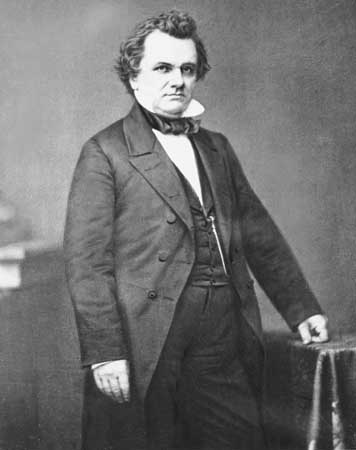
MR. DOUGLAS'S
REPLY.
LADIES AND GENTLEMEN: Permit me to say that
unless silence is observed it will be impossible for me to be heard by
this immense crowd, and my friends can confer no higher favor upon me
than by omitting all expressions of applause or approbation. I desire to be heard rather than to be
applauded. I wish to address myself to
your reason, your judgment, your sense of justice, and not to your
passions.
I
regret that Mr. Lincoln should have deemed it proper for him to again
indulge in gross personalities and base insinuations in regard to the Springfield
resolutions. It has imposed upon me the
necessity of using some portion of my time for the purpose of calling
your attention to the facts of the case, and it will then be for you to
say what you think of a man who can predicate such a charge upon the
circumstances as he has in this. I had
seen the platform adopted by a Republican Congressional Convention held
in Aurora, the Second Congressional District, in September, I854,
published as purporting to be the platform of the Republican party. That
platform declared that the Republican party was pledged never to admit
another slave State into the Union, and also that it pledged to
prohibit slavery in all the Territories of the United States, not only
all that we then had, but all that we should thereafter acquire, and to
repeal unconditionally the Fugitive Slave law, abolish slavery in the
District of Columbia, and prohibit the slave-trade between the
different States. These and other articles
against slavery were contained in this platform, and unanimously
adopted by the Republican Congressional Convention in that District. I had also seen that the Republican
Congressional Conventions at Rockford,
in the First District, and at Bloomington,
in the Third, had adopted the same platform that year, nearly word for
word, and had declared it to be the platform of the Republican party. I had noticed that Major Thomas L. Harris, a
member of Congress from the Springfield District, had referred to that
platform in a speech in Congress as having been adopted by the first
Republican State Convention which assembled in Illinois. When
I had occasion to use the fact in this canvass, I wrote to Major Harris
to know on what day that Convention was held, and to ask him to send me
its proceedings. He being sick, Charles H.
Lanphier answered my letter by sending me the published proceedings of
the Convention held at Springfield
on the 5th of October, 1854, as they appeared in the report of the State Register. I read those
resolutions from that newspaper the same as any of you would refer back
and quote any fact from the files of a newspaper which had published
it. Mr. Lincoln pretends that after I had
so quoted those resolutions he discovered that they had never been
adopted at Springfield.
He does not deny their adoption by
the Republican party at Aurora, at Bloomington, and at Rockford, and by
nearly all the Republican County Conventions in Northern Illinois where
his party is in a majority, but merely because they were not adopted on
the “spot” on which I said they were, he chooses to
quibble about the place rather than meet and discuss the merits of the
resolutions themselves. I stated when I
quoted them that I did so from the State Register. I gave my authority. Lincoln believed at the time, as he has since
admitted, that they had been adopted at Springfield, as published. Does he believe now, that I did not tell the
truth when I quoted those resolutions? He
knows, in his heart, that I quoted them in good faith, believing, at
the time, that they had been adopted at Springfield. I
would consider myself an infamous wretch, if, under such circumstances,
I could charge any man with being a party to a trick or a fraud. And I will tell him, too, that it will not do
to charge a forgery on Charles H. Lanphier or Thomas L. Harris. No man on earth, who knows them, and knows Lincoln, would
take his oath against their word. There
are not two men in the State of Illinois who have higher characters
for truth, for integrity, for moral character, and for elevation of
tone, as gentlemen, than Mr. Lanphier and Mr. Harris. Any
man who attempts to make such charges as Mr. Lincoln has indulged in against them,
only proclaims himself a slanderer.
I
will now show you that I stated with entire fairness, as soon as it was
made known to me, that there was a mistake about the spot where the
resolutions had been adopted, although their truthfulness, as a
declaration of the principles of the Republican party, had not and
could not be questioned. I did not wait
for Lincoln
to point out the mistake; but the moment I discovered it, I made a
speech, and published it to the world, correcting the error. I corrected it myself, as a gentleman, and an
honest man, and as I always feel proud to do when I have made a mistake. I wish Mr. Lincoln could show that he has
acted with equal fairness, and truthfulness, when I have convinced him
that he has been mistaken. I will give you
an illustration to show you how he acts in a similar case: In a speech
at Springfield, he charged Chief Justice Taney, and his associates,
President Pierce, President Buchanan, and myself, with having entered
into a conspiracy at the time the Nebraska bill was introduced, by
which the Dred Scott decision was to be made by the Supreme Court, in
order to carry slavery every where under the Constitution.
I called his attention to the fact, that at the time
alluded to, to wit: the introduction of the Nebraska bill, it was not
possible that such a conspiracy could have been entered into, for the
reason that the Dred Scott case had never been taken before the Supreme
Court, and was not taken before it for a year after; and I asked him to
take back that charge. Did he do it? I showed him that
it was impossible that the charge could be true; I proved it by the
record, and I then called upon him to retract his false charge. What was his answer? Instead
of coming out like an honest man and doing so, he reiterated the
charge, and said that if the case had not gone up to the Supreme Court
from the courts of Missouri at the time he charged that the Judges of
the Supreme Court entered into the conspiracy, yet, that there was an
understanding with the Democratic owners of Dred Scott that they would
take it up. I have since asked him who the
Democratic owners of Dred Scott were, but he could not tell, and why? Because there were no such Democratic owners in
existence. Dred Scott at the time was
owned by the Rev. Dr. Chaffee, an Abolition member of Congress, of Springfield, Massachusetts, in right of his wife. He was owned by one of Lincoln’s
friends, and not by Democrats at all; his case was conducted in court
by Abolition lawyers, so that both the prosecution and the defense were
in the hands of the Abolition political friends of Mr. Lincoln. Notwithstanding I thus proved by the record
that his charge against the Supreme Court was false, instead of taking
it back, he resorted to another false charge to sustain the infamy of
it. He also charged President Buchanan
with having been a party to the conspiracy. I
directed his attention to the fact that the charge could not possibly
be true, for the reason that at the time specified, Mr. Buchanan
was not in America,
but was three thousand miles off, representing the United States at the Court
of St. James, and had been there for a year previous, and did not
return until three years afterward. Yet, I
never could get Mr. Lincoln to take back his false
charge, although I have called upon him over and over again. He refuses to do it, and either remains
silent, or resorts to other tricks to try and palm his slander off on
the country. Therein you will find the
difference between Mr. Lincoln and myself. When
I make a mistake, as an honest man, I correct it without being asked to
do so, but when he makes a false charge he sticks to it, and never
corrects it. One word more in regard to
these resolutions: I quoted them at Ottawa merely to ask Mr. Lincoln
whether he stood on that platform. That
was the purpose for which I quoted them. I
did not think that I had a right to put idle questions to him, and I
first laid a foundation for my questions by showing that the principles
which I wished him either to affirm or deny had been adopted by some
portion of his friends, at least as their creed. Hence
I read the resolutions, and put the questions to him, and he then
refused to answer them. Subsequently, one
week afterward, he did answer a part of them, but the others he has not
answered up to this day.
Now,
let me call your attention for a moment to the answers which Mr.
Lincoln made at Freeport to the questions which I propounded him at
Ottawa, based upon the platform adopted by a majority of the Abolition
counties of the State, which now as then supported him.
In answer to my question whether he indorsed the Black
Republican principle of “no more slave States,” he answered that he was
not pledged against the admission of any more slave States, but that he
would be very sorry if he should ever be placed in a position where he
would have to vote on the question; that he would rejoice to know that
no more slave States would be admitted into the Union; “but,” he added,
“if slavery shall be kept out of the Territories during the territorial
existence of any one given Territory, and then the people shall having
a fair chance and a clear field when they come to adopt the
Constitution, do such an extraordinary thing as to adopt a slave
Constitution, uninfluenced by the actual presence of the institution
among them, I see no alternative, if we own the country, but to admit
them into the Union.” The point I wish him
to answer is this: Suppose Congress should not prohibit slavery in the
Territory, and it applied for admission with a Constitution recognizing
slavery, then how would he vote? His
answer at Freeport does not apply to
any territory in America. I ask you [turning to Lincoln],
will you vote to admit Kansas into
the Union, with just such a
Constitution as her people want, with slavery or without, as they shall
determine? He will not answer. I have put that question to him time and time
again, and have not been able to get an answer out of him.
I ask you again, Lincoln, will you vote to admit New
Mexico when she has the requisite population with such a Constitution
as her people adopt, either recognizing slavery or not, as they shall
determine? He will not answer. I put the same question to him in reference to
Oregon and the new States to be
carved out of Texas, in pursuance of
the contract between Texas and the United States,
and he will not answer. He will not answer
these questions in reference to any territory now in existence; but
says, that if Congress should prohibit slavery in a Territory, and when
its people asked for admission as a State, they should adopt slavery as
one of their institutions, that he supposes he would have to let it
come in. I submit to you whether that
answer of his to my question does not justify me in saying that he has
a fertile genius in devising language to conceal his thoughts. I ask you whether there is an intelligent man
in America
who does not believe, that that answer was made for the purpose of
concealing what he intended to do. He
wished to make the old line Whigs believe that he would stand by the
Compromise measures of I850, which declared that the States might come
into the Union with slavery, or without, as they pleased, while Lovejoy
and his Abolition allies up North, explained to the Abolitionists, that
in taking this ground he preached good Abolition doctrine, because his
proviso would not apply to any territory in America, and therefore
there was no chance of his being governed by it. It
would have been quite easy for him to have said, that he would let the
people of a State do just as they pleased, if he desired to convey such
an idea. Why did he not do it? He would not
answer my question directly, because up north, the Abolition creed
declares that there shall be no more slave States, while down south, in
Adams county, in Coles, and in Sangamon,
he and his friends are afraid to advance that doctrine.
Therefore, he gives an evasive and equivocal answer, to be
construed one way in the south and another way in the north, which,
when analyzed, it is apparent is not an answer at all with reference to
any territory now in existence.
Mr.
Lincoln complains that, in my speech the other day at Galesburgh, I
read an extract from a speech delivered by him at Chicago, and then
another from his speech at Charleston, and compared them, thus showing
the people that he had one set of principles in one part of the State
and another in the other part. And how
does he answer that charge? Why, he quotes
from his Charleston speech as I quoted
from it, and then quotes another extract from a speech which he made at
another place, which he says is the same as the extract from his speech
at Charleston; but he does not quote
the extract from his Chicago
speech, upon which I convicted him of double-dealing.
I quoted from his Chicago
speech to prove that he held one set of principles up north among the
Abolitionists, and from his Charleston
speech to prove that he held another set down at Charleston
and in southern Illinois. In his answer to this charge, he ignores
entirely his Chicago speech, and merely
argues that he said the same thing which he said at Charleston at another place. If he did, it follows that he has twice,
instead of once, held one creed in one part of the State and a
different creed in another part. Up at Chicago, in the
opening of the campaign, he reviewed my reception speech, and undertook
to answer my argument attacking his favorite doctrine of negro equality. I had shown that it was a falsification of the
Declaration of Independence to pretend that that instrument applied to
and included negroes in the clause declaring that all men were created
equal. What was Lincoln's reply?
I will read from his Chicago speech and the one which he
did not quote, and dare not quote, in this part of the State. He said:
“I
should like to know, if taking this old Declaration of Independence,
which declares that all men are equal upon principle, and making
exceptions to it, where will it stop? If
one man says it does not mean a negro, why may not another man say it
does not mean another man? If that
declaration is not the truth, let us get this statute book in which we
find it and tear it out.”
There
you find that Mr. Lincoln told the Abolitionists of Chicago that if the
Declaration of Independence did not declare that the negro was created
by the Almighty the equal of the white man, that you ought to take that
instrument and tear out the clause which says that all men were created
equal. But let me call your attention to
another part of the same speech. You know
that in his Charleston
speech, an extract from which he has read, he declared that the negro
belongs to an inferior race; is physically inferior to the white man,
and should always be kept in an inferior position.
I will now read to you what he said at Chicago on that
point. In concluding his speech at that
place, he remarked:
“My
friends, I have detained you about as long as I desire to do, and I
have only to say let us discard all this quibbling about this man and
the other man—this race and that race, and the other race being
inferior, and therefore they must be placed in an inferior position,
discarding our standard that we have left us. Let
us discard all these things, and unite as one people throughout this
land until we shall once more stand up declaring that all men are
created equal.”
Thus
you see, that when addressing the Chicago Abolitionists he declared
that all distinctions of race must be discarded and blotted out,
because the negro stood on an equal footing with the white man; that if
one man said the Declaration of Independence did not mean a negro when
it declared all men created equal, that another man would say that it
did not mean another man; and hence we ought to discard all difference
between the negro race and all other races, and declare them all
created equal. Did old Giddings, when he
came down among you four years ago, preach more radical Abolitionism
than this? Did
Lovejoy, or Lloyd Garrison, or Wendell Phillips, or Fred Douglass, ever
take higher Abolition grounds than that? Lincoln
told you that I had charged him with getting up these personal attacks
to conceal the enormity of his principles, and then commenced talking
about something else, omitting to quote this part of his Chicago speech
which contained the enormity of his principles to which I alluded. He knew that I alluded to his negro-equality
doctrines when I spoke of the enormity of his principles, yet he did
not find it convenient to answer on that point. Having
shown you what he said in his Chicago
speech in reference to negroes being created equal to white men, and
about discarding all distinctions between the two races, I will again
read to you what he said at Charleston:
“I
will say then, that I am not nor ever have been in favor of bringing
about in any way, the social and political equality of the white and
black races; that I am not nor ever have been in favor of making voters
of the the free negroes, or jurors, or qualifying them to hold office,
or having them to marry with white people. I
will say in addition, that there is a physical difference between the
white and black races, which, I suppose, will forever forbid the two
races living together upon terms of social and political equality, and
inasmuch as they cannot so live, that while they do remain together,
there must be the position of superior and inferior, that I as much as
any other man am in favor of the superior position being assigned to
the white man.”
A voice—“That's the doctrine.”
Mr.
Douglas—Yes, sir, that is good doctrine, but Mr. Lincoln is afraid to advocate it in the latitude
of Chicago,
where he hopes to get his votes. It is
good doctrine in the anti-Abolition counties for him, and his Chicago speech
is good doctrine in the Abolition counties. I
assert, on the authority of these two speeches of Mr. Lincoln, that he
holds one set of principles in the Abolition counties, and a different
and contradictory set in the other counties. I
do not question that he said at Ottawa what he quoted, but that only
convicts him further, by proving that he has twice contradicted himself
instead of once. Let me ask him why he
cannot avow his principles the same in the North as in the South—the
same in every county, if he has a conviction that they are just? But I forgot—he would not be a Republican, if
his principles would apply alike to every part of the country. The party to which he belongs is bounded and
limited by geographical lines. With their
principles they cannot even cross the Mississippi
river on your ferry-boats. They
cannot crossover the Ohio into Kentucky. Lincoln himself cannot visit the land of his
fathers, the scenes of his childhood, the graves of his ancestors, and
carry his Abolition principles, as he declared them at Chicago, with
him.
This
Republican organization appeals to the North against the South; it
appeals to northern passion, northern prejudice, and northern ambition,
against southern people, southern States, and southern institutions,
and its only hope of success is by that appeal. Mr.
Lincoln goes on to justify himself in making a war upon slavery, upon
the ground that Frank Blair and Gratz Brown did not succeed in their
warfare upon the institutions in Missouri. Frank
Blair was elected to Congress in I856, from the State of Missouri, as a
Buchanan Democrat, and he turned Freemonter after the people elected
him, thus belonging to one party before his election, and another
afterward. What right then had he to
expect, after having thus cheated his constituency, that they would
support him at another election? Mr.
Lincoln thinks that it is his duty to preach a crusade in the free States
against slavery, because it is a crime, as he believes, and ought to be
extinguished; and because the people of the slave States will never
abolish it. How is he going to abolish it?
Down in the southern part of the
State he takes the ground openly that he will not interfere with
slavery where it exists, and says that he is not now and never was in
favor of interfering with slavery where it exists in the States. Well, if he is not in favor of that, how does
he expect to bring slavery in a course of ultimate extinction? How can he extinguish it in Kentucky,
in Virginia,
in all the slave States by his policy, if he will not pursue a policy
which will interfere with it in the States where it exists? In his speech at Springfield before the Abolition or
Republican Convention, he declared his hostility to any more slave
States in this language:
“Under
the operation of that policy the agitation has not only not ceased, but
has constantly augmented. In my opinion it
will not cease until a crisis shall have been reached and passed. ‘A house divided against itself cannot stand.’
I believe this Government cannot
endure permanently half slave and half free. I
do not expect the Union to be
dissolved—I do not expect the house to fall—but I do expect it will
cease to be divided. It will become all
one thing or all the other. Either the
opponents of slavery will arrest the further spread of it, and place it
where the public mind shall rest in the belief that it is in the course
of ultimate extinction; or, its advocates will push it forward until it
shall become alike lawful in all the States—old as well as new, north
as well as south.”
Mr.
Lincoln there told his Abolition friends that this Government could not
endure permanently, divided into free and slave States as our fathers
made it, and that it must become all free or all slave, otherwise, that
the Government could not exist. How then
does Lincoln propose to save the Union, unless by compelling all the States to
become free, so that the house shall not be divided against itself? He intends making them all free; he will
preserve the Union in that way, and
yet, he is not going to interfere with slavery any where it now exists. How is he going to bring it about? Why, he will agitate, he will induce the North
to agitate until the South shall be worried out, and forced to abolish
slavery. Let us examine the policy by
which that is to be done. He first tells
you that he would prohibit slavery everywhere in the Territories. He would thus confine slavery within its
present limits. When he thus gets it
confined, and surrounded, so that it cannot spread, the natural laws of
increase will go on until the negroes will be so plenty that they
cannot live on the soil. He will hem them
in until starvation seizes them, and by starving them to death, he will
put slavery in the course of ultimate extinction. If
he is not going to interfere with slavery in the States, but intends to
interfere and prohibit it in the Territories, and thus smother slavery
out, it naturally follows, that he can extinguish it only by
extinguishing the negro race, for his policy would drive them to
starvation. This is the humane and
Christian remedy that he proposes for the great crime of slavery.
He
tells you that I will not argue the question whether slavery is right
or wrong. I tell you why I will not do it. I hold that under the Constitution of the United States, each State of this Union has a right to do as it pleases on the
subject of slavery. In Illinois we
have exercised that sovereign right by prohibiting slavery within our
own limits. I approve of that line of
policy. We have performed our whole duty
in Illinois. We have gone as far as we have a right to go
under the Constitution of our common country. It
is none of our business whether slavery exists in Missouri or not.
Missouri is a sovereign
State of this Union, and has the same right to decide the slavery
question for herself that Illinois
has to decide it for herself. Hence I do
not choose to occupy the time allotted to me in discussing a question
that we have no right to act upon. I
thought that you desired to hear us upon those questions coming within
our Constitutional power or action. Lincoln will not
discuss these. What one question has he
discussed that comes within the power or calls for the action or
interference of an United States Senator? He
is going to discuss the rightfulness of slavery when Congress cannot
act upon it either way. He wishes to
discuss the merits of the Dred Scott decision when, under the
Constitution, a Senator has no right to interfere with the decision of
judicial tribunals. He wants your
exclusive attention to two questions that he has no power to act upon;
to two questions that he could not vote upon if he was in Congress, to
two questions that are not practical, in order to conceal your
attention from other questions which he might be required to vote upon
should he ever become a member of Congress. He
tells you that he does not like the Dred Scott decision.
Suppose he does not, how is he going to help himself? He says that he will reverse it.
How will he reverse it? I
know of' but one mode of reversing judicial decisions, and that is by
appealing from the inferior to the superior court.
But I have never yet learned how or where an appeal could
be taken from the Supreme Court of the United States!
The Dred Scott decision was pronounced by the highest
tribunal on earth. From that decision
there is no appeal this side of Heaven. Yet,
Mr. Lincoln says he is going to reverse that decision.
By what tribunal will he reverse it? Will
he appeal to a mob? Does he intend to
appeal to violence, to Lynch law? Will he
stir up strife and rebellion in the land and overthrow the court by
violence? He does not deign to tell you
how he will reverse the Dred Scott decision, but keeps appealing each
day from the Supreme Court of the United States to political
meetings in the country. He
wants me to argue with you the merits of each point of that decision
before this political meeting. I say to
you, with all due respect, that I choose to abide by the decisions of
the Supreme Court as they are pronounced. It
is not for me to inquire after a decision is made whether I like it in
all the points or not. When I used to
practice law with Lincoln, I never knew him to be beat in a case that
he did not get mad at the judge and talk about appealing; and when I
got beat I generally thought the court was wrong, but I never dreamed
of going out of the court-house and making a stump speech to the people
against the judge, merely because I had found out that I did not know
the law as well as he did. If the decision
did not suit me, I appealed until I got to the Supreme Court, and then
if that court, the highest tribunal in the world, decided against me, I
was satisfied, because it is the duty of every law-abiding man to obey
the constitutions, the laws, and the constituted authorities. He who attempts to stir up odium and rebellion
in the country against the constituted authorities, is stimulating the
passions of men to resort to violence and to mobs instead of to the law. Hence, I tell you that I take the decisions of
the Supreme Court as the law of the land, and I intend to obey them as
such.
But
Mr. Lincoln says that I will not answer his question as to what I would
do in the event of the court making so ridiculous a decision as he
imagines they would by deciding that the free
State of Illinois
could not prohibit slavery within her own limits. I
told him at Freeport
why I would not answer such a question. I
told him that there was not a man possessing any brains in America,
lawyer or not, whoever dreamed that such a thing could be done. I told him then, as I do now, that by all the
principles set forth in the Dred Scott decision, it is impossible. I told him then, as I do now, that it is an
insult to men's understanding, and a gross calumny on the court, to
presume in advance that it was going to degrade itself so low as to
make a decision known to be in direct violation of the Constitution.
A
voice—“The same thing was said about the Dred Scott decision before it
passed.”
Mr.
Douglas—Perhaps you think that the court did the same thing in
reference to the Dred Scott decision: I have heard a man talk that way
before. The principles contained in the
Dred Scott decision had been affirmed previously in various other
decisions. What court or judge ever held
that a negro was a citizen? The State
courts had decided that question over and over again, and the Dred
Scott decision on that point only affirmed what every court in the land
knew to be the law.
But,
I will not be drawn off into an argument upon the merits of the Dred
Scott decision. It is enough for me to
know that the Constitution of the United States created the
Supreme Court for the purpose of deciding all disputed questions
touching the true construction of that instrument, and when such
decisions are pronounced,they are the law of the land, binding on every
good citizen. Mr. Lincoln has every
convenient mode of arguing upon the subject. He
holds that because he is a Republican that he is not bound by the
decisions of the court, but that I being a Democrat am so bound. It may be that Republicans do not hold
themselves bound by the laws of the land and the Constitution of the
country as expounded by the courts; it may be an article in the
Republican creed that men who do not like a decision, have a right to
rebel against it; but when Mr. Lincoln preaches that doctrine, I think
he will find some honest Republican—some law-abiding man in that
party—who will repudiate such a monstrous doctrine.
The decision in the Dred Scott case is binding on every
American citizen alike; and yet Mr. Lincoln argues that the Republicans
are not bound by it, because they are opposed to it, whilst Democrats
are bound by it, because we will not resist it. A
Democrat cannot resist the constituted authorities of this country. A Democrat is a law-abiding man, a Democrat
stands by the Constitution and the laws, and relies upon liberty as
protected by law, and not upon mob or political violence.
I
have never yet been able to make Mr. Lincoln understand, nor can I make
any man who is determined to support him, right or wrong, understand
how it is that under the Dred Scott decision the people of a Territory,
as well as a State, can have slavery or not, just as they please. I believe that I can explain that proposition
to all Constitution-loving, law-abiding men in a way that they cannot
fail to understand it. Chief Justice
Taney, in his opinion in the Dred Scott case, said that slaves being
property, the owner of them has a right to take them into a Territory
the same as he would any other property; in other words, that slave
property, so far as the right to enter a Territory is concerned, stands
on the same footing with other property. Suppose
we grant that proposition. Then any man
has a right to go to Kansas
and take his property with him, but when he gets there he must rely
upon the local law to protect his property, whatever it may be. In order to illustrate this, imagine that
three of you conclude to go to Kansas. One
takes $10,000 worth of slaves, another $10,000 worth of liquors, and
the third $10,000 worth of dry goods. When
the man who owns the dry goods arrives out there and commences
sellingthem, he finds that he is stopped and prohibited from selling
until he gets a license, which will destroy all the profits he can make
on his goods to pay for. When the man with
the liquors gets there and tries to sell he finds a Maine liquor
law in force which prevents him. Now, of
what use is his right to go there with his property unless he is
protected in the enjoyment of that right after he gets there? The man who goes there with his slaves finds
that there is no law to protect him when he arrives there.
He has no remedy if his slaves run away to another country
: there is no slave code or police regulations, and the absence of them
excludes his slaves from the Territory just as effectually and as
positively as a Constitutional prohibition could.
Such
was the understanding when the Kansas
and Nebraska
bill -was pending in Congress. Read the
speech of Speaker Orr, of South Carolina, in the House of
Representatives, in 1856, on the Kansas question, and you will find
that he takes the ground that while the owner of a slave has a right to
go into a Territory, and carry his slaves with him, that he cannot hold
them one day or hour unless there is a slave code to protect him. He tells you that slavery would not exist a
day in South Carolina,
or any other State, unless there was a friendly people and friendly
legislation. Read the speeches of that
giant in intellect, Alexander H. Stephens, of Georgia, and you will
find them to the same effect. Read the
speeches of Sam Smith, of Tenneseee, and of all Southern men, and you
will find that they all understood this doctrine then as we understand
it now. Mr. Lincoln cannot be made to understand
it, however. Down at Jonesboro, he went on
to argue that if it be the law that a man has a right to take his
slaves into territory of the United States under the Constitution, that
then a member of Congress was perjured if he did not vote for a slave
code. I ask him whether the decision of
the Supreme Court is not binding upon him as well as on me? If so, and he holds that he would be perjured
if he did not vote for a slave code under it, I ask him whether, if
elected to Congress, he will so vote? I
have a right to his answer, and I will tell you why.
He put that question to me down in Egypt,
and did it with an air of triumph. This
was about the form of it: “In the event of a slaveholding citizen of
one of the Territories should need and demand a slave code to protect
his slaves, will you vote for it?” I
answered him that a fundamental article in the Democratic creed, as put
forth in the Nebraska bill and the Cincinnati platform, was
non-intervention by Congress with slavery in the States and
Territories, and hence, that I would not vote in Congress for any code
of laws, either for or against slavery in any Territory.
I will leave the people perfectly free to decide that
question for themselves.
Mr.
Lincoln and the Washington Union both think this a
monstrous bad doctrine. Neither Mr.
Lincoln nor the Washington Union like my Freeport
speech on that subject. The Union,
in a late number, has been reading me out of the Democratic party
because I hold that the people of a Territory, like those of a State,
have the right to have slavery or not, as they please.
It has devoted three and a half columns to prove certain
propositions, one of which I will read. It
says:
“We
propose to show that Judge Douglas’s action in 1850 and 1854 was taken
with especial reference to the announcement of doctrine and programme
which was made at Freeport. The declaration at Freeport was, that ‘in his
opinion the people can, by lawful means, exclude slavery from a
Territory before it comes in as a State;’ and he declared that his
competitor had ‘heard him argue the Nebraska bill on that principle all
over Illinois in 1854, 1855 and 1856, and had no excuse to pretend to
have any doubt upon that subject.’”
The
Washington Union there charges me with the monstrous
crime of now proclaiming on the stump, the same doctrine that I carried
out in 1850, by supporting Clay’s Compromise measures.
The Union also charges that I am now
proclaiming the same doctrine that I did in 1854 in support of the Kansas and Nebraska bill. It
is shocked that I should now stand where I stood in 1850, when I was
supported by Clay, Webster, Cass, and the great men of that day, and
where I stood in 1854, and in 1856, when Mr. Buchanan was elected
President. It goes on to prove and
succeeds in proving, from my speeches in Congress on Clay’s Compromise
measures, that I held the same doctrines at that time that I do now,
and then proves that by the Kansas
and Nebraska
bill I advanced the same doctrine that I now advance.
It remarks:
“So
much for the course taken by Judge Douglas on the Compromises of 1850. The record shows, beyond the possibility of
cavil or dispute, that he expressly intended in those bills to give the
Territorial Legislatures power to exclude slavery.
How stands his record in the memorable session of 1854,
with reference to the Kansas-Nebraska bill itself?
We shall not overhaul the votes that were given on that
notable measure. Our space will not afford
it. We have his own words, however,
delivered in his speech closing the great debate on that bill on the
night of March 3, 1854, to show that he meant to do in
1854 precisely what he had meant to do in 1858. The Kansas-Nebraska bill being upon its
passage, he said:”
It then quotes my remarks upon the passage
of the bill as follows:
“The
principle which we propose to carry into effect by this bill is this:
That Congress shall neither legislate slavery into any Territory or
State nor out of the same; but the people shall be left free to
regulate their domestic concerns in their own way, subject only to the
Constitution of the United
States. In
order to carry this principle into practical operation, it becomes
necessary to remove whatever legal obstacles might be found in the way
of its free exercise. It is only for the
purpose of carrying out this great fundamental principle of
self-government that the bill renders the eighth section of the Missouri act
inoperative and void.
“Now,
let me ask, will those Senators who have arraigned me, or any one of
them, have the assurance to rise in his place and declare that this
great principle was never thought of or advocated as applicable to
territorial bills, in 1850; that, from that session until the present,
nobody ever thought of incorporating this principle in all new
territorial organizations, etc., etc. I
will begin with the Compromises of 1850. Any
Senator who will take the trouble to examine our journals will find
that on the 25th of March of that year I reported from the
Committee on Territories two bills, including the following measures:
the admission of California, a
territorial government for Utah, a
territorial government for New Mexico,
and the adjustment of the Texas
boundary. These bills proposed to leave
the people of Utah and New Mexico free to decide the slavery question
for themselves, in the precise language of the Nebraska bill
now under discussion. A few weeks
afterward the committee of thirteen took those bills and put a wafer
between them and reported them back to the Senate as one bill, with
some slight amendments. One of
these amendments was, that the Territorial Legislatures should not
legislate upon the subject of African slavery. I
objected to this provision, upon the ground that it subverted the
great principle of self-government, upon which the bill
had been originally framed by the Territorial Committee. On the first trial the Senate refused to
strike it out, but subsequently did so, upon full debate, in order to
establish that principle as the rule of action in territorial
organizations.”
The
Union
comments thus upon my speech on that occasion.
“Thus
it is seen that, in framing the Nebraska-Kansas bill, Judge Douglas
framed it in the terms and upon the model of those of Utah and New
Mexico, and that in the debate he took pains expressly to revive the
recollection of the voting which had taken place upon amendments
affecting the powers of the Territorial Legislatures over the subject
of slavery in the bills of 1850, in order to give the same meaning,
force, and effect to the Nebraska-Kansas bill on this subject as had
been given to those of Utah and New Mexico.”
The
Union proves the
following propositions: First, that I sustained Clay’s Compromise
measures on the ground that they established the principle of
self-government in the Territories. Secondly,
that I brought in the Kansas and Nebraska bill founded upon the same
principles as Clay’s Compromise measures of 1850; and thirdly, that my
Freeport speech is in exact accordance with those principles. And what do you think is the imputation that
the Union casts upon
me for all this? It says that my Freeport speech
is not Democratic, and that I was not a Democrat in 1854 or in 1850! Now is not that funny? Think
that the author of the Kansas and Nebraska bill
was not a Democrat when he introduced it. The
Union says I was
not a sound Democrat in 1850, nor in 1854, nor in 1856, nor am I in
1858, because I have always taken and now occupy the ground that the
people of a Territory, like those of a State, have the right to decide
for themselves whether slavery shall or shall not exist in a Territory. I wish to cite for the benefit of the Washington Union
and the followers of that sheet, one authority on that point, and I
hope the authority wiill be deemed satisfactory to that class of
politicians. I will read from Mr.
Buchanan’s letter accepting the nomination of the Democratic
Convention, for the Presidency. You know
that Mr. Buchanan, after he was nominated, declared to the Keystone
Club, in a public speech, that he was no longer James Buchanan, but the
embodiment of the Democratic platform. In
his letter to the committee which informed him of his nomination
accepting it, he defined the meaning of the Kansas
and Nebraska bill and the Cincinnati
platform in these words:
“The recent legislation of Congress
respecting domestic slavery, derived as it has been from the original
and pure fountain of legitimate political power, the will of the
majority, promises ere long to allay the dangerous excitement. This legislation is founded upon principles as
ancient as free government itself, and in accordance with them has
simply declared that the people of a Territory, like those of a State,
shall decide for themselves whether slavery shall or shall not exist
within their limits.”
Thus
you see that James Buchanan accepted the nomination at Cincinnati, on
the conditions that the people of a Territory, like those of a State,
should be left to decide for themselves whether slavery should or
should not exist within their limits. I
sustained James Buchanan for the Presidency on that platform as adopted
at Cincinnati,
and expounded by himself. He was elected
President on that platform, and now we are told by the Washington Union
that no man is a true Democrat who stands on the platform on which Mr.
Buchanan was nominated, and which he has explained and expounded
himself. We are told that a man is not a
Democrat who stands by Clay, Webster, and Cass, and the Compromise
measures of 1850, and the Kansas and Nebraska bill
of 1854. Whether a man be a Democrat or
not on that platform, I intend to stand there as long as I have life. I intend to cling firmly to that great
principle which declares that the right of each State and each
Territory to settle the question of slavery, and every other domestic
question, for themselves. I hold that if
they want a slave State, they have a right under the Constitution of
the United States
to make it so, and if they want a free State, it is their right to
have it. But the Union, in advocating the
claims of Lincoln
over me to the Senate, lays down two unpardonable heresies which it
says I advocate. The first, is the right
of the people of a Territory, the same as a State, to decide for
themselves the question whether slavery shall exist within their
limits, in the language of Mr. Buchanan; and the second is, that a
Constitution shall be submitted to the people of a Territory for its
adoption or rejection before their admission as a State under it. It so happens that Mr. Buchanan is pledged to
both these heresies, for supporting which the Washington
Union has read
me out of the Democratic church. In his
annual message he said he trusted that the example of the Minnesota
case would be followed in all future cases, requiring a submission of
the Constitution; and in his letter of acceptance, he said that the
people of a Territory, the same as a State, had the right to decide for
themselves whether slavery should exist within their limits. Thus you find that this little corrupt gang
who control the Union, and wish to elect Lincoln in
preference to me—because, as they say, of these two heresies which I
support—denounce President Buchanan when they denounce me, if he stands
now by the principles upon which he was elected. Will
they pretend that he does not now stand by the principles on which he
was elected? Do they hold that he has
abandoned the Kansas-Nebraska bill, the Cincinnati platform, and his own
letter accepting his nomination, all of which declare the right of the
people of a Territory, the same as a State, to decide the slavery
question for themselves? I will not
believe that he has betrayed or intends to betray the platform which
elected him; but if he does, I will not follow him.
I will stand by that great principle, no matter who may
desert it. I intend to stand by it for the
purpose of preserving peace between the North and the South, the free
and the slave States. If each State will
only agree to mind its own business, and let its neighbors alone, there
will be peace forever between us. We in Illinois tried
slavery when a Territory, and found it was not good for us in this
climate, and with our surroundings, and hence we abolished it. We then adopted a free State Constitution, as we had a
right to do. In this State we have
declared that a negro shall not be a citizen, and we have also declared
that he shall not be a slave. We had a
right to adopt that policy. Missouri has
just as good a right to adopt the other policy. I
am now speaking of rights under the Constitution, and not of moral or
religious rights. I do not discuss the
morals of the people of Missouri,
but let them settle that matter for themselves. I
hold that the people of the slaveholding States are civilized men as
well as ourselves; that they bear consciences as well as we, and that
they are accountable to God and their posterity, and not to us. It is for them to decide, therefore, the moral
and religious right of the slavery question for themselves within their
own limits. I assert that they had as much
right under the Constitution to adopt the system of policy which they
have as we had to adopt ours. So it is
with every other State in this Union. Let each State stand firmly by that great
Constitutional right, let each State mind its own business and let its
neighbors alone, and there will be no trouble on this question. If we will stand by that principle, then Mr.
Lincoln will find that this Republic can exist forever divided into
free and slave States, as our fathers made it and the people of each
State have decided. Stand by that great
principle, and we can go on as we have done, increasing in wealth, in
population, in power, and in all the elements of greatness, until we
shall be the admiration and terror of the world. We
can go on and enlarge as our population increase, require more room,
until we make this continent one ocean-bound republic.
Under that principle the United
States can perform that great mission, that
destiny, which Providence
has marked out for us. Under that
principle we can receive with entire safety that stream of intelligence
which is constantly flowing from the Old World
to the New, filling up our prairies, clearing our wildernesses and
building cities, towns, railroads and other internal improvements, and
thus make this the asylum of the oppressed of the whole earth. We have this great mission to perform, and it
can only be performed by adhering faithfully to that principle of self
government on which our institutions were all established.
I repeat that the principle is the right of each State,
each Territory, to decide this slavery question for itself, to have
slavery or not, as it chooses, and it does not become Mr. Lincoln, or
anybody else, to tell the people of Kentucky that they have no
consciences, that they are living in a state of iniquity, and that they
are cherishing an institution to their bosoms in violation of the law
of God. Better for him to adopt the
doctrine of “judge not lest ye shall be judged.” Let
him perform his own duty at home, and he will have a better fate in the
future. I think there are objects of
charity enough in the free
States to excite the sympathies and open the
pockets of all the benevolence we have amongst us, without going abroad
in search of negroes, of whose condition we know nothing.
We have enough objects of charity at home, and it is our
duty to take care of our own poor, and our own suffering, before we go
abroad to intermeddle with other people’s business.
My
friends, I am told that my time is within two minutes of expiring. I have omitted many topics that I would liked
to have discussed before you at length. There
were many points touched by Mr. Lincoln that I have not been able to
takeup for the want of time. I have
hurried over each subject that I have discussed as rapidly as possible,
so as to omit but few, but one hour and a half is not time sufficient
for a man to discuss at length one half of the great questions which
are now dividing the public mind.
In
conclusion, I desire to return to you my grateful acknowledgments for
the kindness and the courtesy with which you have listened to me. It is something remarkable that in an audience
as vast as this, composed of men of opposite politics and views, with
their passions highly excited, there should be so much courtesy,
kindness and respect exhibited not only toward one another, but toward
the speakers, and I feel that it is due to you that I should thus
express my gratitude for the kindness with which you have treated me.
MR. LINCOLN'S REJOINDER.
MY FRIENDS:
Since Judge Douglas has said to you in his conclusion that he had not
time in an hour and a half to answer all I had said in an hour, it
follows of course that I will not be able to answer in half an hour all
that he said in an hour and a half.
I
wish to return to Judge Douglas my profound thanks for his public
annunciation here to-day, to be put on record, that his system of
policy in regard to the institution of slavery contemplates
that it shall last forever. We are
getting a little nearer the true issue of this controversy, and I am
profoundly grateful for this one sentence. Judge
Douglas asks you, “Why cannot the institution of slavery, or rather,
why cannot the nation, part slave and part free, continue as our
fathers made it forever?” In
the first place, I insist that our fathers did not
make this nation half slave and half free, or part slave and part free. I insist that they found the institution of
slavery existing here. They did not make
it so, but they left it so because they knew of no way to get rid of it
at that time. When Judge Douglas
undertakes to say that, as a matter of choice, the fathers of the
Government made this nation part slave and part free, he
assumes what is historically a falsehood. More
than that: when the fathers of the Government cut off the source of
slavery by the abolition of the slave-trade, and adopted a system of
restricting it from the new Territories where it had not existed, I
maintain that they placed it where they understood, and all sensible
men understood, it was in the course of ultimate extinction; and when
Judge Douglas asks me why it cannot continue as our fathers made it, I
ask him why he and his friends could not let it remain as our fathers
made it?
It
is precisely all I ask of him in relation to the institution of
slavery, that it shall be placed upon the basis that our fathers placed
it upon. Mr. Brooks, of South Carolina,
once said, and truly said, that when this Government was established,
no one expected the institution of slavery to last until this day; and
that the men who formed this Government were wiser and better than the
men of these days; but the men of these days had experience which the
fathers had not, and that experience had taught them the invention of
the cotton-gin, and this had made the perpetuation of the institution
of slavery a necessity in this country. Judge
Douglas could not let it stand upon the basis which our fathers placed
it, but removed it, and put it upon the cotton-gin basis. It is a question, therefore, for him and his
friends to answer—why they could not let it remain where the fathers of
the Government originally placed it.
I
hope nobody has understood me as trying to sustain the doctrine that we
have a right to quarrel with Kentucky,
or Virginia,
or any of the slave States, about the institution of slavery—thus
giving the Judge an opportunity to make himself eloquent and valiant
against us in fighting for their rights. I
expressly declared in my opening speech, that I had neither the
inclination to exercise, nor the belief in the existence of the right
to interfere with the States of Kentucky or Virginia in doing as they
pleased with slavery or any other existing institution.
Then what becomes of all his eloquence in behalf of the
rights of States, which are assailed by no living man?
But
I have to hurry on, for I have but a half hour. The
Judge has informed me, or informed this audience, that the Washington Union
is laboring for my election to the United States Senate.
This is news to me—not very ungrateful news either. [Turning to Mr. W. H. Carlin, who was on the
stand]—I hope that Carlin will be elected to the State Senate and will
vote for me. [Mr. Carlin shook his head.] Carlin don't fall in, I perceive, and I
suppose he will not do much for me, but I am glad of all the support I
can get any where, if I can get it without practicing any deception to
obtain it. In respect to this large
portion of Judge Douglas’s speech, in which he tries to show that in
the controversy between himself and the Administration party, he is in
the right, I do not feel myself at all competent or inclined to answer
him. I say to him, “Give it to them—give
it to them just all you can”—and, on the other hand, I say to Carlin,
and Jake Davis, and to this man Wogley up here in Hancock, “Give it to Douglas—just pour it into him.”
Now,
in regard to this matter of the Dred Scott decision, I wish to say a
word or two. After all, the Judge will not
say whether, if a decision is made, holding that the people of the States cannot exclude slavery, he will support it or not. He obstinately refuses to say what he will do
in that case. The Judges of the Supreme
Court as obstinately refused to say what they would do on this subject.
Before this I reminded him that at
Galesburgh he said the Judges had expressly declared the contrary, and
you remember that in my opening speech I told him I had the book
containing that decision here, and I would thank him to lay his finger
on the place where any such thing was said. He
has occupied his hour and a half, and he has not ventured to try to
sustain his assertion. He
never will. But he is desirous of
knowing how we are going to reverse the Dred Scott decision. Judge Douglas ought to know how.
Did not he and his political friends find a way to reverse
the decision of that same court in favor of the Constitutionality of
the National Bank? Didn’t they find a way
to do it so effectually that they have reversed it as completely as any
decision ever was reversed, so far as its practical operation is
concerned? And let me ask you, didn’t
Judge Douglas find a way to reverse the decision of our Supreme Court,
when it decided that Carlin’s father—old Governor Carlin—had not the
Constitutional power to remove a Secretary of State? Did
he not appeal to the “MOBS,” as
he calls them? Did he not make speeches in
the lobby to show how villainous that decision was, and how it ought to
be overthrown? Did he not succeed, too, in
getting an act passed by the Legislature to have it overthrown? And didn’t he himself sit down on that bench
as one of the five added judges, who were to overslaugh the four old
ones—getting his name of “Judge” in that way and no other?
If there is a villainy in using disrespect or making
opposition to Supreme Court decisions, I commend it to Judge Douglas’s
earnest consideration. I know of no man in
the State of Illinois
who ought to know so well about how much villainy
it takes to oppose a decision of the Supreme Court as our honorable
friend, Stephen Douglas.
Judge
Douglas also makes the declaration that I say the Democrats are bound
by the Dred Scott decision, while the Republicans are not.
In the sense in which he argues, I never said it; but I
will tell you what I have said and what I do not hesitate to repeat
to-day. I have said that, as the Democrats
believe that decision to be correct, and that the extension of slavery
is affirmed in the National Constitution, they are bound to support it
as such; and I will tell you here that General Jackson once said each
man was bound to support the Constitution “as he understood it.” Now, Judge Douglas understands the
Constitution according to the Dred Scott decision, and he is bound to
support it as he understands it. I
understand it another way, and therefore I am bound to support it in
the way in which I understand it. And as
Judge Douglas believes that decision to be correct, I will remake that
argument if I have time to do so. Let me
talk to some gentleman down there among you who looks me in the face. We will say you are a member of the
Territorial Legislature, and like Judge Douglas, you believe that the
right to take and hold slaves there is a Constitutional right. The first thing you do, is to swear
you will support the Constitution and all rights guarantied
therein; that you will, whenever your neighbor needs your legislation
to support his Constitutional rights, not withhold that legislation. If you withhold that necessary legislation for
the support of the Constitution and Constitutional rights, do you not
commit perjury? I
ask every sensible man, if that is not so? That
is undoubtedly just so, say what you please. Now,
that is precisely what Judge Douglas says, that this is a
Constitutional right. Does the Judge mean
to say that the Territorial Legislature in legislating may, by
withholding necessary laws, or by passing unfriendly laws, nullify
that Constitutional right? Does he
mean to say that? Does he mean to ignore
the proposition so long and well established in law, that what you
cannot do directly, you cannot do indirectly? Does
he mean that? The truth about the matter
is this: Judge Douglas has sung paeans to his “Popular Sovereignty”
doctrine until his Supreme Court, co-operating with him, has squatted his Squatter Sovereignty out.
But he will keep up this species of humbuggery about
Squatter Sovereignty. He has at last
invented this sort of do-nothing Sovereignty—that the
people may exclude slavery by a sort of “Sovereignty” that is exercised
by doing nothing at all. Is not that
running his Popular Sovereignty down awfully? Has
it not got down as thin as the homoeopathic soup that was made by
boiling the shadow of a pigeon that had starved to death? But at last, when it is brought to the test of
close reasoning, there is not even that thin decoction of it left. It is a presumption impossible in the domain
of thought. It is precisely no other than
the putting of that most unphilosophical proposition, that two bodies
can occupy the same space at the same time. The
Dred Scott decision covers the whole ground, and while it occupies it,
there is no room even for the shadow of a starved pigeon to occupy the
same ground.
Judge
Douglas, in reply to what I have said about having upon a previous
occasion made the speech at Ottawa as
the one he took an extract from, at Charleston, says it only shows that I
practiced the deception twice. Now, my
friends, are any of you obtuse enough to swallow that? Judge
Douglas had said I had made a speech at Charleston that I would not
make up north, and I turned around and answered him by showing I had made that same speech up north—had made it at
Ottawa—made it in his hearing—made it in the Abolition
District—in Lovejoy’s District—in the personal presence of Lovejoy
himself—in the same atmosphere exactly in which I had made my Chicago
speech, of which he complains so much.
Now,
in relation to my not having said any thing about the quotation from
the Chicago
speech: He thinks that is a terrible subject for me to handle. Why, gentlemen, I can show you that the
substance of the Chicago speech I
delivered two years ago in “Egypt,” as he calls it. It was down at Springfield. That
speech is here in this book, and I could turn to it and read it to you
but for the lack of time. I have not now
the time to read it. [“Read it, read it.”]
No, gentlemen, I am obliged to use discretion in disposing most
advantageously of my brief time. The Judge
has taken great exception to my adopting the heretical statement in the
Declaration of Independence, that “all men are created equal,” and he
has a great deal to say about negro equality. I
want to say that in sometimes alluding to the Declaration of
Independence, I have only uttered the sentiments that Henry Clay used
to hold. Allow me to occupy your time a
moment with what he said. Mr. Clay was at
one time called upon in Indiana,
and in a way that I suppose was very insulting, to liberate his slaves,
and he made a written reply to that application, and one portion of it
is in these words:
“What
is the foundation of this appeal to me in Indiana, to liberate the slaves under my care in
Kentucky? It is a general declaration in the act
announcing to the world the independence of the thirteen American
colonies, that ‘men are created equal.’ Now,
as an abstract principle, there is no doubt of the truth
of that declaration, and it is desirable in the original
construction of society, and in organized societies, to keep it in
view as a great fundamental principle.”
When
I sometimes, in relation to the organization of new societies in new
countries, where the soil is clean and clear, insisted that we should
keep that principle in view, Judge Douglas will have it that I want a
negro wife. He never can be brought to
understand that there is any middle ground on this subject. I have lived until my fiftieth year, and have
never had a negro woman either for a slave or a wife, and I think I can
live fifty centuries, for that matter, without having had one for
either. I maintain that you may take Judge
Douglas’s quotations from my Chicago
speech, and from my Charleston
speech, and the Galesburgh speech—in his speech of to-day, and compare
them over, and I am willing to trust them with you upon his proposition
that they show rascality or double-dealing. I
deny that they do.
The
Judge does not seem at all disposed to have peace, but I find he is
disposed to have a personal warfare with me. He
says that my oath would not be taken against the bare word of Charles
H. Lanphier or Thomas L. Harris. Well,
that is altogether a matter of opinion. It
is certainly not for me to vaunt my word against oaths of these
gentlemen, but I will tell Judge Douglas again the facts upon which I “dared” to say they proved a forgery.
I pointed out at Galesburgh that the publication of these
resolutions in the Illinois State Register could not
have been the result of accident, as the proceedings of that meeting
bore unmistakable evidence of being done by a man who knew
it was a forgery; that it was a publication partly taken from the real
proceedings of the Convention, and partly from the proceedings of a
Convention at another place; which showed that he had the real
proceedings before him, and taking one part of the resolutions, he
threw out another part and substituted false and fraudulent ones in
their stead. I pointed that out to him,
and also that his friend Lanphier, who was editor of the Register
at that time and now is, must have known how it was done.
Now whether he did it or got some friend
to do it for him, I could not tell, but he certainly knew all about it. I pointed out to Judge Douglas that in his Freeport speech
he had promised to investigate that matter. Does he now say he did not make that promise? I have a right to ask why he did
not keep it? I call upon him to tell
here to-day why he did not keep that promise? That
fraud has been traced up so that it lies between him, Harris and
Lanphier. There is little room for escape
for Lanphier. Lanphier is doing the Judge
good service, and Douglas desires his
word to be taken for the truth. He desires
Lanphier to be taken as authority in what he states in his newspaper. He desires Harris to be taken as a man of vast
credibility, and when this thing lies among them, they will not press
it to show where the guilt really belongs. Now,
as he has said that he would investigate it, and implied that he would
tell us the result of his investigation, I demand of him to tell why he
did not investigate it, if he did not; and if he did, why
he won't tell the result. I call upon
him for that.
This
is the third time that Judge Douglas has assumed that he learned about
these resolutions by Harris’s attempting to use them against Norton on
the floor of Congress. I tell Judge
Douglas the public records of the country show that he
himself attempted it upon Trumbull
a month before Harris tried them on Norton—that Harris had the
opportunity of learning it from him, rather than he
from Harris. I now ask his attention to
that part of the record on the case. My
friends, I am not disposed to detain you longer in regard to that
matter.
I
am told that I still have five minutes left. There
is another matter I wish to call attention to. He
says, when he discovered there was a mistake in that case, he came
forward magnanimously, without my calling his attention to it, and
explained it. I will tell you how he
became so magnanimous. When the newspapers
of our side had discovered and published it, and put it beyond his
power to deny it, then he came forward and made a virtue of necessity
by acknowledging it. Now he argues that
all the point there was in those resolutions, although never passed at Springfield, is
retained by their being passed at other localities.
Is that true? He said I had a
hand in passing them, in his opening speech—that I was in the
Convention and helped to pass them. Do the
resolutions touch me at all? It strikes me
there is some difference between holding a man responsible for an act
which he has not done, and holding him responsible
for an act that he has done. You
will judge whether there is any difference in the “spots.”
And he has taken credit for great
magnanimity in coming forward and acknowledging what is proved on him
beyond even the capacity of Judge Douglas to deny, and he has more
capacity in that way than any other living man.
Then he wants to know why I
won’t withdraw the charge in regard to a conspiracy to make slavery
national, as he has withdrawn the one he made. May it please his
worship, I will withdraw it when
it is proven false on me as that was proven false on him. I will add a little
more than that. I will withdraw it whenever a reasonable man
shall be brought to believe that the charge is not true. I have
asked Judge Douglas’s attention to certain matters of fact tending to
prove the charge of a conspiracy to nationalize slavery, and he says he
convinces me that this is all untrue because Buchanan was not in the
country at that time, and because the Dred Scott case had not then got
into the Supreme Court; and he says that I say the Democratic owners of Dred Scott got up
the case. I never did say that. I defy Judge Douglas to
show that I ever said so, for I never uttered it. [One of Mr. Douglas’s
reporters gesticulated affirmatively at Mr. Lincoln.] I don’t
care if your hireling does say I did, I tell you myself that I never said the “Democratic”
owners of Dred Scott got up the case. I have never pretended
to know whether Dred Scott’s owners were Democrats or Abolitionists, or
Freesoilers or Border Ruffians. I have said that there is
evidence about the case tending to show that it was a made up case, for
the purpose of getting that decision. I have said that that
evidence was very strong in the fact that when Dred Scott was declared
to be a slave, the owner of him made him free, showing that he had had
the case tried and the question settled for such use as could be made
of that decision; he cared nothing about the property thus declared to
be his by that decision. But my time is out and I can say no more.
|