|
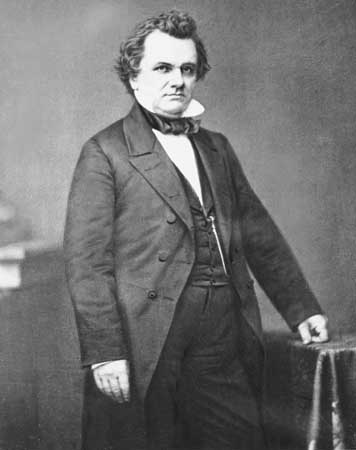
MR. DOUGLAS'S SPEECH.
LADIES AND GENTLEMEN:
I appear before you to-day for the purpose of
discussing the leading political topics which now agitate the public
mind. By an arrangement between Mr. Lincoln and myself, we are present
here to-day for the purpose of having a joint discussion, as the
representatives of the two great political parties of the State and
Union, upon the principles in issue between those parties; and this
vast concourse of people shows the deep feeling which pervades the
public mind in regard to the questions dividing us.
Prior to 1854 this country was divided into two great
political parties, known as the Whig and Democratic parties. Both were
national and patriotic, advocating principles that were universal in
their application. An old line Whig could proclaim his principles in Louisiana and Massachusetts alike. Whig principles
had no boundary sectional line—they were not limited by the Ohio river,
nor by the Potomac, nor by the line
of the free and slave States, but applied and were proclaimed wherever
the Constitution ruled or the American flag waved over the American
soil. So it was, and so it is with the great Democratic party, which,
from the days of Jefferson until this
period, has proven itself to be the historic party of this nation.
While the Whig and Democratic parties differed in regard to a bank, the
tariff, distribution, the specie circular and the sub-treasury, they
agreed on the great slavery question which now agitates the Union. I say that the Whig party and the
Democratic party agreed on this slavery question, while they differed
on those matters of expediency to which I have referred. The Whig party
and the Democratic party jointly adopted the Compromise measures of
1850 as the basis of a proper and just solution of this slavery
question in all its forms. Clay was the great leader, with Webster on
his right and Cass on his left, and sustained by the patriots in the
Whig and Democratic ranks, who had devised and enacted the Compromise
measures of 1850.
In 1851, the Whig party and the Democratic party united in Illinois in
adopting resolutions indorsing and approving the principles of the
Compromise measures of 1850, as the proper adjustment of that question.
In 1852, when the Whig party assembled in Convention at Baltimore for the
purpose of nominating a candidate for the Presidency, the first thing
it did was to declare the Compromise measures of 1850, in substance and
in principle, a suitable adjustment of that question. [Here the speaker
was interrupted by loud and long-continued applause.] My friends,
silence will be more acceptable to me in the discussion of these
questions than applause. I desire to
address myself to your judgment, your understanding, and your
consciences, and not to your passions or your enthusiasm. When the
Democratic Convention assembled in Baltimore in the same year, for the
purpose of nominating a Democratic candidate for the Presidency, it
also adopted the Compromise measures of 1850 as the basis of Democratic
action. Thus you see that up to 1853-54, the Whig party and the
Democratic party both stood on the same platform with regard to the
slavery question. That platform was the right of the people of each
State and each Territory to decide their local and domestic
institutions for themselves, subject only to the Federal Constitution.
During the session of Congress of 1853-'54, I introduced into
the Senate of the United States a bill to organize the Territories of
Kansas and Nebraska on that principle which had been adopted in the
Compromise measures of 1850, approved by the Whig party and the
Democratic party in Illinois in 1851, and indorsed by the Whig party
and the Democratic party in National Convention in 1852. In order that
there might be no misunderstanding in relation to the principle
involved in the Kansas and Nebraska bill, I put forth the true intent
and meaning of the act in these words: "It is the true intent and
meaning of this act not to legislate slavery into any State or
Territory, or to exclude it therefrom, but to leave the people, thereof
perfectly free to form and regulate their domestic institutions in
their own way, subject only to the Federal Constitution." Thus, you
see, that up to 1854, when the Kansas
and Nebraska
bill was brought into Congress for the purpose of carrying out the
principles which both parties had up to that time indorsed and
approved, there had been no division in this country in regard to that
principle except the opposition of the Abolitionists. In the House of
Representatives of the Illinois Legislature, upon a resolution
asserting that principle, every Whig and every Democrat in the House
voted in the affirmative, and only four men voted against it, and those
four were old line Abolitionists.
In 1854, Mr. Abraham Lincoln and Mr. Trumbull entered into an
arrangement, one with the other, and each with his respective friends,
to dissolve the old Whig party on the one hand, and to dissolve the old
Democratic party on the other, and to connect the members of both into
an Abolition party, under the name and disguise of a Republican party.
The terms of that arrangement between Mr. Lincoln and Mr. Trumbull have
been published to the world by Mr. Lincoln's special friend, James H.
Matheny, Esq., and they were, that Lincoln should have Shields's place
in the United States Senate, which was then about to become vacant, and
that Trumbull should have my seat when my term expired. Lincoln went to
work to Abolitionize the old Whig party all over the State, pretending
that he was then as good a Whig as ever; and Trumbull went to work in
his part of the State preaching Abolitionism in its milder and lighter
form, and trying to Abolitionize the Democratic party, and bring old
Democrats handcuffed and bound hand and foot into the Abolition camp. In pursuance of the arrangement, the parties
met at Springfield
in October, 1854, and proclaimed their new platform. Lincoln was to
bring into the Abolition camp the old line Whigs, and transfer them
over to Giddings, Chase, Fred. Douglass, and Parson Lovejoy, who were
ready to receive them and christen them in their new faith. They laid
down on that occasion a platform for their new Republican party, which
was to be thus constructed. I have the resolutions of their State
Convention then held, which was the first mass State Convention ever
held in Illinois by the Black Republican party, and I now hold them in
my hands and will read a part of them, and cause the others to be
printed. Here are the most important and material resolutions of this
Abolition platform:
1. Resolved, That we believe this truth to be
self-evident, that when parties become subversive of the ends for which
they are established, or incapable of restoring the Government to the
true principles of the Constitution, it is the right and duty of the
people to dissolve the political bands by which they may have been
connected therewith, and to organize new parties upon such principles
and with such views as the circumstances and exigencies of the nation
may demand.
2. Resolved, That the times imperatively demand the
reorganization of parties, and, repudiating all previous party
attachments, names and predilections, we unite ourselves together in
defense of the liberty and Constitution of the country, and will
hereafter cooperate as the Republican party, pledged to the
accomplishment of the following purposes: To bring the administration
of the Government back to the control of first principles; to restore
Nebraska and Kansas to the position of free Territories; that, as the
Constitution of the United States vests in the States, and not in
Congress, the power to legislate for the extradition of fugitives from
labor, to repeal and entirely abrogate the Fugitive Slave law; to
restrict slavery to those States in which it exists; to prohibit the
admission of any more slave States into the Union; to abolish slavery
in the District of Columbia; to exclude slavery from all the
Territories over which the General Government has exclusive
jurisdiction; and to resist the acquirements of any more Territories
unless the practice of slavery therein forever shall have been
prohibited.
3. Resolved, That in furtherance of these principles
we will use such Constitutional and lawful means as shall seem best
adapted to their accomplishment, and that we will support no man for
office, under the General or State Government, who is not positively
and fully committed to the support of these principles, and whose
personal character and conduct is not a guaranty that he is reliable,
and who shall not have abjured old party allegiance and ties.
Now, gentlemen, your Black Republicans have cheered every one
of those propositions, and yet I venture to say that you cannot get Mr.
Lincoln to come out and say that he is now in favor of each one of
them. That these propositions, one and all, constitute the platform of
the Black Republican party of this day, I have no doubt; and when you
were not aware for what purpose I was reading them, your Black
Republicans cheered them as good Black Republican doctrines. My object
in reading these resolutions, was to put the question to Abraham
Lincoln this day, whether he now stands and will stand by each article
in that creed, and carry it out. I desire
to know whether Mr. Lincoln to-day stands as he did in 1854, in favor
of the unconditional repeal of the Fugitive Slave law. I desire him to
answer whether he stalls pledged to-day, as he did in 1854, against the
admission of any more slave States into the Union,
even if the people want them. I want to know whether he stands pledged
against the admission of a new State into the Union
with such a Constitution as the people of that State may see fit to
make. I want to know whether he stands to-day pledged to the abolition
of slavery in the District
of Columbia. I
desire him to answer whether he stands pledged to the prohibition of
the slave trade between the different States. I
desire to know whether he stands pledged to prohibit slavery in all the
Territories of the United
States, North as well as South of the
Missouri Compromise line. I desire him to answer whether he is opposed
to the acquisition of any more territory unless slavery is prohibited
therein. I want his answer to these
questions. Your affirmative cheers in favor of this Abolition platform
is not satisfactory. I ask Abraham Lincoln
to answer these questions, in order that, when I trot him down to lower
Egypt, I may put the same questions to him. My principles are the same
everywhere. I can proclaim them alike in the North, the South, the
East, and the West. My principles will apply wherever the Constitution
prevails and the American flag waves. I desire to know whether Mr.
Lincoln's principles will bear transplanting from Ottawa
to Jonesboro?
I put these questions to him to-day distinctly, and ask an answer. I
have a right to an answer, for I quote from the platform of the
Republican party, made by himself and others at the time that party was
formed, and the bargain made by Lincoln to dissolve and kill the old
Whig party, and transfer its members, bound hand and foot, to the
Abolition party, under the direction of Giddings and Fred Douglass. In
the remarks I have made on this platform, and the position of Mr.
Lincoln upon it, I mean nothing personally disrespectful or unkind to
that gentleman. I have known him for nearly twenty-five years. There
were many points of sympathy between us when we first got acquainted. We were both comparatively boys, and both
struggling with poverty in a strange land. I was a school-teacher in
the town of Winchester, and he a
flourishing grocery-keeper in the town of Salem. He was more successful in his
occupation than I was in mine, and hence more fortunate in this world's
goods. Lincoln
is one of those peculiar men who perform with admirable skill
everything which they undertake. I made as
good a school-teacher as I could, and when a cabinet maker I made a
good bedstead and tables, although my old boss said I succeeded better
with bureaus and secretaries than with anything else; but I believe
that Lincoln was always more successful in business than I, for his
business enabled him to get into the Legislature. I
met him there, however, and had a sympathy with him, because of the
up-hill struggle we both had in life. He
was then just as good at telling an anecdote as now. He
could beat any of the boys wrestling, or running a foot-race, in
pitching quoits or tossing a copper; could ruin more liquor than all
the boys of the town together, and the dignity and impartiality with
which he presided at a horserace or fist-fight, excited the admiration
and won the praise of everybody that was present and participated. I sympathised with him, because he was
struggling with difficulties, and so was I. Mr.
Lincoln served with me in the Legislature in 1836, when we both
retired, and he subsided, or became submerged, and he was lost sight of
as a public man for some years. In 1846,
when Wilmot introduced his celebrated proviso, and the Abolition
tornado swept over the country, Lincoln
again turned up as a member of Congress from the Sangamon
district. I was then in the Senate of the United States,
and was glad to welcome my old friend and companion. Whilst
in Congress, he distinguished himself by his opposition to the Mexican
war, taking the side of the common enemy against his own country; and
when he returned home he found that the indignation of the people
followed him everywhere, and he was again submerged or obliged to
retire into private life, forgotten by his former friends.
He came up again in 1854, just in time to make this
Abolition or Black Republican platform, in company with Giddings,
Lovejoy, Chase and Fred Douglass, for the Republican party to stand
upon. Trumbull, too, was one of our own
cotemporaries. He was born and raised in
old Connecticut, was bred a Federalist, but removing to Georgia, turned
Nullifier, when nullification was popular, and as soon as he disposed
of his clocks and wound up his business, migrated to Illinois, turned
politician and lawyer here, and made his appearance in 1841, as a
member of the Legislature. He became noted
as the author of the scheme to repudiate a large portion of the State
debt of Illinois,
which, if successful, would have brought infamy and disgrace upon the
fair escutcheon of our glorious State. The
odium attached to that measure consigned him to oblivion for a time. I helped to do it. I
walked into a public meeting in the hall of the House of
Representatives, and replied to his repudiating speeches, and
resolutions were carried over his head denouncing repudiation, and
asserting the moral and legal obligation of Illinois to pay every dollar of the
debt she owed and every bond that bore her seal. Trumbull's
malignity has followed me since I thus defeated his infamous scheme.
These
two men having formed this combination to abolitionize the old Whig
party and the old Democratic party, and put themselves into the Senate
of the United States,
in pursuance of their bargain, are now carrying out that arrangement. Matheny states that Trumbull broke faith; that
the bargain was that Lincoln should be the Senator in Shields's place,
and Trumbull was to wait for mine; and the story goes, that Trumbull
cheated Lincoln, having control of four or five abolitionized Democrats
who were holding over in the Senate; he would not let them vote for
Lincoln, and which obliged the rest of the Abolitionists to support him
in order to secure an Abolition Senator. There
are a number of authorities for the truth of this besides Matheny, and
I suppose that even Mr. Lincoln will not deny it. Mr.
Lincoln demands that he shall have the place intended for Trumbull, as Trumbull
cheated him and got his, and Trumbull
is stumping the State traducing me for the purpose of securing the
position for Lincoln,
in order to quiet him. It was in
consequence of this arrangement that the Republican Convention was
impaneled to instruct for Lincoln and nobody else, and it was on this
account that they passed resolutions that he was their first, their
last, and their only choice. Archy
Williams was nowhere, Browning was nobody, Wentworth was not to be
considered; they had no man in the Republican party for the place
except Lincoln,
for the reason that he demanded that they should carry out the
arrangement.
Having
formed this new party for the benefit of deserters from Whiggery, and
deserters from Democracy, and having laid down the Abolition platform
which I have read, Lincoln
now takes his stand and proclaims his Abolition doctrines. Let me read a part of them. In
his speech at Springfield
to the Convention, which nominated him for the Senate, he said: [make link to house.htm here]
"In my opinion it will not cease until a crisis shall have
been reached and passed. 'A house divided
against itself cannot stand.' I believe
this government cannot endure permanently half Slave and
half Free. I do not expect the Union to be dissolved—I do not expect the house
to fall—but I do expect it will cease to be divided. It will become all one thing, or all the
other. Either the opponents of slavery will arrest the further spread of it, and place it where
the public mind shall rest in the belief that it is in the
course of ultimate extinction: or its advocates will push it forward
till it shall become alike lawful in all the States—old as well as
new, North as well as South."
["Good," "good," and cheers.]
I am delighted to hear you Black Republicans say "good." I have no doubt that doctrine expresses your
sentiments, and I will prove to you now, if you will listen to me, that
it is revolutionary and destructive of the existence of this Government. Mr. Lincoln, in the extract from which I have
read, says that this Government cannot endure permanently in the same
condition in which it was made by its framers—divided into free and
slave States. He says that it has existed
for about seventy years thus divided, and yet he tells you that it
cannot endure permanently on the same principles and in the same
relative condition in which our fathers made it. Why
can it not exist divided into free and slave States? Washington,
Jefferson, Franklin, Madison, Hamilton, Jay, and the great men of that
day, made this Government divided into free States and slave States,
and left each State perfectly free to do as it pleased on the subject
of slavery. Why can it not exist on the same principles on which our
fathers made it? They knew when they
framed the Constitution that in a country as wide and broad as this,
with such a variety of climate, production and interest, the people
necessarily required different laws and institutions in different
localities. They knew that the laws and
regulations which would suit the granite hills of New Hampshire would
be unsuited to the rice plantations of South Carolina, and they,
therefore, provided that each State should retain its own Legislature
and its own sovereignty, with the full and complete power to do as it
pleased within its own limits, in all that was local and not national.
One of the reserved rights of the States, was the right to regulate the
relations between Master and Servant, on the slavery question. At the time the Constitution was framed, there
were thirteen States in the Union, twelve of which were slaveholding States
and one a free State.
Suppose this doctrine of uniformity
preached by Mr. Lincoln,
that the States should all be free or all be slave had prevailed, and
what would have been the result? Of
course, the twelve slaveholding States would have overruled the one free State, and slavery would have been fastened
by a Constitutional provision on every inch of the American Republic,
instead of being left as our fathers wisely left it, to each State to
decide for itself. Here I assert that
uniformity in the local laws and institutions of the different States
is neither possible or desirable. If
uniformity had been adopted when the Government was established, it
must inevitably have been the uniformity of slavery everywhere, or else
the uniformity of negro citizenship and negro equality everywhere.
We are told by Lincoln
that he is utterly opposed to the Dred Scott decision, and will not
submit to it, for the reason that he says it deprives the negro of the
rights and privileges of citizenship. That
is the first and main reason which he assigns for his warfare on the
Supreme Court of the United
States and its decision. I ask you, are you in favor of conferring upon
the negro the rights and privileges of citizenship?
Do you desire to strike out of our State Constitution that
clause which keeps slaves and free negroes out of the State, and allow
the free negroes to flow in, and cover your prairies with black
settlements? Do you desire to turn this
beautiful State into a free negro colony, in order that when Missouri abolishes slavery she can send one
hundred thousand emancipated slaves into Illinois, to become citizens and
voters, on an equality with yourselves? If
you desire negro citizenship, if you desire to allow them to come into
the State and settle with the white man, if you desire them to vote on
an equality with yourselves, and to make them eligible to office, to
serve on juries, and to adjudge your rights, then support Mr. Lincoln
and the Black Republican party, who are in favor of the citizenship of
the negro. For one, I am opposed to negro
citizenship in any and every form. I
believe this Government was made on the white basis. I
believe it was made by white men, for the benefit of white men and
their posterity for ever, and I am in favor of confining citizenship to
white men, men of European birth and descent, instead of conferring it
upon negroes, Indians, and other inferior races.
Mr.
Lincoln, following the example and lead of all the little Abolition
orators, who go around and lecture in the basements of schools and
churches, reads from the Declaration of Independence, that all men were
created equal, and then asks, how can you deprive a negro of that
equality which God and the Declaration of Independence awards to him? He and they maintain that negro equality is
guarantied by the laws of God, and that it is asserted in the
Declaration of Independence. If they think
so, of course they have a right to say so, and so vote. I
do not question Mr. Lincoln's conscientious belief that the negro was
made his equal, and hence is his brother; but for my own part, I do not
regard the negro as my equal, and positively deny that he is my brother
or any kin to me whatever. Lincoln has
evidently learned by heart Parson Lovejoy's catechism. He
can repeat it as well as Farnsworth, and he is worthy of a medal from
Father Giddings and Fred Douglass for his Abolitionism. He
holds that the negro was born his equal and yours, and that he was
endowed with equality by the Almighty, and that no human law can
deprive him of these rights which were guarantied to him by the Supreme
ruler of the Universe. Now, I do not
believe that the Almighty ever intended the negro to be the equal of
the white man. If he did, he has been a
long time demonstrating the fact. For
thousands of years the negro has been a race upon the earth, and during
all that time, in all latitudes and climates, wherever he has wandered
or been taken, he has been inferior to the race which he has there met.
He belongs to an inferior race, and
must always occupy an inferior position. I
do not hold that because the negro is our inferior that therefore he
ought to be a slave. By no means can such
a conclusion be drawn from what I have said. On
the contrary, I hold that humanity and Christianity both require that
the negro shall have and enjoy every right, every privilege, and every
immunity consistent with the safety of the society in which he lives. On that point, I presume, there can be no
diversity of opinion. You and I are bound
to extend to our inferior and dependent beings every right, every
privilege, every facility and immunity consistent with the public good.
The question then arises, what rights
and privileges are consistent with the public good? This
is a question which each State and each Territory must decide for
itself—Illinois
has decided it for herself. We have
provided that the negro shall not be a slave, and we have also provided
that he shall not be a citizen, but protect him in his civil rights, in
his life, his person and his property, only depriving him of all
political rights whatsoever, and refusing to put him on an equality
with the white man. That policy of Illinois is
satisfactory to the Democratic party and to me, and if it were to the
Republicans, there would then be no question upon the subject; but the
Republicans say that he ought to be made a citizen, and when he becomes
a citizen he becomes your equal, with all your rights and privileges. They assert the Dred Scott decision to be
monstrous because it denies that the negro is or can be a citizen under
the Constitution. Now, I hold that Illinois had a right to abolish and prohibit
slavery as she did, and I hold that Kentucky
has the same right to continue and protect slavery that Illinois had to
abolish it. I hold that New York had as much right to abolish slavery as
Virginia has to continue it, and
that each and every State of this Union
is a sovereign power, with the right to do as it pleases upon this
question of slavery, and upon all its domestic institutions. Slavery is not the only question which comes up
in this controversy. There is a far more
important one to you, and that is, what shall be done with the free
negro? We have settled the slavery
question as far as we are concerned; we have prohibited it in Illinois
forever, and in doing so, I think we have done wisely, and there is no
man in the State who would be more strenuous in his opposition to the
introduction of slavery than I would; but when we settled it for
ourselves, we exhausted all our power over that subject. We
have done our whole duty, and can do no more. We
must leave each and every other State to decide for itself the same
question. In relation to the policy to be
pursued toward the free negroes, we have said that they shall not vote;
whilst Maine,
on the other hand, has said that they shall vote. Maine is a
sovereign State, and has the power to regulate the qualifications of
voters within her limits. I would never
consent to confer the right of voting and of citizenship upon a negro,
but still I am not going to quarrel with Maine for differing from me in
opinion. Let Maine
take care of her own negroes and fix the qualifications of her own
voters to suit herself, without interfering with Illinois,
and Illinois will not interfere with Maine. So with the State of New York. She
allows the negro to vote provided he owns two hundred and fifty
dollars' worth of property, but not otherwise. While
I would not make any distinction whatever between a negro who held
property and one who did not; yet if the sovereign State of New York
chooses to make that distinction it is her business and not mine, and I
will not quarrel with her for it. She can
do as she pleases on this question if she minds her own business, and
we will do the same thing. Now, my
friends, if we will only act conscientiously and rigidly upon this
great principle of popular sovereignty, which guaranties to each State
and Territory the right to do as it pleases on all things, local and
domestic, instead of Congress interfering, we will continue at peace
one with another. Why
should Illinois be at war with Missouri, or Kentucky
with Ohio, or Virginia
with New York,
merely because their institutions differ? Our fathers
intended that our institutions should differ. They
knew that the North and the South, having different climates,
productions and interests, required different institutions. This doctrine of Mr. Lincoln, of uniformity
among the institutions of the different States, is a new doctrine,
never dreamed of by Washington, Madison, or the framers of this
Government. Mr.
Lincoln and the Republican party set themselves up as wiser than these
men who made this Government, which has flourished for seventy years
under the principle of popular sovereignty, recognizing the right of
each State to do as it pleased. Under that
principle, we have grown from a nation of three or four millions to a
nation of about thirty millions of people; we have crossed the
Allegheny mountains and filled up the whole North-west, turning the
prairie into a garden, and building up churches and schools, thus
spreading civilization and Christianity where before there was nothing
but savage barbarism. Under that principle
we have become, from a feeble nation, the most powerful on the face of
the earth, and if we only adhere to that principle, we can go forward
increasing in territory, in power, in strength and in glory until the
Republic of America shall be the North Star that shall guide the
friends of freedom throughout the civilized world. And
why can we not adhere to the great principle of self-government, upon
which our institutions were originally based? I
believe that this new doctrine preached by Mr. Lincoln and his party
will dissolve the Union if it
succeeds. They are trying to array all the
Northern States in one body against the South, to excite a sectional
war between the free States
and the slave States, in order that the one or the other may be driven
to the wall.
I am told that my time is out. Mr. Lincoln will now address
you for an hour and a half, and I will then occupy an half hour in
replying to him.
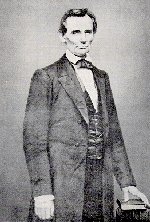
MR. LINCOLN'S REPLY.
MY FELLOW CITIZENS:
When a man hears himself somewhat misrepresented, it provokes him—at
least, I find it so with myself; but when misrepresentation becomes
very gross and palpable, it is more apt to amuse him. The
first thing I see fit to notice, is the fact that Judge Douglas
alleges, after running through the history of the old Democratic and
the old Whig parties, that Judge Trumbull and myself made an
arrangement in 1854, by which I was to have the place of Gen. Shields
in the United States Senate, and Judge Trumbull was to have the place
of Judge Douglas. Now, all I have to say
upon that subject is, that I think no man—not even Judge Douglas—can
prove it, because it is not true.
I have no doubt he is “conscientious" in saying it. As to those resolutions that he took such a
length of time to read, as being the platform of the Republican party
in 1854, I say I never had anything to do with them, and I think Trumbull never
had. Judge Douglas cannot show that either
of us ever did have anything to do with them. I
believe this is true about those resolutions: There
was a call for a Convention to form a Republican party at Springfield, and
I think that my friend, Mr. Lovejoy, who is here upon this stand, had a
hand in it. I think this is true, and I
think if he will remember accurately, he will be able to recollect that
he tried to get me into it, and I would not go in. I
believe it is also true that I went away from Springfield when the Convention was
in session, to attend court in Tazewell county. It
is true they did place my name, though without authority, upon the
committee, and afterward wrote me to attend the meeting of the
committee, but I refused to do so, and I never had anything to do with
that organization. This is the plain truth
about all that matter of the resolutions.
Now, about this story that Judge Douglas tells of Trumbull
bargaining to sell out the old Democratic party, and Lincoln agreeing
to sell out the old Whig party, I have the means of knowing
about that; Judge Douglas cannot have; and I know there is no substance
to it whatever. Yet I have no doubt he is “conscientious”
about it. I know that after Mr. Lovejoy got into the Legislature that
winter, he complained of me that I had told all the old Whigs of his
district that the old Whig party was good enough for them, and some of
them voted against him because I told them so. Now,
I have no means of totally disproving such charges as this which the
Judge makes. A man cannot prove a
negative, but he has a right to claim that when a man makes an
affirmative charge, he must offer some proof to show the truth of what
he says. I certainly cannot introduce,
testimony to show the negative about things, but I have a right to
claim that if a man says he knows a thing, then he
must show how he knows it. I
always have a right to claim this, and it is not satisfactory to me
that he may be “conscientious” on the subject.
Now, gentlemen, I hate to waste my time on such things, but
in regard to that general Abolition tilt that Judge Douglas makes, when
he says that I was engaged at that time in selling out and
abolitionizing the old Whig party—I hope you will permit me to read a
part of a printed speech that I made then at Peoria, which will show
altogether a different view of the position I took in that contest of
1854.
Voice—“Put on your specs.”
Mr.
Lincoln—Yes, sir, I am obliged to do so. I am no longer a young man. “This is the repeal of the Missouri
Compromise.” The foregoing history may not
be precisely accurate in every particular; but I am sure it is
sufficiently so for all the uses I shall attempt to make of it, and in
it we have before us, the chief materials enabling us to correctly
judge whether the repeal of the Missouri Compromise is right or wrong.
“I think, and shall try to show, that it
is wrong; wrong in its direct effect, letting slavery into Kansas and
Nebraska—and wrong in its prospective principle, allowing it to spread
to every other part of the wide world, where men can be found inclined
to take it.”
This
declared indifference, but, as I must think,
covert real zeal for the spread of slavery, I cannot but hate. I hate it because of the monstrous injustice of
slavery itself. I hate it because it
deprives our republican example of its just influence in the
world—enables the enemies of free institutions, with plausibility, to
taunt us as hypocrites—causes the real friends of freedom to doubt our
sincerity, and especially because it forces so many really good men
amongst ourselves into an open war with the very fundamental principles
of civil liberty—criticising the Declaration of Independence, and
insisting that there is no right principle of action but self-interest."
Before
proceeding, let me say I think I have no prejudice against the Southern
people. They are just what we would be in
their situation. If slavery did not now
exist among them, they would not introduce it. If
it did now exist amongst us, we should not instantly give it up. This I believe of the masses North and South. Doubtless there are individuals on both sides,
who would not hold slaves under any circumstances; and others who would
gladly introduce slavery anew, if it were out of existence. We know that some Southern men do free their
slaves, go North, and become tip-top Abolitionists; while some Northern
ones go South, and become most cruel slave-masters.
"When
Southern people tell us they are no more responsible for the origin of
slavery than we, I acknowledge the fact. When
it is said that the institution exists, and that it is very difficult
to get rid of it, in any satisfactory way, I can understand and
appreciate the saying. I surely will not
blame them for not doing what I should not know how to do myself. If all earthly power were given me, I should not
know what to do, as to the existing institution. My
first impulse would be to free all the slaves, and send them to Liberia—to
their own native land. But a moment's
reflection would convince me, that whatever of high hope (as I think
there is) there may be in this, in the long run, its sudden execution
is impossible. If they were all landed
there in a day, they would all perish in the next ten days; and there
are not surplus shipping and surplus money enough in the world to carry
them there in many times ten days. What
then? Free them all, and keep them among
us as underlings? Is it quite certain that
this betters their condition? I think I
would not hold one in slavery at any rate; yet the point is not clear
enough to me to denounce people upon. What
next? Free them, and make them politically
and socially our equals? My own feelings
will not admit of this; and if mine would, we well know that those of
the great mass of white people will not. Whether
this feeling accords with justice and sound judgment, is not the sole
question, if, indeed, it is any part of it. A
universal feeling, whether well or ill-founded, cannot be safely
disregarded. We cannot, then, make them
equals. It does seem to me that systems of
gradual emancipation might be adopted; but for their tardiness in this,
I will not undertake to judge our brethren of the South.
"When they remind us of their
constitutional rights, I acknowledge them, not grudgingly, but fully
and fairly; and I would give them any legislation for the reclaiming of
their fugitives, which should not, in its stringency, be more likely to
carry a free man into slavery, than our ordinary criminal laws are to
hang an innocent one."
But all this, to my judgment, furnishes no
more excuse for permitting slavery to go into our own free territory,
than it would for reviving the African slave-trade by law. The law which forbids the bringing of slaves
from Africa, and that which has so long forbid the taking of them to Nebraska, can
hardly be distinguished on any moral principle; and the repeal of the
former could find quite as plausible excuses as that of the latter."
I
have reason to know that Judge Douglas knows that I said this. I think he has the answer here to one of the
questions he put to me. I do not mean to allow him to catechise me
unless he pays back for it in kind. I will
not answer questions one after another, unless he reciprocates; but as
he has made this inquiry, and I have answered it before, he has got it
without my getting anything in return. He has got my answer on the
Fugitive Slave law.
Now, gentlemen, I don't want to read at
any greater length, but this is the true complexion of all I have ever
said in regard to the institution of slavery and the black race. This is the whole of it, and anything that
argues me into his idea of perfect social and political equality with
the negro, is but a specious and fantastic arrangement of words, by
which a man can prove a horse-chestnut to be a chestnut horse. I will say here, while upon this subject, that I
have no purpose, directly or indirectly, to interfere with the
institution of slavery in the States where it exists. I
believe I have no lawful right to do so, and I have no inclination to
do so. I have no purpose to introduce
political and social equality between the white and the black races. There is a physical difference between the two,
which, in my judgment, will probably forever forbid their living
together upon the footing of perfect equality, and inasmuch as it
becomes a necessity that there must be a difference, I, as well as
Judge Douglas, am in favor of the race to which I belong having the
superior position. I have never said
anything to the contrary, but I hold that, notwithstanding all this,
there is no reason in the world why the negro is not entitled to all
the natural rights enumerated in the Declaration of Independence, the
right to life, liberty, and the pursuit of happiness. I hold that he is
as much entitled to these as the white man. I
agree with Judge Douglas he is not my equal in many respects—certainly
not in color, perhaps not in moral or intellectual endowment. But in the right to eat the bread, without the
leave of anybody else, which his own hand earns, he is my equal and the
equal of Judge Douglas, and the equal of every living man.
Now
I pass on to consider one or two more of these little follies. The
Judge is woefully at fault about his early friend Lincoln being a
"grocery-keeper." I don't know as it would be a great sin, if I had
been; but he is mistaken. Lincoln never
kept a grocery anywhere in the world. It
is true that Lincoln
did work the latter part of one winter in a little still-house, up at
the head of a hollow. And so I think my
friend, the Judge, is equally at fault when he charges me at the time
when I was in Congress of having opposed our soldiers who were fighting
in the Mexican war. The Judge did not make
his charge very distinctly, but I can tell you what he can prove, by
referring to the record. You remember I
was an old Whig, and whenever the Democratic party tried to get me to
vote that the war had been righteously begun by the President, I would
not do it. But whenever they asked for any
money, or land-warrants, or anything to pay the soldiers there, during
all that time, I gave the same vote that Judge Douglas did. You can
think as you please as to whether that was consistent. Such is the
truth; and the Judge has the right to make all he can out of it But when he, by a general charge, conveys the
idea that I withheld supplies from the soldiers who were fighting in
the Mexican war, or did anything else to hinder the soldiers, he is, to
say the least, grossly and altogether mistaken, as a consultation of
the records will prove to him.
As
I have not used up so much of my time as I had supposed, I will dwell a
little longer upon one or two of these minor topics upon which the
Judge has spoken. He has read from my speech in Springfield, in which I say that "a
house divided against itself cannot stand." Does
the Judge say it can stand? I don't know
whether he does or not. The Judge does not
seem to be attending to me just now, but I would like to know if it is
his opinion that a house divided against itself can stand. If he does, then there is a question of
veracity, not between him and me, but between the Judge and an
authority of a somewhat higher character.
Now,
my friends, I ask your attention to this matter for the purpose of
saying something seriously. I know that
the Judge may readily enough agree with me that the maxim which was put
forth by the Saviour is true, but he may allege that I misapply it; and
the Judge has a right to urge that, in my application, I do misapply
it, and then I have a right to show that I do not
misapply it. When he undertakes to say that because I think this
nation, so far as the question of slavery is concerned, will all become
one thing or all the other, I am in favor of bringing about a dead
uniformity in the various States, in all their institutions, he argues
erroneously. The great variety of the
local institutions in the States, springing from differences in the
soil, differences in the face of the country, and in the climate, are
bonds of Union. They do not make “a house
divided against itself” but they make a house united. If they produce
in one section of the country what is called for by the wants of
another section, and this other section can supply the wants of the
first, they are not matters of discord but bonds of union, true bonds
of union. But
can this question of slavery be considered as among these, varieties in
the institutions of the country? I leave
it to you to say whether, in the history of our Government, this
institution of slavery has not always failed to be a bond of union,
and, on the contrary, been an apple of discord, and an element of
division in the house. I ask you to
consider whether, so long as the moral constitution of men's minds
shall continue to be the same, after this generation and assemblage
shall sink into the grave, and another race shall arise, with the same
moral and intellectual development we have—whether, if that institution
is standing in the same irritating position in which it now is, it will
not continue an element of division? If
so, then I have a right to say that, in regard to this question, the
Union is a house divided against itself; and when the Judge reminds me
that I have often said to him that the institution of slavery has
existed for eighty years in some States, and yet it does not exist in
some others, I agree to the fact, and I account for it by looking at
the position in which our fathers originally placed it—restricting it
from the new Territories where it had not gone, and legislating to cut
off its source by the abrogation of the slave-trade, thus putting the
seal of legislation against its spread. The
public mind did rest in the belief that it was in the
course of ultimate extinction. But lately,
I think—and in this I charge nothing on the Judge's motives—lately, I
think, that he, and those acting with him, have placed that institution
on a new basis, which looks to the perpetuity and
nationalization of slavery. And while
it is placed upon this new basis, I say, and I have said, that I
believe we shall not have peace upon the question until the opponents
of slavery arrest the further spread of it, and place it where the
public mind shall rest in the belief that it is in the course of
ultimate extinction; or, on the other hand, that its advocates will
push it forward until it shall become alike lawful in all the States,
old as well as new, North as well as South. Now,
I believe if we could arrest the spread, and place it where Washington,
and Jefferson, and Madison placed it, it would be in the course of
ultimate extinction, and the public mind would, as for eighty years
past, believe that it was in the course of ultimate extinction. The crisis would be past and the institution
might be let alone for a hundred years, if it should live so long, in
the States where it exists, yet it would be going out of existence in
the way best for both the black and the white races.
A Voice—“Then do you repudiate Popular
Sovereignty?”
Mr.
Lincoln—Well, then, let us talk about Popular Sovereignty! What is
Popular Sovereignty? Is it the right of
the people to have slavery or not have it, as they see fit, in the
Territories? I will state—and I have an
able man to watch me—my understanding is that Popular Sovereignty, as
now applied to the question of slavery, does allow the people of a
Territory to have slavery if they want to, but does not allow them not
to have it if they do not want it. I do
not mean that if this vast concourse of people were in a Territory of
the United States, any one of them would be obliged to have a slave if
he did not want one; but I do say that, as I understand the Dred Scott
decision, if any one man wants slaves, all the rest have no way of
keeping that one man from holding them.
When
I made my speech at Springfield,
of which the Judge complains, and from which he quotes, I really was
not thinking of the things which he ascribes to me at all. I had no
thought in the world that I was doing anything to bring about a war
between the free and slave States. I had
no thought in the world that I was doing anything to bring about a
political and social equality of the black and white races. It never occurred to me that I was doing
anything or favoring anything to reduce to a dead uniformity all the
local institutions of the various States. But
I must say, in all fairness to him, if he thinks I am doing something
which leads to these bad results, it is none the better that I did not
mean it. It is just as fatal to the
country, if I have any influence in producing it, whether I intend it
or not. But can it be true, that placing
this institution upon the original basis—the basis upon which our
fathers placed it—can have any tendency to set the Northern and the
Southern States at war with one another, or that it can have any
tendency to make the people of Vermont raise sugar-cane, because they
raise it in Louisiana, or that it can compel the people of Illinois to
cut pine logs on the Grand Prairie, where they will not grow, because
they cut pine logs in Maine, where they do grow? The
Judge says this is a new principle started in regard to this question. Does the Judge claim that he is working on the
plan of the founders of Government? I
think he says in some of his speeches—indeed, I have one here now—that
he saw evidence of a policy to allow slavery to be south of a certain
line, while north of it it should be excluded, and he saw an
indisposition on the part of the country to stand upon that policy, and
therefore he set about studying the subject upon original principles,
and upon original principles he got up the Nebraska bill!
I am fighting it upon these “original principles”—fighting
it in the Jeffersonian, Washingtonian, and Madisonian fashion.
Now,
my friends, I wish you to attend for a little while to one or two other
things in that Springfield
speech. My main object was to show, so far
as my humble ability was capable of showing to the people of this
country, what I believed was the truth—that there was a tendency, if
not a conspiracy among those who have engineered this slavery question
for the last four or five years, to make slavery perpetual and
universal in this nation. Having made that
speech principally for that object, after arranging the evidences that
I thought tended to prove my proposition, I concluded with this bit of
comment:
"We
cannot absolutely know that these exact adaptations are the result of
preconcert, but when we see a lot of framed timbers, different portions
of which we know have been gotten out at different times and places,
and by different workmen—Stephen, Franklin, Roger and James, for
instance—and when we see these timbers joined together, and see they
exactly make the frame of a house or a mill, all the tenons and
mortices exactly fitting, and all the lengths and proportions of the
different pieces exactly adapted to their respective places, and not a
piece too many or too few—not omitting even the scaffolding—or if a
single piece be lacking, we see the place in the frame exactly fitted
and prepared yet to bring such piece in—in such a case we feel it
impossible not to believe that Stephen and Franklin, and Roger and
James, all understood one another from the beginning, and all worked
upon a common plan or draft drawn before the first blow was struck."
When
my friend, Judge Douglas, came to Chicago, on the 9th of July, this
speech having been delivered on the 16th of June, he made an harangue
there, in which he took hold of this speech of mine, showing that he
had carefully read it; and while he paid no attention to this
matter at all, but complimented me as being a "kind, amiable and
intelligent gentleman," notwithstanding I had said this, he goes on and
eliminates, or draws out, from my speech this tendency of mine to set
the States at war with one another, to make all the institutions
uniform, and set the niggers and white people to marrying together. Then,
as the Judge had complimented me with these pleasant titles (I must
confess to my weakness), I was a little "taken," for it came from a
great man. I was not very much accustomed
to flattery, and it came the sweeter to me. I
was rather like the Hoosier, with the gingerbread, when he said he
reckoned he loved it better than any other man, and got less of it. As the Judge had so nattered me, I could not
make up my mind that he meant to deal unfairly with me; so I went to
work to show him that he misunderstood the whole scope of my speech,
and that I really never intended to set the people at war with one
another. As an illustration, the next time
I met him, which was at Springfield,
I used this expression, that I claimed no right under the Constitution,
nor had I any inclination, to enter into the slave States and interfere
with the institutions of slavery. He says
upon that: Lincoln will not enter into
the slave States, but will go to the banks of the Ohio, on this side, and shoot over! He runs on, step by step, in the horse-chestnut
style of argument, until in the Springfield
speech he says, "Unless he shall be successful in firing his batteries,
until he shall have extinguished slavery in all the States, the Union shall be dissolved." Now
I don't think that was exactly the way to treat "a kind, amiable,
intelligent gentleman." I know if I had asked the Judge to show when or
where it was I had said that, if I didn't succeed in firing into the
slave States until slavery should be extinguished, the Union should be dissolved, he could not have
shown it. I understand what he would do. He would say, "I don't mean to quote from you,
but this was the result of what you say. "But
I have the right to ask, and I do ask now, Did you not put it in such a
form that an ordinary reader or listener would take it as an expression
from me?
In
a speech at Springfield,
on the night of the 17th, I thought I might as well attend to my own
business a little, and I recalled his attention as well as I could to
this charge of conspiracy to nationalize slavery. I
called his attention to the fact that he had acknowledged, in my
hearing twice, that he had carefully read the speech, and, in the
language of the lawyers, as he had twice read the speech, and still had
put in no plea or answer, I took a default on him. I
insisted that I had a right then to renew that charge of conspiracy. Ten days afterward I met the Judge at Clinton—that is
to say, I was on the ground, but not in the discussion—and heard him
make a speech. Then he comes in with his
plea to this charge, for the first time, and his plea when put in, as
well as I can recollect it, amounted to this: that he never had any
talk with Judge Taney or the President of the United States
with regard to the Dred Scott decision before it was made. I (Lincoln)
ought to know that the man who makes a charge without knowing it to be
true, falsifies as much as he who knowingly tells a falsehood; and
lastly, that he would pronounce the whole thing a falsehood; but he
would make no personal application of the charge of falsehood, not
because of any regard for the " kind, amiable, intelligent gentleman,"
but because of his own personal self-respect! I
have understood since then (but [turning to Judge Douglas] will not
hold the Judge to it if he is not willing) that he has broken through
the “self-respect,” and has got to saying the thing out.
The Judge nods to me that it is so. It is fortunate for me that I can keep as
good-humored as I do, when the Judge acknowledges that he has been
trying to make a question of veracity with me. I
know the Judge is a great man, while I am only a small man, but I feel that I have got him. I
demur to that plea. I waive all objections
that it was not filed till after default was taken, and demur to it
upon the merits. What if Judge Douglas never did talk with Chief
Justice Taney and the President, before the Dred Scott decision was
made, does it follow that he could not have had as perfect an
understanding without talking as with it? I am not disposed to stand
upon my legal advantage. I am disposed to
take his denial as being like an answer in chancery, that he neither
had any knowledge, information or belief in the existence of such a
conspiracy. I am disposed to take his
answer as being as broad as though he had put it in these words. And now, I ask, even if he had done so, have not
I a right to prove it on him, and to offer the evidence of more than
two witnesses, by whom to prove it; and if the evidence proves the
existence of the conspiracy, does his broad answer denying all
knowledge, information, or belief, disturb the fact? It
can only show that he was used by conspirators, and was not a leader of
them.
Now,
in regard to his reminding me of the moral rule that persons who tell
what they do not know to be true, falsify as much as those who
knowingly tell falsehoods. I remember the
rule, and it must be borne in mind that in what I have read to you, I
do not say that I know such a conspiracy to exist. To that I reply, I believe it. If the Judge says that I do not believe it,
then he says what he does not know, and falls within his own rule, that
he who asserts a thing which he does not know to be true, falsifies as
much as he who knowingly tells a falsehood. I
want to call your attention to a little discussion on that branch of
the case, and the evidence which brought my mind to the conclusion
which I expressed as my belief. If, in
arraying that evidence, I had stated anything which was false or
erroneous, it needed but that Judge Douglas should point it out, and I
would have taken it back with all the kindness in the world. I do not deal in that way. If
I have brought forward anything not a fact, if he will point it out, it
will not even ruffle me to take it back. But
if he will not point out anything erroneous in the evidence, is it not
rather for him to show, by a comparison of the evidence, that I have
reasoned falsely, than to call the “kind, amiable, intelligent
gentleman” a liar? If I have reasoned to a
false conclusion, it is the vocation of an able debater to show by
argument that I have wandered to an erroneous conclusion. I want to ask your attention to a portion of the
Nebraska bill, which Judge Douglas has emoted: “It being the true
intent and meaning of this act, not to legislate slavery into any
Territory or State, nor to exclude it therefrom, but to leave the
people thereof perfectly free to form and regulate their domestic
institutions in their own way, subject only to the Constitution of the
United States." Thereupon Judge Douglas
and others began to argue in favor of “Popular Sovereignty”—the right
of the people to have slaves if they wanted them, and to exclude
slavery if they did not want them. “But,”
said, in substance, a Senator from Ohio (Mr. Chase, I believe), “we
more than suspect that you do not mean to allow the people to exclude
slavery if they wish to, and if you do mean it, accept an amendment
which I propose expressly authorizing the people to exclude slavery." I believe I have the amendment here before me,
which was offered, and under which the people of the Territory, through
their proper representatives, might, if they saw fit, prohibit the
existence of slavery therein. And now I state it as a fact, to betaken
back if there is any mistake about it, that Judge Douglas and those
acting with him voted that amendment down. I now think that those men
who voted it down, had a real reason for doing so. They know what that
reason was. It looks to us, since we have
seen the Dred Scott decision pronounced, holding that, “under the
Constitution,” the people cannot exclude slavery—I say it looks to
outsiders, poor, simple, “amiable, intelligent gentlemen,” as though
the niche was left as a place to put that Dred Scott decision in—a
niche which would have been spoiled by adopting the amendment. And now, I say again, if this was not the
reason, it will avail the Judge much' more to calmly and good-humoredly
point out to these people what that other reason was for voting the
amendment down, than, swelling himself up, to vociferate that he may be
provoked to call somebody a liar.
Again:
there is in that same quotation from the Nebraska bill this clause—"It being
the true intent and meaning of this bill not to legislate slavery into
any Territory or State." I have always
been puzzled to know what business the word “State” had in that
connection. Judge Douglas knows. He put it there. He
knows what he put it there for. We
outsiders cannot say what he put it there for. The
law they were passing was not about States, and was not making
provisions for States. What was it placed
there for? After seeing the Dred Scott
decision, which holds that the people cannot exclude slavery from a
Territory, if another Dred Scott decision shall come, holding that they
cannot exclude it from a State, we shall discover that when the word
was originally put there, it was in view of something which was to come
in due time, we shall see that it was the other half of something. I now say again, if there is any different
reason for putting it there, Judge Douglas, in a good humored way,
without calling anybody a liar, can tell what the reason was.
When
the Judge spoke at Clinton,
he came very near making a charge of falsehood against me. He used, as I found it printed in a newspaper,
which, I remember, was very nearly like the real speech, the following
language:
“I
did not answer the charge [of conspiracy] before, for the reason that I
did not suppose there was a man in America with a heart so
corrupt as to believe such a charge could be true. I
have too much respect for Mr. Lincoln to suppose he is serious in
making the charge.”
I
confess this is rather a curious view, that out of respect for me he
should consider I was making what I deemed rather a grave charge in
fun. I confess it strikes me rather
strangely. But
I let it pass. As the Judge did not for a
moment believe that there was a man in America whose heart was so
“corrupt” as to make such a charge, and as he places me among the “men
in America” who have hearts base enough to make such a charge, I hope
he will excuse me if I hunt out another charge very like this; and if
it should turn out that in hunting I should find that other, and it
should turn out to be Judge Douglas himself who made it, I hope he will
reconsider this question of the deep corruption of heart he has thought
fit to ascribe to me. In Judge Douglas's
speech of March 22d, 1858, which I hold in my hand, he says:
"In
this connection there is another topic to which I desire to allude. I seldom refer to the course of newspapers, or
notice the articles which they publish in regard to myself; but the
course of the Washington Union has been so
extraordinary, for the last two or three months, that I think it well
enough to make some allusion to it. It has
read me out of the Democratic party every other day, at least for two
or three months, and keeps reading me out, and, as if it had not
succeeded, still continues to read me out, using such terms as
“traitor,” “renegade,” “deserter,” and other kind and polite epithets
of that nature. Sir, I have no vindication to make of my Democracy
against the Washington Union, or any other newspapers. I am willing to allow my history and action for
the last twenty years to speak for themselves as to my political
principles, and my fidelity to political obligations. The Washington Union
has a personal grievance. When its editor
was nominated for public printer I declined to vote for him, and stated
that at some time I might give my reasons for doing so. Since
I declined to give that vote, this scurrilous abuse, these vindictive
and constant attacks have been repeated almost daily on me. Will my friend from Michigan read the article to which I
allude ?"
This is a part of the speech. You must excuse me from reading the entire
article of the Washington Union, as Mr. Stuart read it for
Mr. Douglas. The Judge goes on and sums
up, as I think, correctly:
“Mr.
President, you here find several distinct propositions advanced boldly
by the Washington Union editorially, and
apparently authoritatively, and any man who questions any of them is
denounced as an Abolitionist, a Freesoiler, a fanatic.
The propositions are, first, that the primary object of
all government at its original institution is the protection of person
and property; second, that the Constitution of the United States
declares that the citizens of each State shall be entitled to all the
privileges and immunities of citizens in the several States; and that,
therefore, thirdly, all State laws, whether organic or otherwise, which
prohibit the citizens of one State from settling in another with their
slave property, and especially declaring it forfeited, are direct
violations of the original intention of the Government and Constitution
of the United States; and, fourth, that the emancipation of the slaves
of the Northern States was a gross outrage upon the rights of property,
inasmuch as it was involuntarily done on the part of the owners.
“Remember that
this article was published in the Union on the 17th of
November, and on the 18th appeared the first article giving the
adhesion of the Union
to the Lecompton Constitution. It was in these words:
“
‘KANSAS AND HER CONSTITUTION.—The
vexed question is settled. The problem is
solved. The dead point of danger is
passed. All serious trouble to Kansas affairs
is over and gone’—
“And a column, nearly, of the same sort. Then, when you come to look into the Lecompton
Constitution, you find the same doctrine incorporated in it which was
put forth editorially in the Union.
What is it?
“
‘Article 7, Section 1. The right of property is before and higher than
any Constitutional sanction; and the right of the owner of a slave to
such slave and its increase is the same and as inviolable as the right
of the owner of any property whatever.’
“Then in the schedule is a provision that
the Constitution may be amended after 1864 by a two-thirds vote.
“
‘But no alteration shall be made to affect the right of property in the
ownership of slaves.’
“ ‘It will be seen by these clauses in the
Lecompton Constitution, that they are identical in spirit with the authoritative article in the Washington
Union of the day
previous to its indorsement of this Constitution.”
I
pass over some portions of the speech, and I hope that any one who
feels interested in this matter will read the entire section of the
speech, and see whether I do the Judge injustice. He
proceeds:
“When
I saw that article in the Union of the 17th of
November, followed by the glorification of the Lecompton Constitution
on the 18th of November, and this clause in the Constitution asserting
the doctrine that a State has no right to prohibit slavery within its
limits, I saw that there was a fatal blow being struck
at the sovereignty of the States of this Union.”
I stop the quotation there, again
requesting that it may all be read. I have read all of the portion I
desire to comment upon. What is this
charge that the Judge thinks I must have a very corrupt heart to make? It was a purpose on the part of certain high
functionaries to make it impossible for the people of one State to
prohibit the people of any other State from entering it with their
“property,” so called, and making it a slave State. In
other words, it was a charge implying a design to make the institution
of slavery national. And now I ask your
attention to what Judge Douglas has himself done here. I
know he made that part of the speech as a reason why he had refused to
vote for a certain man for public printer, but when we get at it, the
charge itself is the very one I made against him, that he thinks I am
so corrupt for uttering. Now, whom does he make that charge against? Does he make it against that newspaper editor
merely? No; he says it is identical in
spirit with the Lecompton Constitution, and so the framers of that
Constitution are brought in with the editor of the newspaper in that
“fatal blow being struck.” He did not call
it a “conspiracy.” In his language it is a
“fatal blow being struck.” And if the
words carry the meaning better when changed from a “conspiracy” into a
“fatal blow being struck,” I will change my expression and call it
“fatal blow being struck.” We see the
charge made not merely against the editor of the Union, but all the framers of the Lecompton
Constitution; and not only so, but the article was an authoritative
article. By whose authority?
Is
there any question but he moans it was by the authority of the
President and his Cabinet—the Administration? Is
there any sort of question but he means to make that charge? Then there are the editors of the Union,
the framers of the Lecompton Constitution, the President of the United States
and his Cabinet, and all the supporters of the Lecompton Constitution,
in Congress and out of Congress, who are all involved in this “fatal
blow being struck.” I commend to Judge
Douglas's consideration the question of how corrupt a man's heart must
be to make such a charge!
Now, my friends, I have but one branch of
the subject, in the little time I have left, to which to call your
attention, and as I shall come to a close at the end of that branch, it
is probable that I shall not occupy quite all the time allotted to me. Although on these questions I would like to talk
twice as long as I have, I could not enter upon another head and
discuss it properly without running over my time. I
ask the attention of the people here assembled and elsewhere, to the
course that Judge Douglas is pursuing every day as bearing upon this
question of making slavery national. Not going back to the records, but
taking the speeches he makes, the speeches he made yesterday and day
before, and makes constantly all over the country—I ask your attention
to them. In the first place, what is
necessary to make the institution national? Not
war. There is no danger that the people of Kentucky
will shoulder their muskets, and, with a young nigger stuck on every
bayonet, march into Illinois
and force them upon us. There is no danger
of our going over there and making war upon them. Then
what is necessary for the nationalization of slavery? It is simply the
next Dred Scott decision. It is merely for
the Supreme Court to decide that no State under the Constitution can
exclude it, just as they have already decided that under the
Constitution neither Congress nor the Territorial Legislature can do
it. When that is decided and acquiesced
in, the whole thing is done. This being
true, and this being the way, as I think, that slavery is to be made
national, let us consider what Judge Douglas is doing every day to that
end. In the first place, let us see what
influence he is exerting on public sentiment. In
this and like communities, public sentiment is everything. With public sentiment, nothing can fail; without
it nothing can succeed. Consequently he
who moulds public sentiment, goes deeper than he who enacts statutes or
pronounces decisions. He makes statutes
and decisions possible or impossible to be executed. This
must be borne in mind, as also the additional fact that Judge Douglas
is a man of vast influence, so great that it is enough for many men to
profess to believe anything, when they once find out that Judge Douglas
professes to believe it. Consider also the
attitude he occupies at the head of a large party—a party which he
claims has a majority of all the voters in the country. This
man sticks to a decision which forbids the people of a Territory from
excluding slavery, and he does so not because he says it is right in
itself—he does not give any opinion on that—but because it has been decided by the court, and being decided by the court, he
is, and you are bound to take it in your political action as law—not
that he judges at all of its merits, but because a decision of the
court is to him a “Thus saith the Lord” He
places it on that ground alone, and you will bear in mind that, thus
committing himself unreservedly to this decision, commits
him to the next one just as firmly as to this. He
did not commit himself on account of the merit or demerit of the
decision, but it is a Thus saith the Lord. The next
decision, as much as this, will be a Thus saith the Lord.
There is nothing that can divert or turn him away from this decision. It is nothing that I point out to him that his
great prototype, Gen. Jackson, did not believe in the binding force of
decisions. It is nothing to him that Jefferson did not so believe. I
have said that I have often heard him approve of Jackson's course in disregarding the
decision of the Supreme Court pronouncing a National Bank
constitutional. He says, I did not hear
him say so. He denies the accuracy of my recollection. I
say he ought to know better than I, but I will make no question about
this thing, though it still seems to me that I heard him say it twenty
times. I will tell him though, that he now
claims to stand on the Cincinnati
platform, which affirms that Congress cannot charter a National Bank,
in the teeth of that old standing decision that Congress can charter a
bank. And I remind him of another piece of
history on the question of respect for judicial decisions, and it is a
piece of Illinois history, belonging to a time when the large party to
which Judge Douglas belonged, were displeased with a decision of the
Supreme Court of Illinois, because they had decided that a Governor
could not remove a Secretary of State. You will find the whole story in
Ford's History of Illinois, and I know that Judge Douglas will not deny
that he was then in favor of overslaughing that decision by the mode of
adding five new Judges, so as to vote down the four old ones. Not only
so, but it ended in the Judge's sitting down on that very
bench as one of the five new Judges to break down the four old ones.
It was in this way precisely that he got his title of Judge. Now, when
the Judge tells me that men appointed conditionally to sit as members
of a court, will have to be catechised before hand upon some subject, I
say, “You know, Judge; you have tried it.” When
he says a court of this kind will lose the confidence of all men, will
be prostituted and disgraced by such a proceeding, I say, “You know
best, Judge; you have been through the mill.” But
I cannot shake Judge Douglas's teeth loose from the Dred Scott
decision. Like some obstinate animal (I mean no disrespect), that will
hang on when he has once got his teeth fixed; you may cutoff a leg, or
you may tear away an arm, still he will not relax his hold. And so I
may point out to the Judge, and say that he is bespattered all over,
from the beginning of his political life to the present time, with
attacks upon judicial decisions—I may cut off limb after limb of his
public record, and strive to wrench him from a single dictum of the
court—yet I cannot divert him from it. He
hangs, to the last, to the Dred Scott decision. These
things show there is a purpose strong as death and eternity for which
he adheres to this decision, and for which he will adhere to all other
decisions of the same court.
A
Hibernian—“Give us something besides Drid [sic] Scott”
Mr. Lincoln—Yes; no doubt you want to hear
something that don't hurt. Now, having
spoken of the Dred Scott decision, one more word and I am done. Henry Clay, my beau ideal of a statesman, the
man for whom I fought all my humble life—Henry Clay once said of a
class of men who would repress all tendencies to liberty and ultimate
emancipation, that they must, if they would do this, go back to the era
of our Independence, and muzzle the cannon which thunders its annual
joyous return; they must blow out the moral lights around us; they must
penetrate the human soul, and eradicate there the love of liberty; and
then, and not till then, could they perpetuate slavery in this country!
To my thinking, Judge Douglas is, by
his example and vast influence, doing that very thing in this
community, when he says that the negro has nothing in the Declaration
of Independence. Henry Clay plainly
understood the contrary. Judge Douglas is
going back to the era of our Revolution, and to the extent of his
ability, muzzling the cannon which thunders its annual joyous return.
When he invites any people, willing to have slavery, to establish it,
he is blowing out the moral lights around us. When
he says he “cares not whether slavery is voted down or voted up”—that
it is a sacred right of self-government he is, in my judgment,
penetrating the human soul and eradicating the light of reason and the
love of liberty in this American people. And
now I will only say that when, by all these means and appliances, Judge
Douglas shall succeed in bringing public sentiment to an exact
accordance with his own views—when these vast assemblages shall echo
back all these sentiments—when they shall come to repeat his views and
to avow his principles, and to say all that he says on these mighty
questions then it needs only the formality of the second Dred Scott
decision, which he indorses in advance, to make slavery alike lawful in
all the States—old as well as new, North as well as South.
My friends, that ends the chapter. The
Judge can take his half hour.
MR. DOUGLAS'S
REPLY.
FELLOW CITIZENS:
I will now occupy the half hour allotted to me in replying to Mr.
Lincoln. The first point to which I will
call your attention is, as to what I said about the organization of the
Republican party in 1854, and the platform that was formed on the fifth
of October, of that year, and I will then put the question to Mr.
Lincoln, whether or not, he approves of each article in that platform,
and ask for a specific answer. I did not
charge him with being a member of the committee which reported that
platform. I charged that that platform was
the platform of the Republican party adopted by them. The
fact that it was the platform of the Republican party is not denied,
but Mr. Lincoln now says, that although his name was on the committee
which reported it, that he does not think he was there, but thinks he
was in Tazewell, holding court. Now, I want to remind Mr. Lincoln that
he was at Springfield
when that Convention was held and those resolutions adopted.
The
point I am going to remind Mr. Lincoln of is this: that after I had
made my speech in 1854, during the fair, he gave me notice that he was
going to reply to me the next day. I was
sick at the time, but I staid over in Springfield to hear his reply and to
reply to him. On that day this very
Convention, the resolutions adopted by which I have read, was to meet
in the Senate chamber. He spoke in the
hall of the House; and when he got through his speech—my recollection
is distinct, and 1shall never forget it—Mr. Codding walked in as I took
the stand to reply, and gave notice that the Republican State
Convention would meet instantly in the Senate chamber, and called upon
the Republicans to retire there and go into this very Convention,
instead of remaining and listening to me.
In
the first place, Mr. Lincoln was selected by the very men who made the
Republican organization, on that day, to reply to me. He spoke for them
and for that party, and he was the leader of the party; and on the very
day he made his speech in reply to me, preaching up this same doctrine
of negro equality, under the Declaration of Independence, this
Republican party met in Convention. Another evidence that he was acting
in concert with them is to be found in the fact that that Convention
waited an hour after its time of meeting to hear Lincoln's speech, and
Codding, one of their leading men, marched in the moment Lincoln got
through, and gave notice that they did not want to hear me, and would
proceed with the business of the Convention. Still
another fact. I have here a newspaper printed at Springfield Mr.
Lincoln's own town, in October, 1854, a few days afterward, publishing
these resolutions, charging Mr. Lincoln with entertaining these
sentiments, and trying to prove that they were also the sentiments of
Mr. Yates, then candidate for Congress. This
has been published on Mr. Lincoln over and over again, and never before
has he denied it.
But,
my friends, this denial of his that he did not act on the committee, is
a miserable quibble to avoid the main issue, which is, that this
Republican platform declares in favor of the unconditional repeal of
the Fugitive Slave law. Has Lincoln answered
whether he indorsed that or not? I called
his attention to it when I first addressed you, and asked him for an
answer, and I then predicted that he would not answer. How
does he answer? Why, that he was not on
the committee that wrote the resolutions. I
then repeated the next proposition contained in the resolutions, which
was to restrict slavery in those States in which it exists, and asked
him whether he indorsed it. Does he answer
yes, or no? He says in reply, “I was not
on the committee at the time; I was up in Tazewell.” The
next question I put to him was, whether he was in favor of prohibiting
the admission of any more slave States into the Union.
I put the question to him distinctly, whether, if the people of the
Territory, when they had sufficient population to make a State, should
form their Constitution recognizing slavery, he would vote for or
against its admission. He is a candidate
for the United States Senate, and it is possible, if he should be
elected, that he would have to vote directly on that question. I asked him to answer me and you, whether he
would vote to admit a State into the Union,
with slavery or without it, as its own people might choose. He did not answer that question. He dodges that
question also, under the cover that he was not on the Committee at the
time, that he was not present when the platform was made. I want to know if he should happen to be in the
Senate when a State applied for admission, with a Constitution
acceptable to her own people, he would vote to admit that State, if
slavery was one of its institutions. He
avoids the answer.
It
is true he gives the Abolitionists to understand by a hint that he
would not vote to admit such a State. And
why? He goes on to say that the man who would talk about giving each
State the right to have slavery, or not, as it pleased, was akin to the
man who would muzzle the guns which thundered forth the annual joyous
return of the day of our independence. He says that that kind of talk
is casting a blight on the glory of this country. What is the meaning
of that? That he is not in favor of each
State to have the right of doing as it pleases on the slavery question?
I will put the question to him again
and again, and I intend to force it out of him.
Then
again, this platform which was made at Springfield
by his own party, when he was its acknowledged head, provides that
Republicans will insist on the abolition of slavery in the District of Columbia, and I asked Lincoln
specifically whether he agreed with them in that? [“Did
you get an answer?”] He is afraid to
answer it. He knows I will trot him down
to Egypt.
I intend to make him answer there, or
I will show the people of Illinois
that he does not intend to answer these questions.
The Convention to which I have been alluding goes a little
further, and pledges itself to exclude slavery from all the Territories
over which the General Government has exclusive jurisdiction north of
36 deg. 30 min., as well as South. Now I
want to know whether he approves that provision. I
want him to answer, and when he does, I want to know his opinion on
another point, which is, whether he will redeem the pledge of this
platform and resist the acquirement of any more territory unless
slavery therein shall be forever prohibited. I
want him to answer this last question. Each
of the questions I have put to him are practical questions—questions
based upon the fundamental principles of the Black Republican party,
and I want to know whether he is the first, last, and only choice of a
party with whom he does not agree in principle. He does not deny but
that that principle was unanimously adopted by the Republican party; he
does not deny that the whole Republican party is pledged to it; he does
not deny that a man who is not faithful to it is faithless to the
Republican party; and now I want to know whether that party is
unanimously in favor of a man who does not adopt that creed and agree
with them in their principles: I want to know whether the man who does
not agree with them, and who is afraid to avow his differences, and who
dodges the issue, is the first, last, and only choice of the Republican
party.
A voice —“How about the conspiracy?”
Mr.
Douglas—Never mind, I will come to that soon enough. But
the platform which I have read to you, not only lays down these
principles, but it adds:
Resolved, That in furtherance of these principles we will
use such constitutional and lawful means as shall seem best adapted to
their accomplishment, and that we will support no man for office, under
the General or State Government, who is not positively and fully
committed to the support of these principles, and whose personal
character and conduct is not a guaranty that he is reliable, and who
shall not have abjured old party allegiance and ties.
The
Black Republican party stands pledged that they will never support
Lincoln until he has pledged himself to that platform, but he cannot
devise his answer; he has not made up his mind whether he will or not.
He talked about everything else he could think of to occupy his hour
and a half, and when he could not think of anything more to say,
without an excuse for refusing to answer these questions, he sat down
long before his time was out.
In
relation to Mr. Lincoln's charge of conspiracy against me, I have a
word to say. In his speech to-day he
quotes a playful part of his speech at Springfield, about Stephen, and
James, and Franklin, and Roger, and says that I did not take exception
to it. I did not answer it, and he repeats
it again. I did not take exception to this
figure of his. He has a right to be as
playful as he pleases in throwing his arguments together, and I will
not object; but I did take objection to his second Springfield speech,
in which he stated that he intended his first speech as a charge of
corruption or conspiracy against the Supreme Court of the United
States, President Pierce, President Buchanan, and myself. That gave the
offensive character to the charge. He then
said that when he made it he did not know whether it was true or not,
but inasmuch as Judge Douglas had not denied it, although he had
replied to the other parts of his speech three times, he repeated it as
a charge of conspiracy against me, thus charging me with moral
turpitude. When he put it in that form, I
did say, that inasmuch as he repeated the charge simply because I had
not denied it, I would deprive him of the opportunity of ever repeating
it again, by declaring that it was, in all its bearings, an infamous
lie. He says he will repeat it until I answer his folly and nonsense,
about Stephen, and Franklin, and Roger, and Bob, and James.
He
studied that out—prepared that one sentence with the greatest care,
committed it to memory, and put it in his first Springfield speech, and now he
carries that speech around and reads that sentence to show how pretty
it is. His vanity is wounded because I will not go into that beautiful
figure of his about the building of a house. All I have to say is, that
I am not green enough to let him make a charge which he acknowledges he
does not know to he true, and then take up my time in answering it,
when I know it to be false and nobody else knows it to be true.
I
have not brought a charge of moral turpitude against him. When he, or
anyother man, brings one against me, instead of disproving it, I will
say that it is a he,and let him prove it if he can.
I
have lived twenty-five years in Illinois. I have served you with all
the fidelity and ability which I possess, and Mr. Lincoln is at liberty
to attack my public action, my votes, and my conduct; but when he dares
to attack my moral integrity, by a charge of conspiracy between myself,
Chief Justice Taney and the Supreme Court, and two Presidents of the United States,
I will repel it.
Mr.
Lincoln has not character enough for integrity and truth, merely on his
own ipse dixit, to arraign President Buchanan,
President Pierce, and nine Judges of the Supreme Court, not one of whom
would be complimented by being put on an equality with him. There
is an unpardonable presumption in a man putting himself up before
thousands of people, and pretending that his ipse dixit,
without proof, without fact and without truth, is enough to bring down
and destroy the purest and best of living men.
Fellow-citizens,
my time is fast expiring; I must pass on. Mr.
Lincoln wants to know why I voted against Mr. Chase's amendment to the Nebraska bill.
I will tell him. In the first place, the
bill already conferred all the power which Congress had, by giving the
people the whole power over the subject. Chase
offered a proviso that they might abolish slavery, which by implication
would convey the idea that they could prohibit by not introducing that
institution. Gen. Cass asked him to modify
his amendment, so as to provide that the people might either prohibit
or introduce slavery, and thus make it fair and equal. Chase
refused to so modify his proviso, and then Gen. Cass and all the rest
of us, voted it down. Those facts appear
on the journals and debates of Congress, where Mr. Lincoln found the
charge, and if he had told the whole truth, there would have been no
necessity for me to occupy your time in explaining the matter.
Mr.
Lincoln wants to know why the word “State,” as well as “Territory,” was
put into the Nebraska
bill? I will tell him. It
was put there to meet just such false arguments as he has been
adducing. That first, not only the people
of the Territories should do as they pleased, but that when they come
to be admitted as States, they should come into the Union with or
without slavery, as the people determined. I
meant to knock in the head this Abolition doctrine of Mr. Lincoln's,
that there shall be no more slave States, even if the people want them.
And it does not do for him to say, or for any other Black Republican to
say, that there is nobody in favor of the doctrine of no more slave
States, and that nobody wants to interfere with the right of the people
to do as they please. What was the origin
of the Missouri
difficulty and the Missouri Compromise? The people of Missouri formed a Constitution as a slave State,
and asked admission into the Union,
but the Free soil party of the North being in a majority, refused to
admit her because she had slavery as one of her institutions. Hence
this first slavery agitation arose upon a State and not upon a
Territory, and yet Mr. Lincoln does not know why the word State was
placed in the Kansas-Nebraska bill. The
whole Abolition agitation arose on that doctrine of prohibiting a State
from coming in with Slavery or not, as it pleased, and that same
doctrine is here in this Republican platform of 1854; it has never been
repealed; and every Black Republican stands pledged by that platform,
never to vote for any man who is not in favor of it. Yet
Mr. Lincoln does not know that there is a man in the world who is in
favor of preventing a State from coming in as it pleases,
notwithstanding. The Springfield platform says that they,
the Republican party, will not allow a State to come in under such
circumstances. He is an ignorant man.
Now
you see that upon these very points I am as far from bringing Mr.
Lincoln up to the line as I ever was before. He
does not want to avow his principles. I do want to avow mine, as clear
as sunlight in mid-day. Democracy is founded upon the eternal principle
of right. The plainer these principles are
avowed before the people, the stronger will be the support which they
will receive. I only wish I had the power
to make them so clear that they would shine in the heavens for every
man, woman, and child to read. The first
of those principles that I would proclaim would be in opposition to Mr.
Lincoln's doctrine of uniformity between the different States, and I
would declare instead the sovereign right of each State to decide the
slavery question as well as all other domestic questions for
themselves, without interference from any other State or power
whatsoever.
When
that principle is recognized, you will have peace and harmony and
fraternal feeling between all the States of this Union;
until you do recognize that doctrine, there will be sectional warfare
agitating and distracting the country. What does Mr. Lincoln
propose? He says that the Union cannot exist divided into free and slave
States. If it cannot endure thus divided,
then he must strive to make them all free or all slave, which will
inevitably bring about a dissolution of the Union.
Gentlemen, I am told that my time is out,
and I am obliged to stop.
|