|
MR.
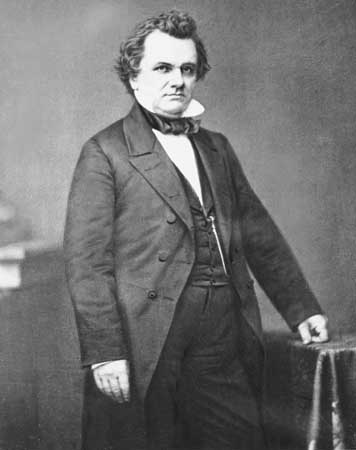
DOUGLAS'S SPEECH.
LADIES AND
GENTLEMEN: I appear before
you to-day in pursuance of a previous notice, and have made
arrangements with Mr. Lincoln to divide time, and discuss with him the
leading political topics that now agitate the country.
Prior
to 1854 this country was divided into two great political parties known
as Whig and Democratic. These parties
differed from each other on certain questions which were then deemed to
be important to the best interests of the Republic.
Whig and Democrats differed about a bank, the tariff,
distribution, the specie circular and the sub-treasury. On
those issues we went before the country and discussed the principles,
objects and measures of the two great parties. Each
of the parties could proclaim its principles in Louisiana
as well as in Massachusetts, in Kentucky as well as in Illinois. Since
that period, a great revolution has taken place in the formation of
parties, by which they now seem to be divided by a geographical line, a
large party in the North being arrayed under the Abolition or
Republican banner, in hostility to the Southern States, Southern
people, and Southern institutions. It
becomes important for us to inquire how this transformation of parties
has occurred, made from those of national principles to geographical
factions. You remember that in 1850—this
country was agitated from its center to its circumference about this
slavery question—it became necessary for the leaders of the great Whig
party and the leaders of the great Democratic party to postpone, for
the time being, their particular disputes, and unite first to save the
Union before they should quarrel as to the mode in which it was to be
governed. During the Congress of 1849—50,
Henry Clay was the leader of the Union men, supported by Cass and
Webster, and the leaders of the Democracy and the leaders of the Whigs,
in opposition to Northern Abolitionists or Southern Disunionists. That great contest of 1850 resulted in the
establishment of the Compromise Measures of that year, which measures
rested on the great principle that the people of each State and each
Territory of this Union ought to be permitted to regulate their own
domestic institutions in their own way, subject to no other limitation
than that which the Federal Constitution imposes.
I now wish
to ask you whether that principle was right or wrong which guarantied
to every State and every community the right to form and regulate their
domestic institutions to suit themselves. These
measures were adopted, as I have previously said, by the joint action
of the Union Whigs and Union Democrats in opposition to Northern
Abolitionists and Southern Disunionists. In
1858, when the Whig party assembled at Baltimore, in National Convention for
the last time, they adopted the principle of the Compromise Measures of
1850 as their rule of party action in the future. One
month thereafter the Democrats assembled at the same place to nominate
a candidate for the Presidency, and declared the same great principle
as the rule of action by which the Democracy would be governed. The Presidential election of 1852 was fought
on that basis. It is true that the Whigs
claimed special merit for the adoption of those measures, because they
asserted that their great Clay originated them, their god-like Webster
defended them and their Fillmore signed the bill making them the law of
the land; but on the other hand, the Democrats claimed special credit
for the Democracy, upon the ground that we gave twice as many votes in
both Houses of Congress for the passage of these measures as the Whig
party.
Thus
you see that in the Presidential election of 1852, the Whigs were
pledged by their platform and their candidate to the principle of the
Compromise Measures of 1850, and the Democracy were likewise pledged by
our principles, our platform, and our candidate to the same line of
policy, to preserve peace and quiet between the different sections of
this Union. Since that period the Whig
party has been transformed into a sectional party, under the name of
the Republican party, whilst the Democratic party continues the same
national party it was at that day. All
sectional men, all men of Abolition sentiments and principles, no
matter whether they were old Abolitionists or had been Whigs or
Democrats, rally under the sectional Republican banner, and
consequently all national men, all Union-loving men, whether Whigs,
Democrats, or by whatever name they have been known, ought to rally
under the stars and stripes in defense of the Constitution as our
fathers made it, and of the Union as it has existed under the
Constitution.
How has this
departure from the faith of the Democracy and the faith of the Whig
party been accomplished? In 1854, certain
restless, ambitious, and disappointed politicians throughout the land
took advantage of the temporary excitement created by the Nebraska bill
to try and dissolve the old Whig party and the old Democratic party, to
abolitionize their members, and lead them, bound hand and foot,
captives into the Abolition camp. In the
State of New York a Convention was held by some of these men and a
platform adopted, every plank of which was as black as night, each one
relating to the negro, and not one referring to the interests of the
white man. That example was followed
throughout the Northern States, the effect being made to combine all
the free States
in hostile array against the slave States. The
men who thus thought that they could build up a great sectional party,
and through its organization control the political destinies of this
country, based all their hopes on the single fact that the North was
the stronger division of the nation, and hence, if the North could be
combined against the South, a sure victory awaited their efforts. I am doing no more than justice to the truth
of history when I say that in this State Abraham Lincoln, on behalf of
the Whigs, and Lyman Trumbull, on behalf of the Democrats, were the
leaders who undertook to perform this grand scheme of abolitionizing
the two parties to which they belonged. They
had a private arrangement as to what should be the political destiny of
each of the contracting parties before they went into the operation. The arrangement was that Mr. Lincoln was to
take the old line Whigs with him, claiming that he was still as good a
Whig as ever, over to the Abolitionists, and Mr. Trumbull was to run
for Congress in the Belleville District, and, claiming to be a good
Democrat, coax the old Democrats into the Abolition camp, and when, by
the joint efforts of the abolitionized Whigs, the abolitionized
Democrats, and the old line Abolition and Freesoil party of this State,
they should secure a majority in the Legislature. Lincoln was then to be made United States Senator
in Shields’s place, Trumbull remaining
in Congress until I should be accommodating enough to die or resign,
and give him a chance to follow Lincoln. That
was a very nice little bargain so far as Lincoln and Trumbull were
concerned, if it had been carried out in good faith, and friend Lincoln had
attained to Senatorial dignity according to the contract.
They went into the contest in every part of the State,
calling upon all disappointed politicians to join in the crusade
against the Democracy, and appealed to the prevailing sentiments and
prejudices in all the northern counties of the State.
In three Congressional Districts in the north end of the
State they adopted, as the platform of this new party thus formed by
Lincoln and Trumbull in the connection with the Abolitionists, all of
those principles which aimed at a warfare on the part of the North
against the South. They declared in that
platform that the Wilmot Proviso was to be applied to all the
Territories of the United
States, North as well as South of 36
deg. 30 min., and not only to all the
territory we then had, but all that we might hereafter acquire; that
hereafter no more slave States should be admitted into this Union, even
if the people of such State desired slavery; that the Fugitive Slave
law should be absolutely and unconditionally repealed; that slavery
should be abolished in the District of Columbia; that the slave-trade
should be abolished between the different States, and, in fact, every
article in their creed related to this slavery question, and pointed to
a Northern geographical party in hostility to the Southern States of
this Union. Such were their principles in Northern Illinois. A
little further South they became bleached and grew paler just in
proportion as public sentiment moderated and changed in this direction. They were Republicans or Abolitionists in the
North, anti-Nebraska men down about Springfield, and in this neighborhood
they contented themselves with talking about the inexpediency of the
repeal of the Missouri Compromise. In the
extreme northern counties they brought out men to canvass the State
whose complexion suited their political creed, and hence Fred Douglass,
the negro, was to be found there, following Gen. Cass, and attempting
to speak on behalf of Lincoln, Trumbull and
Abolitionism, against that illustrious Senator. Why,
they brought Fred Douglass to Freeport,
when I was addressing a meeting there, in a carriage driven by the
white owner, the negro sitting inside with the white lady and her
daughter. When I got through canvassing
the northern counties that year, and progressed as far south as Springfield, I
was met and opposed in discussion by Lincoln, Lovejoy, Trumbull, and
Sidney Breese, who were on one side. Father
Giddings, the high-priest of Abolitionism, had just been there, and
Chase came about the time I left. [“Why
didn’t you shoot him?”] I did take a
running shot at them, but as I was single-handed against the white,
black and mixed drove, I had to use a shot-gun and fire into the crowd
instead of taking them off singly with a rifle. Trumbull had for his lieutenants, in aiding him
to abolitionize the Democracy, such men as John Wentworth, of Chicago,
Gov. Reynolds, of Belleville, Sidney
Breese, of Carlisle, and John Dougherty, of Union,
each of whom modified his opinions to suit the locality he was in. Dougherty, for instance, would not go much
further than to talk about the inexpediency of the Nebraska
bill, whilst his allies at Chicago,
advocated negro citizenship and negro equality, putting the white man
and the negro on the same basis under the law. Now
these men, four years ago, were engaged in a conspiracy to breakdown
the Democracy; to-day they are again acting together for the same
purpose! They do not hoist the same flag;
they do not own the same principles, or profess the same faith; but
conceal their union for the sake of policy. In
the northern counties, you find that all the Conventions are called in
the name of the Black Republican party; at Springfield,
they dare not call a Republican Convention, but invite all the enemies
of the Democracy to unite, and when they get down into Egypt, Trumbull issues notices calling upon
the “free Democracy” to assemble and hear him speak. I have one of the handbills calling a Trumbull meeting at Waterloo the other day, which I
received there, which is in the following language:
A
meeting of the Free Democracy will take place in Waterloo, on Monday, Sept. 13th inst., whereat Hon. Lyman Trumbull, Hon.
John Baker and others, will address the people upon the different
political topics of the day. Members of
all parties are cordially invited to be present, and hear and determine
for themselves.
THE MONROE
FREE DEMOCRACY.
What
is that name of “Free Democrats” put forth for unless to deceive the
people, and make them believe that Trumbull and his followers are not
the same party as that which raises the black flag of Abolitionism in
the northern part of this State, and makes war upon the Democratic
party throughout the State. When I put
that question to them at Waterloo
on Saturday last, one of them rose and stated that they had changed
their name for political effect in order to get votes.
There was a candid admission. Their
object in changing their party organization and principles in different
localities was avowed to be an attempt to cheat and deceive some
portion of the people until after the election. Why
cannot a political party that is conscious of the rectitude of its
purposes and the soundness of its principles declare them every where
alike? I would disdain to hold any
political principles that I could not avow in the same terms in Kentucky that I declared in Illinois,
in Charleston as well as in Chicago, in New Orleans
as well as in New York. So long as we live under a Constitution common
to all the States, our political faith ought to be as broad, as
liberal, and just as that Constitution itself, and should be proclaimed
alike in every portion of the Union. But
it is apparent that our opponents find it necessary, for partisan
effect, to change their colors in different counties in order to catch
the popular breeze, and hope with these discordant materials combined
together to secure a majority in the Legislature for the purpose of
putting down the Democratic party. This
combination did succeed in 1854 so far as to elect a majority of their
confederates to the Legislature, and the first important act which they
performed was to elect a Senator in the place of the eminent and
gallant Senator Shields. His term expired
in the United States Senate at that time, and he had to be crushed by
the Abolition coalition for the simple reason that he would not join in
their conspiracy to wage war against one-half of the Union. That was the only objection to General Shields. He had served the people of the State with
ability in the Legislature, he had served you with fidelity and ability
as Auditor, he had performed his duties to the satisfaction of the
whole country at the head of the Land Department at Washington, he had
covered the State and the Union with immortal glory on the bloody
fields of Mexico in defense of the honor of our flag, and yet he had to
be stricken down by this unholy combination. And
for what cause? Merely because he would
not join a combination of one-half of the States to make war upon the
other half, after having poured out his heart’s blood for all the
States in the Union. Trumbull was put in his place by
Abolitionism. How
did Trumbull
get there? Before the Abolitionists would
consent to go into an election for United States Senator they required
all the members of this new combination to show their hands upon this
question of Abolitionism. Lovejoy, one of
their high-priests, brought in resolutions defining the Abolition
creed, and required them to commit themselves on it by their votes—yea
or nay. In that creed, as laid down by
Lovejoy, they declared first, that the Wilmot Proviso must be put on
all the Territories of the United States, North as
well as South of 36 deg. 30min., and that
no more territory should ever be acquired unless slavery was at first
prohibited therein; second, that no more States should ever be received
into the Union unless slavery was first prohibited, by Constitutional
provision, in such States; third, that the Fugitive Slave law must be
immediately repealed, or, failing in that, then such amendments were to
be made to it as would render it useless and inefficient for the
objects for which it was passed, etc. The
next day after these resolutions were offered they were voted upon,
part of them carried, and the others defeated, the same men who voted
for them, with only two exceptions, voting soon after for Abraham
Lincoln as their candidate for the United States Senate.
He came within one or two votes of being elected, but he
could not quite get the number required, for the simple reason that his
friend Trumbull, who was a party to the bargain by which Lincoln was to
take Shields’s place, controlled a few abolitionized Democrats in the
Legislature, and would not allow them all to vote for him, thus
wronging Lincoln by permitting him on each ballot to be almost elected,
but not quite, until he forced them to drop Lincoln and elect him
(Trumbull), in order to unite the party. Thus
you find, that although the Legislature was carried that year by the
bargain between Trumbull, Lincoln, and the Abolitionists, and the union
of these discordant elements in one harmonious party; yet Trumbull violated his pledge, and played a Yankee
trick on Lincoln
when they came to divide the spoils. Perhaps
you would like a little evidence on this point if you would, I will
call Col. James H. Matheny, of Springfield,
to the stand, Mr. Lincoln’s especial confidential friend for the last
twenty years, and see what he will say upon the subject, of this
bargain. Matheny is now the Black
Republican or Abolition candidate for Congress in the Springfield
District against the gallant Col. Harris, and is making speeches all
over that part of the State against me and in favor of Lincoln, in concert with Trumbull. He
ought to be a good witness, and I will read an extract from a speech
which he made in 1856, when he was mad because his friend Lincoln had
been cheated. It is one of numerous
speeches of the same tenor that were made about that time, exposing
this bargain between Lincoln, Trumbull and the
Abolitionists. Matheny then said:
“The Whigs,
Abolitionists, Know Nothings and renegade Democrats made a solemn
compact for the purpose of carrying this State against the Democracy,
on this plan: 1st. That they would all
combine and elect Mr. Trumbull
to Congress, and thereby carry his district for the Legislature, in
order to throw all the strength that could be obtained into that body
against the Democrats. 2d.
That when the Legislature should meet, the officers of
that body, such as speaker, clerks, door-keepers, etc., would be given
to the Abolitionists; and 3d. That the
Whigs were to have the United States Senator. That,
accordingly, in good faith, Trumbull
was elected to Congress, and his district carried for the Legislature,
and, when it convened, the Abolitionists got all the officers of that
body, and thus far the “bond” was fairly executed.
The Whigs, on their part, demanded the election of Abraham
Lincoln to the United States Senate, that the bond might be fulfilled,
the other parties to the contract having already secured to themselves
all that was called for. But, in the most
perfidious manner, they refused to elect Mr. Lincoln; and the mean,
low-lived, sneaking Trumbull succeeded, by pledging all that was
required by any party, in thrusting Lincoln aside and foisting himself,
an excrescence from the rotten bowels of the Democracy, into the United
States Senate; and thus it has ever been, that an honest man makes a
bad bargain when he conspires or contracts with rogues.”
Matheny
thought that his friend Lincoln made a bad bargain when he conspired
and contracted with such rogues as Trumbull and his Abolition associates
in that campaign. Lincoln
was shoved off the track, and he and his friends all at once began to
mope; became sour and mad, and disposed to tell, but dare not; and thus
they stood for a long time, until the Abolitionists coaxed and
flattered him back by their assurances that he should certainly be a
Senator in Douglas’s place. In that way the Abolitionists have been
enabled to hold Lincoln
to the alliance up to this time, and now they have brought him into a
fight against me, and he is to see if he is again to be cheated by them. Lincoln this
time, though, required more of them than a promise, and holds their
bond, if not security, that Lovejoy shall not cheat him as Trumbull did.
When the
Republican Convention assembled at Springfield, in June last, for the
purpose of nominating State officers only, the Abolitionists could not
get Lincoln and his friends into it until they would pledge themselves
that Lincoln should be their candidate for the Senate; and you will
find, in proof of this, that that Convention passed a resolution
unanimously declaring that Abraham Lincoln was the “first, last and
only choice” of the Republicans for United States Senator.
He was not willing to have it understood that he was
merely their first choice, or their last choice, but their only choice. The Black Republican party had nobody else. Browning was nowhere; Gov. Bissell was of no
account; Archie Williams was not to be taken into consideration; John
Wentworth was not worth mentioning; John M. Palmer was degraded; and
their party presented the extraordinary spectacle of having but one—the
first, the last, and only choice for the Senate. Suppose
that Lincoln
should die, what a horrible condition the Republican party would be in! They would have nobody left.
They have no other choice, and it was necessary for them
to put themselves before the world in this ludicrous, ridiculous
attitude of having no other choice in order to quiet Lincoln’s suspicions, and assure him that he was
not to be cheated by Lovejoy, and the trickery by which Trumbull
outgeneraled him. Well, gentlemen, I think
they will have a nice time of it before they get through.
I do not intend to give them any chance to cheat Lincoln at all
this time. I intend to relieve him of all
anxiety upon that subject, and spare them the mortification of more
exposures of contracts violated, and the pledged honor of rogues
forfeited.
But I wish
to invite your attention to the chief points at issue between Mr.
Lincoln and myself in this discussion. Mr.
Lincoln knowing that he was to be the candidate of his party on account
of the arrangement of which I have already spoken, knowing that be was
to receive the nomination of the Convention for the United States
Senate, had his speech, accepting that nomination, all written and
committed to memory, ready to be delivered the moment the nomination
was announced. Accordingly,
when it was made, he was in readiness, and delivered his speech, a
portion of which I will read, in order that I may state his political
principles fairly, by repeating them in his own language:
“We are now
far into the fifth year since a policy was instituted for the avowed
object, and with the confident promise of putting an end to slavery
agitation; under the operation of that policy, that agitation has not
only not ceased, but has constantly augmented. I
believe it will not cease until a crisis shall have been reached and
passed. ‘A house divided against itself
cannot stand.’ I believe this Government
cannot endure permanently half slave and half free.
I do not expect the Union
to be dissolved. I do not expect the house
to fall, but I do expect it will cease to be divided.
It will become all one thing or all the other. Either the opponents of slavery will arrest
the spread of it, and place it where the public mind shall rest in the
belief that it is in the course of ultimate extinction, or its
advocates will push it forward until it shall become alike lawful in
all the States, North as well as South.”
There you
have Mr. Lincoln’s first and main proposition, upon which he bases his
claims, stated in his own language. He
tells you that this Republic cannot endure permanently divided into
slave and free States,
as our fathers made it. He says that they
must all become free or all become slave, that they must all be one
thing or all be the other, or this Government cannot last.
Why can it not last, if we will execute the Government in
the same spirit and upon the same principles upon which it is founded? Lincoln, by his proposition, says to the
South, “If you desire to maintain your institutions as they are now,
you must not be satisfied with minding your own business, but you must
invade Illinois and all the other Northern States, establish slavery in
them, and make it universal;” and in the same language he says to the
North, “You must not be content with regulating your own affairs, and
minding your own business, but if you desire to maintain your freedom,
you must invade the Southern States, abolish slavery there and every
where, in order to have the States all one thing or all the other.” I say that this is the inevitable and
irresistible result of Mr. Lincoln’s argument, inviting a warfare
between the North and the South, to be carried on with ruthless
vengeance, until the one section or the other shall be driven to the
wall, and become the victim of the rapacity of the other.
What good would follow such a system of warfare? Suppose the North should succeed in conquering
the South, how much would she be the gainer? or
suppose the South should conquer the North, could the Union be preserved in that way?
Is this sectional warfare to be waged between Northern
States and Southern States until they all shall become uniform in their
local and domestic institutions merely because Mr. Lincoln says that a
house divided against itself cannot stand, and pretends that this
scriptural quotation, this language of our Lord and Master, is
applicable to the American Union and the American Constitution? Washington and his compeers, in the Convention
that framed the Constitution, made this Government divided into free
and slave States. It was composed then of
thirteen sovereign and independent States, each having sovereign
authority over its local and domestic institutions, and all bound
together by the Federal Constitution. Mr.
Lincoln likens that bond of the Federal Constitution, joining free and
slave States together, to a house divided against itself, and says that
it is contrary to the law of God and cannot stand.
When did he learn, and by what authority does he proclaim,
that this Government is contrary to the law of God and cannot stand? It has stood thus divided into free and slave
States from its organization up to this day. During
that period we have increased from four millions to thirty millions of
people; we have extended our territory from the Mississippi to the
Pacific ocean; we have acquired the Floridas and Texas, and other
territory sufficient to double our geographical extent; we have
increased in population, in wealth, and in power beyond any example on
earth; we have risen from a weak and feeble power to become the terror
and admiration of the civilized world; and all this has been done under
a Constitution which Mr. Lincoln, in substance, says is in violation of
the law of God, and under a Union divided into free and slave States,
which Mr. Lincoln thinks, because of such division, can not stand. Surely, Mr. Lincoln is a wiser man than those
who framed the Government. Washington did
not believe, nor did his compatriots, that the local laws and domestic
institutions that were well adapted to the Green Mountains of Vermont
were suited to the rice plantations of South Carolina; they did not
believe at that day that in a Republic so broad and expanded as this,
containing such a variety of climate, soil, and interest, that
uniformity in the local laws and domestic institutions was either
desirable or possible. They believed then
as our experience has proved to us now, that each locality, having
different interests, a different climate and different surroundings,
required different local laws, local policy and local institutions,
adapted to the wants of that locality. Thus
our Government was formed on the principle of diversity in the local
institutions and laws, and not on that of uniformity.
As my time
flies, I can only glance at these points and not present them as fully
as I would wish, because I desire to bring all the points in
controversy between the two parties before you in order to have Mr.
Lincoln’s reply. He makes war on the
decision of the Supreme Court, in the case known as the Dred Scott case. I wish to say to you, fellow-citizens, that I
have no war to make on that decision, or any other ever rendered by the
Supreme Court. I am content to take that
decision as it stands delivered by the highest judicial tribunal on
earth, a tribunal established by the Constitution of the United States
for that purpose, and hence that decision becomes the law of the land,
binding on you, on me, and on every other good citizen, whether we like
it or not. Hence I do not choose to go
into an argument to prove, before this audience, whether or not Chief
Justice Taney understood the law better than Abraham Lincoln.
Mr. Lincoln
objects to that decision, first and mainly because it deprives the
negro of the rights of citizenship. I am
as much opposed to his reason for that objection as I am to the
objection itself. I hold that a negro is
not and never ought to be a citizen of the United States.
I hold that this Government was made on the white basis,
by white men, for the benefit of white men and their posterity forever,
and should be administered by white men and none others.
I do not believe that the Almighty made the negro capable
of self-government. I am aware that all
the Abolition lecturers that you find traveling about through the
country, are in the habit of reading the Declaration of Independence to
prove that all men were created equal and endowed by their Creator with
certain inalienable rights, among which are life, liberty, and the
pursuit of happiness. Mr. Lincoln is very
much in the habit of following in the track of Lovejoy in this
particular, by reading that part of the Declaration of Independence to
prove that the negro was endowed by the Almighty with the inalienable
right of equality with white men. Now, I
say to you, my fellow-citizens, that in my opinion, the signers of the
Declaration had no reference to the negro whatever, when they declared
all men to be created equal. They desired
to express by that phrase white men, men of European birth and European
descent, and had no reference either to the negro, the savage Indians,
the Fejee, the Malay, or any other inferior and degraded race, when
they spoke of the equality of men. One
great evidence that such was their understanding, is to be found in the
fact that at that time every one of the thirteen colonies was a
slaveholding colony, every signer of the Declaration represented a
slaveholding constituency, and we know that no one of them emancipated
his slaves, much less offered citizenship to them when they signed the
Declaration; and yet, if they intended to declare that the negro was
the equal of the white man, and entitled by divine right to an equality
with him, they were bound, as honest men, that day and hour to have put
their negroes on an equality with themselves. Instead
of doing so, with uplifted eyes to heaven they implored the divine
blessing upon them, during the seven years’ bloody war they had to
fight to maintain that Declaration, never dreaming that they were
violating divine law by still holding the negroes in bondage and
depriving them of equality.
My friends,
I am in favor of preserving this Government as our fathers made it. It does not follow by any means that because a
negro is not your equal or mine, that hence he must necessarily be a
slave. On the contrary, it does follow
that we ought to extend to the negro every right, every privilege,
every immunity which he is capable of enjoying, consistent with the
good of society. When you ask me what
these rights are, what their nature and extent is, I tell you that that
is a question which each State of this Union
must decide for itself. Illinois has
already decided the question. We have
decided that the negro must not be a slave within our limits, but we
have also decided that the negro shall not be a citizen within our
limits; that he shall not vote, hold office, or exercise any political
rights. I maintain that Illinois, as a
sovereign State, has a right thus to fix her policy with reference to
the relation between the white man and the negro; but while we had that
right to decide the question for ourselves, we must recognize the same
right in Kentucky and in every other State to make the same decision,
or a different one. Having decided our own
policy with reference to the black race, we must leave Kentucky and Missouri and every other State
perfectly free to make just such a decision as they see proper on that
question.
Kentucky has
decided that question for herself. She has
said that within her limits a negro shall not exercise any political
rights, and she has also said that a portion of the negroes under the
laws of that State shall be slaves. She
had as much right to adopt that as her policy as we had to adopt the
contrary for our policy. New York has
decided that in that State a negro may vote if he has $250 worth of
property, and if he owns that much he may vote upon an equality with
the white man. I, for one, am utterly
opposed to negro suffrage any where and under any circumstances: yet,
inasmuch as the Supreme Court have decided in the celebrated Dred
Scott case that a State has a right to confer the privilege of voting
upon free negroes, I am not going to make war upon New York because she
has adopted a policy repugnant to my feelings. But
New York
must mind her own business, and keep her negro suffrage to herself, and
not attempt to force it upon us.
In the State
of Maine
they have decided that a negro may vote and hold office on an equality
with a white man. I had occasion to say to
the Senators from Maine, in a discussion last session, that if they
thought that the white people within the limits of their State were no
better than negroes, I would not quarrel with them for it, but they
must not say that my white constituents of Illinois were no better than
negroes, or we would be sure to quarrel.
The Dred
Scott decision covers the whole question, and declares that each State
has the right to settle this question of suffrage for itself, and all
questions as to the relations between the white man and the negro. Judge Taney expressly lays down the doctrine. I receive it as law, and I say that while
those States are adopting regulations on that subject disgusting and
abhorrent, according to my views, I will not make war on them if they
will mind their own business and let us alone.
I now come
back to the question, why cannot this Union
exist forever divided into free and slave States, as our fathers made
it? It can thus exist if each State will
carry out the principles upon which our institutions were founded, to
wit: the right of each State to do as it pleases, without meddling with
its neighbors. Just act upon that great
principle, and this Union will not only live forever, but it will
extend and expand until it covers the whole continent, and makes this
confederacy one grand, ocean-bound Republic. We
must bear in mind that we are yet a young nation, growing with a
rapidity unequaled in the history of the world, that our national
increase is great, and that the emigration from the old world is
increasing, requiring us to expand and acquire new territory from time
to time, in order to give our people land to live upon.
If we live upon the principle of State rights and State
sovereignty, each State regulating its own affairs and minding its own
business, we can go on and extend indefinitely, just as fast and as far
as we need the territory. The time may
come, indeed has now come, when our interests would be advanced by the
acquisition of the Island
of Cuba. When we get Cuba
we must take it as we find it, leaving the people to decide the
question of slavery for themselves, without interference on the part of
the Federal Government, or of any State of this Union. So, when it becomes necessary to acquire any
portion of Mexico or Canada, or of this continent or the adjoining
islands, we must take them as we find them, leaving the people free to
do as they please—to have slavery or not, as they choose.
I never have inquired and never will inquire whether a new
State, applying for admission, has slavery or not for one of her
institutions. If the Constitution that is
presented be the act and deed of the people, and embodies their will,
and they have the requisite population, I will admit them with slavery
or without it, just as that people shall determine.
My objection to the Lecompton Constitution did not consist
in the fact that it made Kansas
a slave State. I would have been as much
opposed to its admission under such a Constitution as a free State as I
was opposed to its admission under it as a slave State.
I hold that that was a question which that people had a
right to decide for themselves, and that no power on earth ought to
have interfered with that decision. In my
opinion, the Lecompton Constitution was not the act and deed of the
people of Kansas, and did not embody their will, and the recent
election in that Territory, at which it was voted down by nearly ten to
one, shows conclusively that I was right in saying, when the
Constitution was presented, that it was not the act and deed of the
people, and did not embody their will.
If we wish to
preserve our institutions in their purity, and transmit them unimpaired
to our latest posterity, we must preserve with religious good faith
that great principle of self-government which guaranties to each and
every State, old and new, the right to make just such Constitutions as
they desire, and come into the Union with their own Constitution, and
not one palmed upon them. Whenever you sanction the doctrine that
Congress may crowd a Constitution down the throats of an unwilling
people, against their consent, you will subvert the great fundamental
principle upon which all our free institutions rest. In the
future I have no fear that the attempt will ever be made.
President Buchanan declared in his annual message, that hereafter the
rule adopted in the Minnesota case, requiring a Constitution to be
submitted to the people, should be followed in all future cases, and if
he stands by that recommendation there will be no division in the
Democratic party on that principle in the future. Hence, the
great mission of the Democracy is to unite the fraternal feeling of the
whole country, restore peace and quiet, by teaching each State to mind
its own business, and regulate its own domestic affairs, and all to
unite in carrying out the Constitution as our fathers made it, and thus
to preserve the Union and render it perpetual in all time to
come. Why should we not act as our fathers who made the
Government? There was no sectional strife in Washington’s army. They were all brethren of a
common confederacy; they fought under a common flag that they might
bestow upon their posterity a common destiny, and to this end they
poured out their blood in common streams, and shared, in some
instances, a common grave.
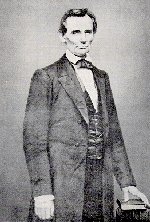
MR. LINCOLN'S REPLY.
LADIES AND
GENTLEMEN: There is very
much in the principles that Judge Douglas has here enunciated that I
most cordially approve, and over which I shall have no controversy with
him. In so far as he has insisted that all
the States have the right to do exactly as they please about all their
domestic relations, including that of slavery, I agree entirely with
him. He places me wrong in spite of all I
can tell him, though I repeat it again and again, insisting that I have
no difference with him upon this subject. I
have made a great many speeches, some of which have been printed, and
it will be utterly impossible for him to find any thing that I have
ever put in print contrary to what I now say upon this subject. I hold myself under constitutional obligations
to allow the people in all the States, without interference, direct or
indirect, to do exactly as they please, and I deny that I have any
inclination to interfere with them, even if there were no such
constitutional obligation. I can only say
again that I am placed improperly—altogether improperly, in spite of
all I can say—when it is insisted that I entertain any other view or
purposes in regard to that matter.
While I am
upon this subject, I will make some answers briefly to certain
propositions that Judge Douglas has put. He
says, “Why can’t this Union endure
permanently, half slave and half free?” I
have said that I supposed it could not, and I will try, before this new
audience, to give briefly some of the reasons for entertaining that
opinion. Another form of his question is,
“Why can’t we let it stand as our fathers placed it?” That
is the exact difficulty between us. I say,
that Judge Douglas and his friends have changed them from the position
in which our fathers originally placed it. I
say, in the way our fathers originally left the slavery question, the
institution was in the course of ultimate extinction, and the public
mind rested in the helief that it was in the course of
ultimate extinction. I say when this
Government was first established, it was the policy of its founders to
prohibit the spread of slavery into the new Territories of the United States,
where it had not existed. But Judge
Douglas and his friends have broken up that policy, and placed it upon
a new basis by which it is to become national and perpetual. All I have asked or desired any where is that
it should be placed back again upon the basis that the fathers of our
Government originally placed it upon. I
have no doubt that it would become extinct, for all
time to come, if we but readopted the policy of the fathers by
restricting it to the limits it has already covered—restricting it from
the new Territories.
I do
not wish to dwell at great length on this branch of the subject at this
time, but allow me to repeat one thing that I have stated before. Brooks, the man who assaulted Senator Sumner
on the floor of the Senate, and who was complimented with dinners, and
silver pitchers, and gold-headed canes, and a good many other things
for that feat, in one of his speeches declared that when this
Government was originally established, nobody expected that the
institution of slavery would last until this day. That
was but the opinion of one man, but it was such an opinion as we can
never get from Judge Douglas or anybody in favor of slavery in the
North at all. You can sometimes get it
from a Southern man. He said at the same
time that the framers of our Government did not have the knowledge that
experience has taught us—that experience and the invention of the
cotton-gin have taught us that the perpetuation of slavery is a
necessity. He insisted, therefore, upon
its being changed from the basis upon which the fathers of the
Government left it to the basis of its perpetuation and nationalization.
I insist
that this is the difference between Judge Douglas and myself—that Judge
Douglas is helping that change along. I
insist upon this Government being placed where our fathers originally
placed it.
I remember
Judge Douglas once said that he saw the evidences on the statute books
of Congress, of a policy in the origin of Government to divide slavery
and freedom by a geographical line—that he saw an indisposition to
maintain that policy, and therefore he set about studying up a way to
settle the institution on the right basis—the basis which he thought it
ought to have been placed upon at first; and in that speech he
confesses that he seeks to place it, not upon the basis that the
fathers placed it upon, but upon one gotten up on “original
principles.” When he asks me why we cannot
get along with it in the attitude where our fathers placed it, he had
better clear up the evidences that he has himself changed it from that
basis; that he has himself been chiefly instrumental in changing the
policy of the fathers. Any one who will
read his speech of the 22d of last March, will see that he there makes
an open confession, showing that he set about fixing the institution
upon an altogether different set of principles. I
think I have fully answered him when he asks me why we cannot let it
alone upon the basis where our fathers left it, by showing that he has
himself changed the whole policy of the Government in that regard.
Now,
fellow-citizens, in regard to this matter about a contract that was
made between Judge Trumbull and myself, and all that long portion of
Judge Douglas’s speech on this subject—I wish simply to say what I have
said to him before, that he cannot know whether it is true or not, and
I do know that there is not a word of truth in it. And I have told him so before.
I don’t want any harsh language indulged in, but I do not
know how to deal with this persistent insisting on a story that I know
to be utterly without truth. It used to be
a fashion amongst men that when a charge was made, some sort of proof
was brought forward to establish it, and if no proof was found to
exist, the charge was dropped. I don’t
know how to meet this kind of an argument. I
don’t want to have a fight with Judge Douglas, and I have no way of
making an argument up into the consistency of a corn-cob and stopping
his mouth with it. All I can do is,
good-humoredly to say that, from the beginning to the end of all that
story about a bargain between Judge Trumbull and myself, there
is not a word of truth in it. I can
only ask him to show some sort of evidence of the truth of his story. He brings forward here and reads from what he
contends is a speech by James H. Matheny, charging such a bargain
between Trumbull and myself. My own
opinion is that Matheny did do some such immoral thing as to tell a
story that he knew nothing about. I
believe he did. I contradicted it
instantly, and it has been contradicted by Judge Trumbull, while nobody
has produced any proof, because there is none. Now,
whether the speech which the Judge brings forward here is really the
one Matheny made I do not know, and I hope the Judge will pardon me for
doubting the genuineness of this document, since his production of
those Springfield resolutions at Ottawa. I do not wish to dwell at any great length
upon this matter. I can say nothing when a
long story like this is told, except it is not true, and demand that he
who insists upon it shall produce some proof. That
is all any man can do, and I leave it in that way, for I know of no
other way of dealing with it.
The Judge
has gone over a long account of the old Whig and Democratic parties,
and it connects itself with this charge against Trumbull and myself. He says that they agreed upon a compromise in
regard to the slavery question in 1850; that in a National Democratic
Convention resolutions were passed to abide by that compromise as a
finality upon the slavery question. He
also says that the Whig party in National Convention agreed to abide by
and regard as a finality the Compromise of 1850. I
understand the Judge to be altogether right about that; I understand
that part of the history of the country as stated by him to be correct. I recollect that I, as a member of that party,
acquiesced in that compromise. I recollect
in the Presidential election which followed, when we had General Scott
up for the Presidency, Judge Douglas was around berating us Whigs as
Abolitionists, precisely as he does to-day—not a bit of difference. I have often heard him. We
could do nothing when the old Whig party was alive that was not
Abolitionism, but it has got an extremely good name since it has passed
away.
When that
Compromise was made it did not repeal the old Missouri Compromise. It left a region of United States territory half as large
as the present territory of the United States, north of the
line of 36 degrees 30 minutes, in which slavery was prohibited by act
of Congress. This compromise did not
repeal that one. It did not affect or
propose to repeal it. But at last it
became Judge Douglas’s duty, as he thought (and I find no fault with
him), as Chairman of the Committee on Territories, to bring in a bill
for the organization of a Territorial Government—first of one, then of
two Territories north of that line. When
he did so it ended in his inserting a provision substantially repealing
the Missouri Compromise. That was because
the Compromise of 1850 had not repealed it. And now I ask why he could not have let that
compromise alone? We were quiet from the
agitation of the slavery question. We were
making no fuss about it. All
had acquiesced in the Compromise measures of 1850.
We never had been seriously disturbed by any abolition
agitation before that period. When he came
to form governments for the Territories north of the line of 36 degrees
30 minutes, why could he not have let that matter stand as it was
standing? Was it necessary to the
organization of a Territory? Not at all. Iowa lay
north of the line and had been organized as a Territory and come into
the Union as a State without
disturbing that Compromise. There was no
sort of necessity for destroying it to organize these Territories. But, gentlemen, it would take up all my time
to meet all the little quibbling arguments of Judge Douglas to show
that the Missouri Compromise was repealed by the Compromise of 1850. My own opinion is, that a careful
investigation of all the arguments to sustain the position that that
Compromise was virtually repealed by the Compromise of 1850, would show
that they are the merest fallacies. I have
the Report that Judge Douglas first brought into Congress at the time
of the introduction of the Nebraska
bill, which in its original form did not repeal the
Missouri Compromise, and he there expressly stated that he had forborne
to do so because it had not been done by the Compromise of
1850. I close this part of the discussion
on my part by asking him the question again, “Why,
when we had peace under the Missouri Compromise, could you not have let
it alone?”
In
complaining of what I said in my speech at Springfield, in which he says I
accepted my nomination for the Senatorship (where, by the way, he is at
fault, for if he will examine it, he will find no acceptance in it), he
again quotes that portion in which I said that “a house divided against
itself cannot stand.” Let me say a word in regard to that matter.
He tries to
persuade us that there must be a variety in the different institutions
of the States of the Union; that that
variety necessarily proceeds from the variety of soil, climate, of the
face of the country, and the difference in the natural feature of the
States. I agree to all that.
Have these very matters ever produced any difficulty
amongst us? Not at all.
Have we ever had any quarrel over the fact that they have
laws in Louisiana
designed to regulate the commerce that springs from the production of
sugar? Or because we have a different
class relative to the production of flour in this State?
Have they produced any differences? Not
at all. They are the very cements of this Union. They don’t
make the house a house divided against itself. They
are the props that hold up the house and sustain the Union.
But has it
been so with this element of slavery? Have
we not always had quarrels and difficulties over it?
And when will we cease to have quarrels over it? Like causes produce like effects.
It is worth while to observe that we have generally had
comparative peace upon the slavery question, and that there has been
[just] cause for alarm until it was excited by the effort to spread it
into new territory. Whenever it has been
limited to its present bounds, and there has been no effort to spread
it, there has been peace. All the trouble
and convulsion has proceeded from efforts to spread it over more
territory. It was thus at the date of the
Missouri Compromise. It was so again with
the annexation of Texas;
so with the territory acquired by the Mexican war, and it is so now. Whenever there has been an effort to spread it
there has been agitation and resistance. Now,
I appeal to this audience (very few of whom are my political friends),
as national men, whether we have reason to expect that the agitation in
regard to this subject will cease while the causes that tend to
reproduce agitation are actively at work? Will
not the same cause that produced agitation in 1820, when the Missouri
Compromise was formed—that which produced the agitation upon the
annexation of Texas,
and at other times—work out the same results always?
Do you think that the nature of man will be changed—that
the same causes that produced agitation at one time will not have the
same effect at another?
This has
been the result so far as my observation of the slavery question and my
reading in history extends. What right
have we then to hope that the trouble will cease—that the agitation
will come to an end—until it shall either be placed back where it
originally stood, and where the fathers originally placed it, or, on
the other hand, until it shall entirely master all opposition? This is the view I entertain, and this is the
reason why I entertained it, as Judge Douglas has read from my Springfield
speech.
Now, my
friends, there is one other thing that I feel myself under some sort of
obligation to mention. Judge Douglas has
here to-day—in a very rambling way, I was about saying—spoken of the
platforms for which he seeks to hold me responsible.
He says, “Why can’t you come out and make an open avowal
of principles in all places alike?” and he reads from an advertisement
that he says was used to notify the people of a speech to be made by
Judge Trumbull at Waterloo. In commenting on it he desires to know whether
we cannot speak frankly and manfully as he and his friends do! How, I ask, do his friends speak out their own
sentiments? A Convention of his party in
this State met on the 21st of April, at Springfield, and passed a set of
resolutions which they proclaim to the country as their platform. This does constitute their platform, and it is
because Judge Douglas claims it is his platform—that these are his
principles and purposes—that he has a right to declare he speaks his
sentiments “frankly and manfully.” On
the 9th of June, Col. John Dougherty, Gov.
Reynolds and others, calling themselves National Democrats, met in Springfield and
adopted a set of resolutions which are as easily understood, as plain
and as definite in stating to the country and to the world what they
believed in and would stand upon, as Judge Douglas’s platform. Now, what is the reason, that Judge Douglas is
not willing that Col. Dougherty and Gov. Reynolds should stand upon
their own written and printed platform as well as he upon his? Why must he look farther than their platform
when he claims himself to stand by his platform? Again,
in reference to our platform: On the 16th of June the Republicans had
their Convention and published their platform, which is as clear and
distinct as Judge Douglas’s. In it they
spoke their principles as plainly and as definitely to the world. What is the reason that Judge Douglas is not
willing I should stand upon that platform? Why
must he go around hunting for some one who is supporting me, or has
supported me at some time in his life, and who has said something at
some time contrary to that platform? Does
the Judge regard that rule as a good one? If
it turn out that the rule is a good one for me—that I am responsible
for any and every opinion that any man has expressed who is my
friend—then it is a good rule for him. I
ask, is it not as good a rule for him as it is for me?
In my opinion, it is not a good rule for either of us. Do you think differently, Judge?
Mr.
Douglas—“I do not.”
Mr. Lincoln—Judge
Douglas says he does not think differently. I
am glad of it. Then can he tell me why he
is looking up resolutions of five or six years ago, and insisting that
they were my platform, notwithstanding my protest that they are not,
and never were my platform, and my pointing out the platform of the
State Convention which he delights to say nominated me for the Senate? I cannot see what he means by parading these
resolutions, if it is not to hold me responsible for them in some way. If he says to me here, that he does not hold
the rule to be good, one way or the other, I do not comprehend how he
could answer me more fully if he answered me at greater length. I will therefore put in as my answer to the
resolutions that he has hunted up against me, what I, as a lawyer,
would call a good plea to a bad declaration. I
understand that it is a maxim of law, that a poor plea maybe a good
plea to a bad declaration. I think that
the opinions the Judge brings from those who support me, yet differ
from me, is a bad declaration against me; but if I can bring the same
things against him, I am putting in a good plea to that kind of
declaration, and now I propose to try it.
At Freeport
Judge Douglas occupied a large part of his time in producing
resolutions and documents of various sorts, as I understood, to make me
somehow responsible for them; and I propose now doing a little of the
same sort of thing for him. In 1850 a very
clever gentleman by the name of Thompson Campbell, a personal friend of
Judge Douglas and myself, a political friend of Judge Douglas and
opponent of mine, was a candidate for Congress in the Galena District. He was interrogated as to his views on this
same slavery question. I have here before
me the interrogatories and Campbell’s
answers to them. I will read them:
INTERROGATORIES.
1st. Will you, if elected, vote for and cordially
support a bill prohibiting slavery in the Territories of the United States?
2d. Will you vote for and support a bill abolishing
slavery in the District of
Columbia?
3d. Will you oppose the admission of any slave
States which may be formed out of Texas or the Territories?
4th. Will you vote for and advocate the repeal of
the Fugitive Slave law passed at the recent session of Congress?
5th. Will you advocate and vote for the election of
a Speaker of the House of Representatives who shall be willing to
organize the committee of that House so as to give the free States
their just influence in the business of legislation?
6th. What are your views, not only as to the
constitutional right of Congress to prohibit the slave-trade between
the States, but also as to the expediency of exercising that right
immediately?
CAMPBELL’S REPLY.
To the first
and second interrogatories, I answer unequivocally in the affirmative.
To the third
interrogatory I reply, that I am opposed to the admission of any more
slave States into the Union, that may
be formed out of Texan or any other Territory.
To the
fourth and fifth interrogatories I unhesitatingly answer in the
affirmative.
To the sixth
interrogatory I reply, that so long as the slave States continue to
treat slaves as articles of commerce, the Constitution confers power on
Congress to pass laws regulating that peculiar COMMERCE, and that the
protection of Human Rights imperatively demands the interposition of
every constitutional means to prevent this most inhuman and iniquitous
traffic.
T.
CAMPBELL.
I want to
say here that Thompson Campbell was elected to Congress on that
platform, as the Democratic candidate in the Galena District, against
Martin P. Sweet.
Judge
Douglas—“Give me the date of the letter.”
Mr. Lincoln—The time Campbell ran was in 1850. I have not the exact date here.
It was some time in 1850 that these interrogatories were
put and the answer given. Campbell was
elected to Congress, and served out his term. I
think a second election came up before he served out his term and he
was not re-elected. Whether defeated or
not nominated, I do not know. [Mr.
Campbell was nominated for re-election by the Democratic party, by
acclamation.] At
the end of his term his very good friend, Judge Douglas, got him a high
office from President Pierce, and sent him off to California. Is
not that the fact? Just
at the end of his term in Congress it appears that our mutual friend
Judge Douglas got our mutual friend Campbell a good office, and sent
him to California
upon it. And not only so, but on the 27th
of last month, when Judge Douglas and myself spoke at Freeport in joint
discussion, there was his same friend Campbell, come all the way from
California, to help the Judge beat me; and there was poor Martin P.
Sweet standing on the platform, trying to help poor me to be elected. That is true of one of Judge Douglas’s friends.
So
again, in that same race of 1850, there was a Congressional Convention
assembled at Joliet,
and it nominated K. S. Molony for Congress, and unanimously adopted the
following resolution:
Resolved, That we are uncompromisingly opposed to the
extension of slavery; and while we would not make such opposition a
ground of interference with the interests of the States where it
exists, yet we moderately but firmly insist that it is the duty of
Congress to oppose its extension into Territory now free, by all means
compatible with the obligations of the Constitution, and with good
faith to our sister States; that these principles were recognized by
the Ordinance of 1787, which received the sanction of Thomas Jefferson,
who is acknowledged by all to be the great oracle and expounder of our
faith.
Subsequently
the
same interrogatories were propounded to Dr. Molony which had been
addressed to Campbell, as above, with the exception of the 6th,
respecting the inter-State slave-trade, to which Dr. Molony, the
Democratic nominee for Congress, replied as follows:
I
received the written interrogatories this day, and as you will see by
the La Salle Democrat and Ottawa Free
Trader, I took at Peru on the 5th and at Ottawa on the 7th, the
affirmative side of interrogatories 1st and 2d, and in relation to the
admission of any more slave States from free Territory, my position
taken at these meetings, as correctly reported in said papers, was emphatically and distinctly opposed to
it. In relation to the admission of any
more slave States from Texas,
whether I shall go against it or not will depend upon the opinion that
I may hereafter form of the true meaning and nature of the resolutions
of annexation. If, by said resolutions,
the honor and good faith of the nation is pledged to admit more slave
States from Texas when she (Texas) may
apply for the admission of such State, then I should, if in Congress,
vote for their admission. But if not so
pledged and bound by sacred contract, then a bill for the admission of
more slave States from Texas
would never receive my vote.
To
your fourth interrogatory I answer most decidedly in
the affirmative, and for reasons set forth in my reported remarks at Ottawa last
Monday.
To
your fifth interrogatory I also reply in the affirmative most
cordially, and that I will use my utmost exertions to secure the
nomination and election of a man who will accomplish the objects of
said interrogatories. I most cordially
approve of the resolutions adopted at the union meeting held at Princeton on the 27th September ult.
Yours, etc.,
K. S. MOLONY.
All I have
to say in regard to Dr. Molony is, that he was the regularly nominated
Democratic candidate for Congress in his district—was elected at that
time, at the end of his term was appointed to a land-office at Danville. (I never heard any thing of Judge Douglas’s
instrumentality in this.) He held this
office a considerable time, and when we were at Freeport the other day, there were
handbills scattered about notifying the public that after our debate
was over, R. S. Molony
would make a Democratic speech in favor of Judge Douglas.
That is all I know of my own personal knowledge. It is added here to this resolution, and truly
I believe, that—
“Among those
who participated in the Joliet Convention, and who supported its
nominee, with his platform as laid down in the resolution of the
Convention and in his reply as above given, we call at random the
following names, all of which are recognized at this day as leading
Democrats:
“Cook County—E. B. Williams, Charles McDonell, Arno Voss, Thomas
Hoyne, Isaac Cook.”
I reckon we
ought to except Cook.
“F. C. Sherman.”
“Will—Joel A. Matteson, S. W. Bowen.”
“Kane—B. F.
Hall, G. W. Renwick, A. M. Herrington,
Elijah Wilcox.”
“McHenry—W.
M. Jackson, Enos W. Smith, Neil Donnelly.”
“La Salle—John Hise, William Reddick.”
William
Reddick! another one of Judge Douglas’s
friends that stood on the stand with him at Ottawa, at the time the Judge says my
knees trembled so that I had to be carried away. The
names are all here:
“DuPage—Nathan
Allen.”
“DeKalb—Z.
B. Mayo.”
Here is
another set of resolutions which I think are apposite to the matter in
hand.
On the 28th
of February of the same year, a Democratic District Convention was held
at Naperville,
to nominate a candidate for Circuit Judge. Among
the delegates were Bowcn and Kelly, of Will; Captain Naper, H. H. Cody,
Nathan Allen, of DuPage; W. M. Jackson, J. M. Strode, P. W. Piatt and
Enos W. Smith, of McHenry; J. Horsman and others, of Winnebago. Col. Strode presided over the Convention. The following resolutions were unanimously
adopted—the first on motion of P. W. Piatt, the second on motion of
William M. Jackson:
Resolved,
That this Convention is in favor of the Wilmot Proviso, both in Principle and Practice, and that we know
of no good reason why any person should oppose the
largest latitude in Free Soil, Free Territory and Free
Speech.
Resolved, That in the opinion of the Convention, the time
has arrived when all men should be free, whites as
well as others.
Judge
Douglas—“What is the date of those resolutions?”
Mr.
Lincoln—I understand it was in 1850, but I do not know
it. I do not state a thing and say I know
it, when I do not. But I have the highest
belief that this is so. I know of no way
to arrive at the conclusion that there is an error in it.
I mean to put a case no stronger than the truth will allow. But what I was going to comment upon is an
extract from a newspaper in DeKalb county, and it strikes me as being
rather singular, I confess, under the circumstances.
There is a Judge Mayo in that county, who is a candidate
for the Legislature, for the purpose, if he secures his election, of
helping to re-elect Judge Douglas. He is
the editor of a newspaper [DeKalb County Sentinel],
and in that paper I find the extract I am going to read. It
is part of an editorial article in which he was electioneering as
fiercely as he could for Judge Douglas and against me.
It was a curious thing, I think, to be in such a paper. I will agree to that, and the Judge may make
the most of it:
“Our
education has been such, that we have ever been rather in
favor of the equality of the blacks; that is, that they should enjoy
all the privileges of the whites where they reside.
We are aware that this is not a very popular doctrine. We have had many a confab with some who are
now strong ‘Republicans,’ we taking the broad ground of equality and
they the opposite ground.
“We were
brought up in a State where blacks were voters, and we do not know of
any inconvenience resulting from it, though perhaps it would not work
as well where the blacks are more numerous. We
have no doubt of the right, of the whites to guard against such an
evil, if it is one. Our opinion is that it
would be best for all concerned to have the colored population in a
State by themselves [in this I agree with him]; but if within the
jurisdiction of the United States, we say by all means
they should have the right to have their Senators and Representatives
in Congress, and to vote for President. With
us ‘worth makes the man, and want of it the fellow.’ We have seen many
a ‘nigger’ that we thought more of than some white men.”
That is
one of Judge Douglas’s friends. Now I do
not want to leave myself in an attitude where I can be misrepresented,
so I will say I do not think the Judge is responsible for this article;
but he is quite as responsible for it as I would be if one of my
friends had said it. I think that is fair
enough.
I have here
also a set of resolutions parsed by a Democratic State Convention in
Judge Douglas’s own good old State of Vermont, that I think ought to be
good for him too:
Resolved, That liberty is a right inherent and
inalienable in man and that herein all men are equal.
Resolved,
That we claim no authority in the Federal Government to abolish slavery
in the several Slates, but we do claim for it Constitutional power
perpetually to prohibit the introduction of slavery into territory now
free, and abolish it wherever, under the jurisdiction of Congress, it
exists.
Resolved,
That no more slave States should be admitted into the Federal Union.
Resolved,
That the Government ought to return to its ancient policy, not to
extend, nationalize or encourage, but to limit, localize and discourage
slavery.
At Freeport I answered several interrogatories that
had been propounded to me by Judge Douglas at the Ottawa meeting. The
Judge has yet not seen fit to find any fault with the position that I
took in regard to those seven interrogatories, which were certainly
broad enough, in all conscience, to cover the entire ground. In my answers, which have been printed, and
all have had the opportunity of seeing, I take the ground that those
who elect me must expect that I will do nothing which will not be in
accordance with those answers. I have some
right to assert that Judge Douglas has no fault to find with them. But he chooses to still try to thrust me upon
different ground without paying any attention to my answers, the
obtaining of which from me cost him so much trouble and concern. At the same time, I propounded four
interrogatories to him, claiming it as a right that he should answer as
many interrogatories for me as I did for him, and I would reserve
myself for a future installment when I got them ready.
The Judge in answering me upon that occasion, put in what
I suppose he intends as answers to all four of my interrogatories. The first one of these interrogatories I have
before me, and it is in these words:
“Question
1. If the people of Kansas
shall, by means entirely unobjectionable in all other respects, adopt a
State Constitution, and ask admission into the Union
under it, before they have the requisite number of
inhabitants according to the English bill—some ninety-three
thousand—will you vote to admit them?”
As I read
the Judge’s answer in the newspaper, and as I remember it as pronounced
at the time, he does not give any answer which is equivalent to yes or
no—I will or I wont. He answers at very
considerable length, rather quarreling with me for asking the question,
and insisting that Judge Trumbull had done something that I ought to
say something about; and finally getting out such statements as induce
me to infer that he means to be understood he will, in that supposed
case, vote for the admission of Kansas. I
only bring this forward now for the purpose of saying that if he
chooses to put a different construction upon his answer he may do it. But if he does not, I shall from this time
forward assume that he will vote for the admission of Kansas in
disregard of the English bill. He has the
right to remove any misunderstanding I may have. I
only mention it now that I may hereafter assume this to be the true
construction of his answer, if he does not now choose to correct me.
The second
interrogatory that I propounded to him, was this:
“Question 2. Can the people of a United
States Territory,
in any lawful way, against the wish of any citizen of the United States,
exclude slavery from its limits prior to the formation of a State
Constitution?”
To this
Judge Douglas answered that they can lawfully exclude slavery from the
Territory prior to the formation of a Constitution.
He goes on to tell us how it can be done.
As I understand him, he holds that it can be done by the
Territorial Legislature refusing to make any enactments for the
protection of slavery in the Territory, and especially by adopting
unfriendly legislation to it. For the sake
of clearness I state it again; that they can exclude slavery from the
Territory, 1st, by withholding what he assumes to be an indispensable
assistance to it in the way of legislation; and, 2d, by unfriendly
legislation. If I rightly understand him,
I wish to ask your attention for a while to his position.
In the first
place, the Supreme Court of the United States has decided that any
Congressional prohibition of slavery in the Territories is
unconstitutional—that they have reached this proposition as a
conclusion from their former proposition, that the Constitution of the
United States expressly recognizes property in slaves, and from that
other Constitutional provision, that no person shall be deprived of
property without due process of law. Hence
they reach the conclusion that as the Constitution of the United States
expressly recognizes property in slaves, and prohibits any person from
being deprived of property without due process of law, to pass an act
of Congress by which a man who owned a slave on one side of a line
would be deprived of him if he took him on the other side, is depriving
him of that property without due process of law. That
I understand to be the decision of the Supreme Court.
I understand also that Judge Douglas adheres most firmly
to that decision; and the difficulty is, how is it possible for any
power to exclude slavery from the Territory unless in violation of that
decision? That is the difficulty.
In the
Senate of the United States, in 1850, Judge Trumbull, in a speech,
substantially, if not directly, put the same interrogatory to Judge
Douglas, as to whether the people of a Territory had the lawful power
to exclude slavery prior to the formation of a Constitution? Judge Douglas then answered at considerable
length, and his answer will be found in the Congressional
Globe, under date of June 9th, 1856.
The Judge said that whether the people could exclude
slavery prior to the formation of a Constitution or not was
a question to be decided by the Supreme Court.
He put that proposition, as will be seen by the Congressional Globe, in a variety of forms, all running
to the same thing in substance—that it was a question for the Supreme
Court. I maintain that when he says, after
the Supreme Court have decided the question, that the people may yet
exclude slavery by any means whatever, he does virtually say, that it
is not a question for the Supreme Court.
He shifts his ground. I
appeal to you whether he did not say it was a question for the Supreme
Court? Has not the Supreme Court decided
that question? When he now says the people
may exclude slavery, does he not make it a
question for the people? Does he not
virtually shift his ground and say that it is not a
question for the court, but for the people? This
is a very simple proposition—a very plain and naked one.
It seems to me that there is no difficulty in deciding it. In a variety of ways he said that it was a
question for the Supreme Court. He did not
stop then to tell us that whatever the Supreme Court decides, the
people can by withholding necessary “police regulations” keep slavery
out. He did not make any such answer. I submit to you now, whether the new state of
the case has not induced the Judge to sheer away from his original
ground. Would not this be the impression
of every fair-minded man?
I hold that
the proposition that slavery cannot enter a new country without police
regulations is historically false. It is
not true at all. I hold that the history
of this country shows that the institution of slavery was originally
planted upon this continent without these “police
regulations” which the Judge now thinks necessary for the actual
establishment of it. Not only so, but is
there not another fact—how came this Dred Scott decision to be made? It was made upon the case of a negro being
taken and actually held in slavery in Minnesota Territory,
claiming his freedom because the act of Congress prohibited his being
so held there. Will the Judge
pretend that Dred Scott was not held there without police regulations? There is at least one matter of record as to
his having been held in slavery in the Territory, not only without
police regulations, but in the teeth of Congressional legislation
supposed to be valid at the time. This
shows that there is vigor enough in slavery to plant itself in a new
country even against unfriendly legislation. It
takes not only law but the enforcement of law to keep
it out. That is the history of this
country upon the subject.
I wish to
ask one other question. It being
understood that the Constitution of the United States guaranties
property in slaves in the Territories, if there is any infringement of
the right of that property, would not the United States Courts,
organized for the government of the Territory, apply such remedy as
might be necessary in that case? It is a
maxim held by the courts, that there is no wrong without its remedy;
and the courts have a remedy for whatever is acknowledged and treated
as a wrong.
Again: I
will ask you, my friends, if you were elected members of the
Legislature, what would be the first thing you would have to do before
entering upon your duties? Swear
to support the Constitution of the United States. Suppose you believe, as Judge Douglas does,
that the Constitution of the United States guaranties to your neighbor
the right to hold slaves in that Territory—that they are his
property—how can you clear your oaths unless you give him such
legislation as is necessary to enable him to enjoy that property? What do you understand by supporting the
Constitution of a State, or of the United States? Is it not to give such Constitutional helps to
the rights established by that Constitution as may be practically
needed? Can you, if you swear to support
the Constitution, and believe that the Constitution establishes a
right, clear your oath, without giving it support? Do
you support the Constitution if, knowing or believing there is a right
established under it which needs specific legislation, you withhold
that legislation? Do you not violate and
disregard your oath? I can conceive of
nothing plainer in the world. There can be
nothing in the words “support the Constitution,” if you may run counter
to it by refusing support to any right established under the
Constitution. And what I say here will
hold with still more force against the Judge’s doctrine of “unfriendly
legislation.” How
could you, having sworn to support the Constitution and believing it
guarantied the right to hold slaves in the Territories, assist in
legislation intended to defeat that right? That would be violating your own view of the
Constitution. Not only so, but if you were
to do so, how long would it take the courts to hold your votes
unconstitutional and void? Not a moment.
Lastly
I would ask—is not Congress, itself, under obligation to give
legislative support to any right that is established under the United
States Constitution? I repeat the
question—is not Congress, itself, bound to give legislative support to
any right that is established in the United States Constitution? A member of Congress swears to support the
Constitution of the United
States, and if he sees a right
established by that Constitution which needs specific legislative
protection, can he clear his oath without giving that protection? Let me ask you why many of us who are opposed
to slavery upon principle, give our acquiescence to a Fugitive Slave
law? Why do we hold ourselves under
obligations to pass such a law, and abide by it when it is passed? Because the Constitution makes provision that
the owners of slaves shall have the right to reclaim them.
It gives the right to reclaim slaves, and that right is,
as Judge Douglas says, a barren right, unless there is legislation that
will enforce it.
The mere
declaration, “No person held to service or labor in one State under the
laws thereof, escaping into another, shall in consequence of any law or
regulation therein be discharged from such service or labor, but shall
be delivered up on claim of the party to whom such service or labor may
be due,” is powerless without specific legislation to enforce it. Now, on what ground would a member of Congress
who is opposed to slavery in the abstract, vote for a Fugitive law, as
I would deem it my duty to do? Because
there is a Constitutional right which needs legislation to enforce it. And although it is distasteful to me, I have
sworn to support the Constitution, and having so sworn, I cannot
conceive that I do support it if I withhold from that right any
necessary legislation to make it practical. And
if that is true in regard to a Fugitive Slave law, is the right to have
fugitive slaves reclaimed any better fixed in the Constitution than the
right to hold slaves in the Territories? For
this decision is a just exposition of the Constitution, as Judge
Douglas thinks. Is the one right any
better than the other? Is there any man
who, while a member of Congress, would give support to the one any more
than the other? If I wished to refuse to
give legislative support to slave property in the Territories, if a
member of Congress, I could not do it, holding the view that the
Constitution establishes that right. If I
did it at all, it would be because I deny that this decision properly
construes the Constitution. But if I
acknowledge, with Judge Douglas, that this decision properly construes
the Constitution, I cannot conceive that I would be less than a
perjured man if I should refuse in Congress to give such protection to
that property as in its nature it needed.
At the end
of what I have said here I propose to give the Judge my fifth
interrogatory, which he may take and answer at his leisure. My fifth interrogatory is this:
If the
slaveholding citizens of a United States Territory
should need and demand Congressional legislation for the protection of
their slave property in such Territory, would you, as a member of
Congress, vote for or against such legislation?
Judge
Douglas—“Will you repeat that? I want to
answer that question.”
Mr.
Lincoln—If the slaveholding citizens of a United States Territory
should need and demand Congressional legislation for the protection of
their slave property in such Territory, would you, as a member of
Congress, vote for or against such legislation?
I am aware
that in some of the speeches Judge Douglas has made, he has spoken as
if he did not know or think that the Supreme Court had decided that a
Territorial Legislature cannot exclude slavery. Precisely
what the Judge would say upon the subject—whether he would say
definitely that he does not understand they have so decided, or whether
he would say he does understand that the court have so decided, I do
not know; but I know that in his speech at Springfield he spoke of it
as a thing they had not decided yet; and in his answer to me at
Freeport, he spoke of it so far again, as I can comprehend it, as a
thing that had not yet been decided. Now I
hold that if the Judge does entertain that view, I think that he is not
mistaken in so far as it can be said that the court has not decided any
thing save the mere question of jurisdiction. I
know the legal arguments that can be made—that after a court has
decided that it cannot take jurisdiction in a case, it then has decided
all that is before it, and that is the end of it. A
plausible argument can be made in favor of that proposition, but I know
that Judge Douglas has said in one of his speeches that the court went
forward, like honest men as they were, and decided all
the points in the case. If any points are
really extra-judicially decided because not necessarily before them,
then this one as to the power of the Territorial Legislature to exclude
slavery is one of them, as also the one that the Missouri Compromise
was null and void. They are both
extra-judicial, or neither is, according as the court held that they
had no jurisdiction in the case between the parties, because of want of
capacity of one party to maintain a suit in that court.
I want, if I have sufficient time, to show that the court
did pass its opinion, but that is the only thing
actually done in the case. If they did not
decide, they showed what they were ready to decide whenever the matter
was before them. What is that opinion? After having argued that Congress had no power
to pass a law excluding slavery from a United States Territory, they
then used language to this effect: That
inasmuch as Congress itself could not exercise such a power, it
followed as a matter of course that it could not authorize a
Territorial Government to exercise it, for the Territorial Legislature
can do no more than Congress could do. Thus
it expressed its opinion emphatically against the power of a
Territorial Legislature to exclude slavery, leaving us in just as
little doubt on that point as upon any other point they really decided.
Now, my
fellow-citizens, I will detain you only a little while longer. My time is nearly out. I
find a report of a speech made by Judge Douglas at Joliet,
since we last met at Freeport—published,
I believe, in the Missouri Republican—on the 9th of
this month, in which Judge Douglas says
“You know at
Ottawa,
I read this platform, and asked him if he concurred in each and all of
the principles set forth in it. He would
not answer these questions. At last I said
frankly, I wish you to answer them, because when I get them up here
where the color of your principles are a little darker than in Egypt, I
intend to trot you down to Jonesboro. The
very notice that I was going to take him down to Egypt made him tremble in
the knees so that he had to be carried from the platform.
He laid up seven days, and in the meantime held a
consultation with his political physicians; they had Lovejoy and
Farnsworth and all the leaders of the Abolition party, they consulted
it all over, and at last Lincoln came to the conclusion that he would
answer, so he came up to Freeport last Friday.”
Now that
statement altogether furnishes a subject for philosophical
contemplation. I have been treating it in
that way, and I have really come to the conclusion that I can explain
it in no other way than by believing the Judge is crazy.
If he was in his right mind, I cannot conceive how he
would have risked disgusting the four or five thousand of his own
friends who stood there, and knew, as to my having been carried from
the platform, that there was not a word of truth in it.
Judge
Douglas—“Didn’t they carry you off?”
Mr.
Lincoln—There; that question illustrates the character of this man
Douglas, exactly. He smiles now and says,
“Didn’t they carry you off?” But he said then, “he had to
be carried off;” and he said it to convince the country that he had
so completely broken me down by his speech that I had to be carried
away. Now he seeks to dodge it, and asks,
“Didn’t they carry you off?” Yes, they did. But, Judge Douglas, why didn’t you
tell the truth? I would like to know
why you didn’t tell the truth about it. And
then again, “He laid up seven days.” He
puts this in print for the people of the country to read as a serious
document. I think if he had been in his
sober senses he would not have risked that barefacedness in the
presence of thousands of his own friends, who knew that I made speeches
within six of the seven days at Henry, Marshall county; Augusta,
Hancock county, and Macomb, McDonough county, including all the
necessary travel to meet him again at Freeport at the end of the six
days. Now, I say, there is no charitable
way to look at that statement, except to conclude that he is actually
crazy. There is another thing in that
statement that alarmed me very greatly as he states it, that he was
going to “trot me down to Egypt.” Thereby
he would have you to infer that I would not come to Egypt unless he
forced me—that I could not be got here, unless he, giant like, had
hauled me down here. That statement he
makes, too, in the teeth of the knowledge that I had made the
stipulation to come down here, and that he
himself had been very reluctant to enter into the stipulation. More than all this, Judge Douglas, when he
made that statement, must have been crazy, and wholly out of his sober
senses, or else he would have known that when he got me down here—that
promise—that windy promise—of his powers to annihilate me, wouldn’t
amount to anything. Now, how little do I
look like being carried away trembling? Let
the Judge go on, and after he is done with his half hour, I want you
all, if I can’t go home myself, to let me stay and rot here; and if
anything happens to the Judge, if I cannot carry him to the hotel and
put him to bed, let me stay here and rot. I
say, then, there is something extraordinary in this statement. I ask you if you know any other living man who
would make such a statement? I will ask my
friend Casey, over there, if he would do such a thing? Would
he send that out and have his men take it as the truth? Did
the Judge talk of trotting me down to Egypt to scare me to death? Why, I know this people better than he does. I was raised just a little east of here. I am a part of this people.
But the Judge was raised further north, and perhaps he has
some horrid idea of what this people might be induced to do. But really I have talked about this matter
perhaps longer than I ought, for it is no great thing, and yet the
smallest are often the most difficult things to deal with.
The Judge has set about seriously trying to make the
impression that when we meet at different places I am literally in his
clutches—that I am a poor, helpless, decrepit mouse, and that I can do
nothing at all. This is one of the ways he
has taken to create that impression. I
don’t know any other way to meet it, except this. I
don’t want to quarrel with him—to call him a liar—but when I come
square up to him I don’t know what else to call him, if I must tell the
truth out. I want to be at peace, and
reserve all my fighting powers for necessary occasions.
My time, now, is very nearly out, and I give up the trifle
that is left to the Judge, to let him set my knees trembling again, if
he can.
MR.
DOUGLAS'S REPLY.
My friends,
while I am very grateful to you for the enthusiasm which you show for
me, I will say in all candor, that your quietness will be much more
agreeable than your applause, inasmuch as you deprive me of some part
of my time when ever you cheer.
I will
commence where Mr. Lincoln left off, and make a remark upon this
serious complaint of his about my speech at Joliet. I did say there in a playful manner that when I
put these questions to Mr. Lincoln at Ottawa he failed to answer, and
that he trembled and had to be carried off the stand, and required
seven days to get up his reply. That he
did not walk off from that stand he will not deny.
That when the crowd went away from the stand with me, a
few persons carried him home on their shoulders and laid him down, he
will admit. I wish to say to you that
whenever I degrade my friends and myself by allowing them to carry me
on their backs along through the public streets, when I am able to
walk, I am willing to be deemed crazy. I
did not say whether I beat him or he beat me in the argument. It is true I put these questions to him, and I
put them not as mere idle questions, but showed that I based them upon
the creed of the Black Republican party as declared by their
Conventions in that portion of the State which he depends upon to elect
him, and desired to know whether he indorsed that creed.
He would not answer. When I
reminded him that I intended bringing him into Egypt
and renewing my questions if he refused to answer, he then consulted
and did get up his answers one week after—answers which I may refer to
in a few minutes and show you how equivocal they are.
My object was to make him avow whether or not he stood by
the platform of his party; the resolutions I then read, and upon which
I based my questions, had been adopted by his party in the Galena
Congressional District, and the Chicago and Bloomington Congressional
Districts, composing a large majority of the counties in this State
that give Republican or Abolition majorities. Mr.
Lincoln cannot and will not deny that the doctrines laid down in these
resolutions were in substance put forth in Lovejoy’s resolutions, which
were voted for by a majority of his party, some of them, if not all,
receiving the support of everyman of his party. Hence,
I laid a foundation for my questions to him before I asked him whether
that was or was not the platform of his party. He
says that he answered my questions. One of
them was whether he would vote to admit any more slave States into the Union. The creed of
the Republican party as set forth in the resolutions of their various
Conventions was, that they would under no circumstances vote to admit
another slave State. It was put forth in
the Lovejoy resolutions in the Legislature; it was put forth and passed
in a majority of all the counties of this State which give Abolition or
Republican majorities, or elect members to the Legislature of that
school of polities. I had a right to know
whether he would vote for or against the admission of another slave
State in the event the people wanted it. He
first answered that he was not pledged on the subject, and then said,
“In regard to the other question, of whether I am pledged to the
admission of any more slave States into the Union, I state to you very
frankly that I would be exceedingly sorry ever to be put in the
position of having to pass on that question. I
should be exceedingly glad to know that there would never be another
slave State admitted into the Union; but I must add that if slavery
shall be kept out of the Territories during the territorial existence
of any one given Territory, and then the people, having a fair chance
and clean field when they come to adopt a Constitution, do such an
extraordinary thing as adopt a slave Constitution, uninfluenced by the
actual presence of the institution among them, I see no alternative, if
we own the country, but to admit them into the Union.”
Now analyze
that answer. In the first place he says he
would be exceedingly sorry to be put in a position where he would have
to vote on the question of the admission of a slave State.
Why is he a candidate for the Senate if he would be sorry
to be put in that position? I trust the
people of Illinois
will not put him in a position which he would be so sorry to occupy. The next position he takes is that he would be
glad to know that there would never be another slave State, yet, in
certain contingencies, he might have to vote for one.
What is that contingency? “If
Congress keeps slavery out by law while it is a Territory, and then the
people should have a fair chance and should adopt slavery, uninfluenced
by the presence of the institution,” he supposed he would have to admit
the State. Suppose Congress should not
keep slavery out during their territorial existence, then how would he
vote when the people applied for admission into the Union with a slave Constitution?
That he does not answer, and that is the condition of
every Territory we have now got. Slavery
is not kept out of Kansas
by act of Congress, and when I put the question to Mr. Lincoln, whether
he will vote for the admission with or without slavery, as her people
may desire, he will not answer, and you have not got an answer from him. In Nebraska
slavery is not prohibited by act of Congress, but the people are
allowed, under the Nebraska bill, to
do as they please on the subject; and when I ask him whether he will
vote to admit Nebraska
with a slave Constitution if her people desire it, he will not answer. So with New Mexico,
Washington Territory, Arizonia, and the four new States
to be admitted from Texas. You cannot get an answer from him to these
questions. His answer only applies to a
given case, to a condition—things which he knows does not exist in any
one Territory in the Union. He tries to give you to understand that he
would allow the people to do as they please, and yet he dodges the
question as to every Territory in the Union. I now ask why cannot Mr. Lincoln answer to each of these
Territories? He
has not done it, and he will not do it. The
Abolitionists up North understand that this answer is made with a view
of not committing himself on any one Territory now in existence. It is so understood there, and you cannot
expect an answer from him on a case that applies to any one Territory,
or applies to the new States which by compact we are pledged to admit
out of Texas,
when they have the requisite population and desire admission. I submit to you whether he has made a frank
answer, so that you can tell how he would vote in any one of these
cases. “He would be sorry to be put in the
position.” Why would he be sorry to be put
in this position if his duty required him to give the vote? If the people of a Territory ought to be
permitted to come into the Union as a
State, with slavery or without it, as they pleased, why not give the
vote admitting them cheerfully? If in his
opinion they ought not to come in with slavery, even if they wanted to,
why not say that he would cheerfully vote against their admission? His intimation is that conscience would not
let him vote “No,” and he would be sorry to do that which his
conscience would compel him to do as an honest man.
In regard to
the contract or bargain between Trumbull, the Abolitionists and him,
which he denies, I wish to say that the charge can be proved by
notorious historical facts. Trumbull,
Lovejoy, Giddings, Fred Douglass, Hale, and Banks, were traveling the
State at that time making speeches on the same side and in the same
cause with him. He contents himself with
the simple denial that no such thing occurred. Does
he deny that he, and Trumbull,
and Breese, and Giddings, and Chase, and Fred Douglass, and Lovejoy,
and all those Abolitionists and deserters from the Democratic party,
did make speeches all over this State in the same common cause? Does he deny that Jim Matheny was then, and is
now, his confidential friend, and does he deny that Matheny made the
charge of the bargain and fraud in his own language, as I have read it
from his printed speech. Matheny spoke of
his own personal knowledge of that bargain existing between Lincoln, Trumbull, and the Abolitionists.
He still remains Lincoln’s
confidential friend, and is now a candidate for Congress, and is
canvassing the Springfield District for Lincoln. I
assert that I can prove the charge to be true in detail if I can ever
get it where I can summon and compel the attendance of witnesses. I have the statement of another man to the
same effect as that made by Matheny, which I am not permitted to use
yet, but Jim Matheny is a good witness on that point, and the history
of the country is conclusive upon it. That
Lincoln up to that time had been a Whig, and then undertook to
Abolitionize the Whigs and bring them into the Abolition camp, is
beyond denial; that Trumbull up to that time had been a Democrat, and
deserted, and undertook to Abolitionize the Democracy, and take them
into the Abolition camp, is beyond denial; that they are both now
active, leading, distinguished members of this Abolition Republican
party, in full communion, is a fact that cannot be questioned or denied.
But Lincoln is not
willing to be responsible for the creed of his party.
He complains because I hold him responsible, and in order
to avoid the issue, he attempts to show that individuals in the
Democratic party, many years ago, expressed Abolition sentiments. It is true that Tom Campbell, when a candidate
for Congress in 1850, published the letter which Lincoln read. When
I asked Lincoln
for the date of that letter he could not give it. The
date of the letter has been suppressed by other speakers who have used
it, though I take it for granted that Lincoln did not know the date. If he will take the trouble to examine, he
will find that the letter was published only two days before the
election, and was never seen until after it, except in one county. Tom Campbell would have been beat to death by
the Democratic party if that letter had been made public in his
district. As to Molony, it is true he
uttered sentiments of the kind referred to by Mr. Lincoln, and the best
Democrats would not vote for him for that reason. I
returned from Washington
after the passage of the Compromise Measures in 1850, and when I found
Molony running under John Wentworth’s tutelage, and on his platform, I
denounce! him, and declared that he was no Democrat.
In my speech at Chicago,
just before the election that year, I went before the infuriated people
of that city and vindicated the Compromise Measures of 1850. Remember the city council had passed
resolutions nullifying acts of Congress and instructing the police to
withhold their assistance from the execution of the laws, and as I was
the only man in the city of Chicago who was responsible for the passage
of the Compromise Measures, I went before the crowd, justified each and
every one of those measures, and let it be said to the eternal honor of
the people of Chicago, that when they were convinced by my exposition
of those measures that they were right and they had done wrong in
opposing them, they repealed their nullifying resolutions and declared
that they would acquiesce in and support the laws of the land. These facts are well known, and Mr. Lincoln
can only get up individual instances, dating back to 1849-50, which are
contradicted by the whole tenor of the Democratic creed.
But Mr.
Lincoln does not want to be held responsible for the Black Republican
doctrine of no more slave States. Farnsworth
is the candidate of his party to-day in the Chicago District, and he
made a speech in the last Congress in which he called upon God to palsy
his right arm if he ever voted for the admission of another slave
State, whether the people wanted it or not. Lovejoy
is making speeches all over the State for Lincoln now, and taking ground
against any more slave States. Washburne,
the Black Republican candidate for Congress in the Galena District, is
making speeches in favor of this same Abolition platform declaring no
more slave States. Why are men running for
Congress in the northern districts, and taking that Abolition platform
for their guide, when Mr. Lincoln does not want to be held to it down
here in Egypt
and in the center of the State, and objects to it so as to get votes
here. Let me tell Mr. Lincoln that his
party in the northern part of the State hold to that Abolition
platform, and that if they do not in the South and in the center they
present the extraordinary spectacle of a “house divided against
itself,” and hence “cannot stand.” I now
bring down upon him the vengeance of his own scriptural quotation, and
give it a more appropriate application than he did, when I say to him
that his party, Abolition in one end of the State and opposed to it in
the other, is a house divided against itself, and cannot stand, and
ought not to stand, for it attempts to cheat the American people out of
their votes by disguising its sentiments.
Mr. Lincoln
attempts to cover up and get over his Abolitionism by telling you that
he was raised a little east of you, beyond the Wabash in Indiana, and he
thinks that makes a mighty sound and good man of him on all these
questions. I do not know that the place
where a man is born or raised has much to do with his political
principles. The worst Abolitionist I have
ever known in Illinois have been men who have sold their slaves in
Alabama and Kentucky, and have come here and turned Abolitionists
whilst spending the money got for the negroes they sold, and I do not
know that an Abolitionist from Indiana or Kentucky ought to have any
more credit because he was born and raised among slaveholders. I do not know that a native of Kentucky is more excusable because raised among
slaves, his father and mother having owned slaves, he comes to Illinois, turns
Abolitionist, and slanders the graves of his father and mother, and
breathes curses upon the institutions under which he was born, and his
father and mother bred. True, I was not
born out west here. I was born away down
in Yankee land, I was born in a valley in Vermont, with the high mountains
around me. I love the old green mountains
and valleys of Vermont,
where I was born, and where I played in my childhood.
I went up to visit them some seven or eight years ago, for
the first time for twenty odd years. When
I got there they treated me very kindly. They
invited me to the commencement of their college, placed me on the seats
with their distinguished guests, and conferred upon me the degree of
LL. D. in Latin (doctor of laws), the same
as they did old Hickory, at Cambridge, many years ago, and I give you
my word and honor I understood just as much of the Latin as he did. When they got through conferring the honorary
degree, they called upon me for a speech, and I got up with my heart
lull and swelling with gratitude for their kindness, and I said to
them, “My friends, Vermont is the most glorious spot on the face of
this globe for a man to be born in, provided he
emigrates when he is very young.”
I emigrated
when I was very young. I came out here
when I was a boy, and I found my mind liberalized, and my opinions
enlarged when I got on these broad prairies, with only the Heavens to
bound my vision, instead of having them circumscribed by the little
narrow ridges that surrounded the valley where I was born.
But, I discard all flings of the land where a man was born. I wish to be judged by my principles, by those
great public measures and Constitutional principles upon which the
peace, the happiness and the perpetuity of this Republic now rest.
Mr. Lincoln
has framed another question, propounded it to me, and desired my answer. As I have said before, I did not put a
question to him that I did not first lay a foundation for by showing
that it was a part of the platform of the party whose votes he is now
seeking, adopted in a majority of the counties where he now hopes to
get a majority, and supported by the candidates of his party now
running in those counties. But I will
answer his question. It is as follows: “If
the slaveholding citizens of a United States Territory
should need and demand Congressional legislation for the protection of
their slave property in such Territory, would you, as a member of
Congress, vote for or against such legislation?” I
answer him that it is a fundamental article in the Democratic creed
that there should be non-interference and non-intervention by Congress
with slavery in the States or Territories. Mr.
Lincoln could have found an answer to his question in the Cincinnati
platform, if he had desired it. The
Democratic party have always stood by that great principle of
noninterference and non-intervention by Congress with slavery in the
States and Territories alike, and I stand on that platform now.
Now I desire
to call your attention to the fact that Lincoln did not define his own
position in his own question. How does he
stand on that question? He put the
question to me at Freeport whether or
not I would vote to admit Kansas into
the Union before she had 93,420
inhabitants. I answered him at once that
it having been decided that Kansas
had now population enough for a slave State, she had population enough
for a free State.
I answered
the question unequivocally, and then I asked him whether he would vote
for or against the admission of Kansas before she had 93,420
inhabitants, and he would not answer me. To-day
he has called attention to the fact that, in his opinion, my answer on
that question was not quite plain enough, and yet he has not answered
it himself. He now puts a question in
relation to Congressional interference in the Territories to me. I answer him direct, and yet he has not
answered the question himself. I ask you
whether a man has any right, in common decency, to put questions in
these public discussions, to his opponent, which he will not answer
himself, when they are pressed home to him. I
have asked him three times, whether he would vote to admit Kansas
whenever the people applied with a Constitution of their own making and
their own adoption, under circumstances that were fair, just and
unexceptionable, but I cannot get an answer from him.
Nor will he answer the question which he put to me, and
which I have just answered in relation to Congressional interference in
the Territories, by making a slave code there.
It is true
that he goes on to answer the question by arguing that under the
decision of the Supreme Court it is the duty of a man to vote for a
slave code in the Territories. He says
that it is his duty, under the decision that the court has made, and if
he believes in that decision he would be a perjured man if he did not
give the vote. I want to know whether he
is not bound to a decision which is contrary to his opinions just as
much as to one in accordance with his opinions. If
the decision of the Supreme Court, the tribunal created by the
Constitution to decide the question, is final and binding, is he not
bound by it just as strongly as if he was for it instead of against it
originally? Is every man in this land
allowed to resist decisions he does not like, and only support those
that meet his approval? What are important
courts worth unless their decisions are binding on all good citizens? It is the fundamental principles of the
judiciary that its decisions are final. It
is created for that purpose, so that when you cannot agree among
yourselves on a disputed point you appeal to the judicial tribunal
which steps in and decides for you, and that decision is then binding
on every good citizen. It is the law of
the land just as much with Mr. Lincoln
against it as for it. And yet he says that
if that decision is binding he is a perjured man if he does not vote
for a slave code in the different Territories of this Union. Well, if you
[turning to Mr. Lincoln] are not going to resist the decision, if you
obey it, and do not intend to array mob law against the constituted
authorities, then, according to your own statement, you will be a
perjured man if you do not vote to establish slavery in these
Territories. My doctrine is, that even
taking Mr. Lincoln’s view that the decision recognizes the right of a
man to carry his slaves into the Territories of the United States,
if he pleases, yet after he gets there he needs affirmative law to make
that right of any value. The same doctrine
not only applies to slave property, but all other kinds of property. Chief Justice Taney places it upon the ground
that slave property is on an equal footing with other property. Suppose one of your merchants should move to
Kansas and open a liquor store; he has a right to take groceries and
liquors there, but the mode of selling them, and the circumstances
under which they shall be sold, and all the remedies must be prescribed
by local legislation, and if that is unfriendly it will drive him out
just as effectually as if there was a Constitutional provision against
the sale of liquor. So the absence of
local legislation to encourage and support slave property in a
Territory excludes it practically just as effectually as if there was a
positive Constitutional provision against it. Hence,
I assert that under the Dred Scott decision you cannot maintain slavery
a day in a Territory where there is an unwilling people and unfriendly
legislation. If the people are opposed to
it, our right is a barren, worthless, useless right, and if they are
for it, they will support and encourage it. We
come right back, therefore, to the practical question, if the people of
a Territory want slavery they will have it, and if they do not want it
you cannot force it on them. And this is
the practical question, the great principle, upon which our
institutions rest. I am willing to take
the decision of the Supreme Court as it was pronounced by that august
tribunal without stopping to inquire whether I would have decided that
way or not. I have had many a decision
made against me on questions of law which I did not like, but I was
bound by them just as much as if I had had a hand in making them, and
approved them. Did you ever see a lawyer
or a client lose his case that he approved the decision of the court? They always think the decision unjust when it is
given against them. In a Government of
laws like ours we must sustain the Constitution as our fathers made it,
and maintain the rights of the States as they are guarantied under the
Constitution, and then we will have peace and harmony between the
different States and sections of this glorious Union.
|