|
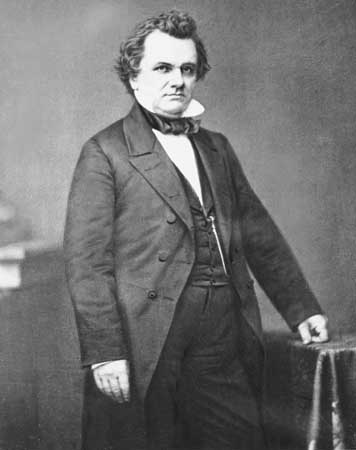
MR.
DOUGLAS'S SPEECH.
LADIES AND GENTLEMEN: Four years ago I
appeared before the people of Knox county for the purpose of defending
my political action upon the Compromise measures of 1850 and the
passage of the Kansas-Nebraska bill. Those
of you before me, who were present then, will remember that I
vindicated myself for supporting those two measures by the fact that
they rested upon the great fundamental principle that the people of
each State and each Territory of this Union have the right, and ought
to be permitted to exercise the right, of regulating their own domestic
concerns in their own way, subject to no other limitation or
restriction than that which the Constitution of the United States
imposes upon them. I then called upon the
people of Illinois
to decide whether that principle of self-government was right or wrong. If it was and is right, then the Compromise
measures of 1850 were right, and, consequently, the Kansas and Nebraska
bill, based upon the same principle, must necessarily have been right.
The Kansas and Nebraska bill declared, in so many
words, that it was the true intent and meaning of the act not to
legislate slavery into any State or Territory, nor to exclude it
therefrom, but to leave the people thereof perfectly free
to form and regulate their domestic institutions in their
own way, subject only to the Constitution of the United States.
For the last four years I have devoted all my energies, in
private and public, to commend that principle to the American people. Whatever else may be said in condemnation or
support of my political course, I apprehend that no honest man will
doubt the fidelity with which, under all circumstances, I have stood by
it.
During the
last year a question arose in the Congress of the United States whether or not that
principle would be violated by the admission of Kansas
into the Union under the Lecompton
Constitution. In my opinion, the attempt
to force Kansas in under that Constitution, was a gross violation of
the principle enunciated in the Compromise measures of 1850, and Kansas
and Nebraska bill of 1854, and therefore I led off in the fight against
the Lecompton Constitution, and conducted it until the effort to carry
that Constitution through Congress was abandoned. And
I can appeal to all men, friends and foes, Democrats and Republicans,
Northern men and Southern men, that during the whole of that fight I
carried the banner of Popular Sovereignty aloft, and never allowed it
to trail in the dust, or lowered my flag until victory perched upon our
arms. When the Lecompton Constitution was
defeated, the question arose in the minds of those who had advocated it
what they should next resort to in order to carry put their views. They devised a measure known as the English
bill, and granted a general amnesty and political pardon to all men who
had fought against the Lecompton Constitution, provided they would
support that bill. I for one did not
choose to accept the pardon, or to avail myself of the amnesty granted
on that condition. The fact that the
supporters of Lecompton were willing to forgive all differences of
opinion at that time in the event those who opposed it favored the
English bill, was an admission they did not think that opposition to
Lecompton impaired a man’s standing in the Democratic party. Now the question arises, what was that English
bill which certain men are now attempting to make a test of political
orthodoxy in this country. It provided, in
substance, that the Lecompton Constitution should be sent back to the
people of Kansas for their adoption
or rejection, at an election which was held in August last, and in case
they refused admission under it, that Kansas
should be kept out of the Union until
she had 93,420 inhabitants. I was in favor
of sending the Constitution back in order to enable the people to say
whether or not it was their act and deed, and embodied their will; but
the other proposition, that if they refused to come into the Union
under it, they should be kept out until they had double or treble the
population they then had, I never would sanction by my vote. The reason why I could not sanction it is to
be found in the fact that by the English bill, if the people of Kansas
had only agreed to become a slaveholding State under the Lecompton
Constitution, they could have done so with 35,000 people, but if they
insisted on being a free State, as they had a right to do, then they
were to be punished by being kept out of the Union until they had
nearly three times that population. I then
said in my place in the Senate, as I now say to you, that whenever Kansas has population enough for a slave State
she has population enough for a free State. I
have never yet given a vote, and I never intend to record one, making
an odious and unjust distinction between the different States of this Union. I hold it to
be a fundamental principle in our republican form of government that
all the States of this Union, old and
new, free and slave, stand on an exact equality. Equality
among the different States is a cardinal principle on which all our
institutions rest. Wherever, therefore,
you make a discrimination, saying to a slave State that it shall be
admitted with 35,000 inhabitants, and to a free State that it shall not be
admitted until it has 93,000 or 100,000 inhabitants, you are throwing
the whole weight of the Federal Government into the scale in favor of
one class of States against the other. Nor
would I on the other hand any sooner sanction the doctrine that a free State could be admitted into the Union with 35,000 people, while a slave State
was kept out until it had 93,000. I have
always declared in the Senate my willingness, and I am willing now to
adopt the rule, that no Territory shall ever become a State, until it
has the requisite population for a member of Congress, according to the
then existing ratio. But while I have
always been, and am now willing to adopt that general rule, I was not
willing and would not consent to make an exception of Kansas, as a
punishment for her obstinacy, in demanding the right to do as she
pleased in the formation of her Constitution. It
is proper that I should remark here, that my opposition to the
Lecompton Constitution did not rest upon the peculiar position taken by
Kansas
on the subject of slavery. I held then,
and hold now, that if the people of Kansas want a slave State, it is
their right to make one and be received into the Union under it; if, on
the contrary, they want a free State, it is their right to have it, and
no man should ever oppose their admission because they ask it under the
one or the other. I hold to that great
principle of self-government which asserts the right of every people to
decide for themselves the nature and character of the domestic
institutions and fundamental law under which they are to live.
The effort
has been and is now being made in this State by certain postmasters and
other Federal office-holders, to make a test of faith on the support of
the English bill. These men are now making
speeches all over the State against me and in favor of Lincoln, either directly or indirectly, because I
would not sanction a discrimination between slave and free States by
voting for the English bill. But while
that bill is made a test in Illinois
for the purpose of breaking up the Democratic organization in this
State, how is it in the other States? Go
to Indiana, and there you find English himself, the author of the
English bill, who is a candidate for re-election to Congress, has been
forced by public opinion to abandon his own darling project, and to
give a promise that he will vote for the admission of Kansas at once,
whenever she forms a Constitution in pursuance of law, and ratifies it
by a majority vote of her people. Not only
is this the case with English himself, but I am informed that every
Democratic candidate for Congress in Indiana takes the same ground. Pass to Ohio, and there you find that
Groesbeck, and Pendleton, and Cox, and all the other anti-Lecompton men
who stood shoulder to shoulder with me against the Lecompton
Constitution, but voted for the English bill, now repudiate it and take
the same ground that I do on that question. So
it is with the Joneses and others of Pennsylvania,
and so it is with every other Lecompton Democrat in the free States. They now abandon even the English bill, and
come back to the true platform which I proclaimed at the time in the
Senate, and upon which the Democracy of Illinois now stand. And yet, notwithstanding the fact, that every
Lecompton and anti-Lecompton Democrat in the free States has abandoned
the English bill, you are told that it is to be made a test upon me,
while the power and patronage of the Government are all exerted to
elect men to Congress in the other States who occupy the same position
with reference to it that I do. It seems
that my political offense consists in the fact that I first did not
vote for the English bill, and thus pledge myself to keep Kansas out of the Union
until she has a population of 93,420, and then return home, violate
that pledge, repudiate the bill, and take the opposite ground. If I had done this, perhaps the Administration
would now be advocating my re-election, as it is that of the others who
have pursued this course. I did not choose
to give that pledge, for the reason that I did not intend to carry out
that principle. I never will consent, for
the sake of conciliating the frowns of power, to pledge myself to do
that which I do not intend to perform. I
now submit the question to you as my constituency, whether I was not
right, first, in resisting the adoption of the Lecompton Constitution;
and secondly, in resisting the English bill. I
repeat, that I opposed the Lecompton Constitution because it was not
the act and deed of the people of Kansas, and did not embody their
will. I denied the right of any power on
earth, under our system of Government, to force a Constitution on an
unwilling people. There was a time when
some men could pretend to believe that the Lecompton Constitution
embodied the will of the people of Kansas, but that time has passed. The question was referred to the people of Kansas under
the English bill last August, and then, at a fair election, they
rejected the Lecompton Constitution by a vote of from eight to ten
against it to one in its favor. Since it
has been voted down by so overwhelming a majority, no man can pretend
that it was the act and deed of that people. I
submit the question to you whether or not, if it had not been for me,
that Constitution would have been crammed down the throats of the
people of Kansas
against their consent. While at least
ninety-nine out of every hundred people here present, agree that I was
right in defeating that project, yet my enemies use the fact that I did
defeat it by doing right, to break me down and put another man in the
United States in my place. The very men
who acknowledge that I was right in defeating Lecompton, now form an
alliance with Federal office-holders, professed Lecompton men, to
defeat me, because I did right. My
political opponent, Mr. Lincoln, has no hope on earth, and has never
dreamed that he had a chance of success, were it not for the aid that
he is receiving from Federal office-holders, who are using their
influence and the patronage of the Government against me in revenge for
my having defeated the Lecompton Constitution. What
do you Republicans think of a political organization that will try to
make an unholy and unnatural combination with its professed foes to
beat a man merely because he has done right? You
know such is the fact with regard to your own party.
You know that the ax of decapitation is suspended over
every man in office in Illinois,
and the terror of proscription is threatened every Democrat by the
present Administration, unless he supports the Republican ticket in
preference to my Democratic associates and myself.
I could find an instance in the postmaster of the city of Galesburgh, and
in every other postmaster in this vicinity, all of whom have been
stricken down simply because they discharged the duties of their
offices honestly, and supported the regular Democratic ticket in this
State in the right. The Republican party
is availing itself of every unworthy means in the present contest to
carry the election, because its leaders know that if they let this
chance slip they will never have another, and their hopes of making
this a Republican
State will
be blasted forever.
Now, let me
ask you whether the country has any interest in sustaining this
organization, known as the Republican party. That
party is unlike all other political organizations in this country. All other parties have been national in their
character—have avowed their principles alike in the slave and free States, in Kentucky
as well as Illinois, in Louisiana as well as in Massachusetts. Such
was the case with the old Whig party, and such was and is the case with
the Democratic party. Whigs and Democrats
could proclaim their principles boldly and fearlessly in the North and
in the South, in the East and in the West, wherever the Constitution
ruled and the American flag waved over American soil.
But now you
have a sectional organization, a party which appeals to the Northern
section of the Union against the Southern, a party which appeals to
Northern passion, Northern pride, Northern ambition, and Northern
prejudices, against Southern people, the Southern States, and Southern
institutions. The leaders of that party
hope that they will be able to unite the Northern States in one great
sectional party, and inasmuch as the North is the strongest section,
that they will thus be enabled to out vote, conquer, govern, and
control the South. Hence you find that
they now make speeches advocating principles and measures which cannot
be defended in any slaveholding
State, of this Union. Is there a
Republican residing in Galesburgh who can travel into Kentucky and carry his principles with him
across the Ohio?
What Republican from Massachusetts can visit the Old Dominion without
leaving his principles behind him when he crosses Mason and Dixon’s line? Permit me to say to you in perfect good humor,
but in all sincerity, that no political creed is sound which cannot be
proclaimed fearlessly in every State of this Union
where the Federal Constitution is not the supreme law of the land. Not only is this Republican party unable to
proclaim its principles alike in the North and in the South, in the
free States and in the slave States, but it cannot even proclaim them
in the same forms and give them the same strength and meaning in all
parts of the same State. My friend Lincoln
finds it extremely difficult to manage a debate in the center part of
the State, where there is a mixture of men from the North and the South. In the extreme Northern part of Illinois he
can proclaim as bold and radical Abolitionism as ever Giddings,
Lovejoy, or Garrison enunciated, but when he gets down a little further
South he claims that he is an old line Whig, a disciple of Henry Clay,
and declares that he still adheres to the old line Whig creed, and has
nothing whatever to do with Abolitionism, or negro equality, or negro
citizenship. I once before hinted this of
Mr. Lincoln in a public speech, and at Charleston he defied me to show that
there was any difference between his speeches in the North and in the
South, and that they were not in strict harmony. I
will now call your attention to two of them, and you can then say
whether you would be apt to believe that the same man ever uttered both. In a speech in reply to me at Chicago in July
last, Mr. Lincoln, in speaking of the
equality of the negro with the white man, used the following language:
“I should
like to know, if taking this old Declaration of Independence, which
declares that all men are equal upon principle, and making exceptions
to it, where will it stop? If one man says
it does not mean a negro, why may not another man say it does not mean
another man? If the Declaration is not the
truth, let us get the statute book in which we find it and tear it out. Who is so bold as to do it?
If it is not true, let us tear it out.”
You find
that Mr. Lincoln there proposed that if the doctrine of the Declaration
of Independence, declaring all men to be born equal, did not include
the negro and put him on an equality with the white man, that we should
take the statute book and tear it out. He
there took the ground that the negro race is included in the
Declaration of Independence as the equal of the white race, and that
there could be no such thing as a distinction in the races, making one
superior and the other inferior. I read
now from the same speech:
“My friends
[he says], I have detained you about as long as I desire to do, and I
have only to say let us discard all this quibbling about this man and
the other man—this race and that race and the other race being
inferior, and therefore they must be placed in an inferior position,
discarding our standard that we have left us. Let
us discard all these things, and unite as one people throughout this
land, until we shall once more stand up declaring that all men are
created equal.”
[“That’s
right,” etc.]
Yes, I have
no doubt that you think it is right, but the Lincoln
men down in Coles, Tazewell and Sangamon
counties do not think it is right. In the
conclusion of the same speech, talking to the Chicago Abolitionists, he
said: “I leave you, hoping that the lamp of liberty will burn in your
bosoms until there shall no longer be a doubt that all men are created
free and equal.” [“Good, good.”] Well, you say good to that, and you are going to
vote for Lincoln
because he holds that doctrine. I will not
blame you for supporting him on that ground, but I will show you in
immediate contrast with that doctrine, what Mr. Lincoln said down in
Egypt in order to get votes in that locality where they do not hold to
such a doctrine. In a joint discussion
between Mr. Lincoln and myself, at Charleston, I think, on the 18th of
last month, Mr. Lincoln, referring to this subject, used the following
language:
“I will say
then, that I am not nor never have been in favor of bringing about in
any way the social and political equality of the white and black races;
that I am not nor never have been in favor of making voters of the free
negroes, or jurors, or qualifying them to hold office, or having them
to marry with white people. I will say in
addition, that there is a physical difference between the white and
black races, which, I suppose, will forever forbid the two races living
together upon terms of social and political equality, and inasmuch as
they cannot so live, that while they do remain together, there must be
the position of superior and inferior, that I as much as any other man
am in favor of the superior position being assigned to the white man.”
[“Good
for Lincoln.”]
Fellow-citizens,
here you find men hurraing for Lincoln
and saying that he did right, when in one part of the State he stood up
for negro equality, and in another part for political effect, discarded
the doctrine and declared that there always must be a superior and
inferior race. Abolitionists up north are
expected and required to vote for Lincoln because he goes for the
equality of the races, holding that by the Declaration of Independence
the white man and the negro were created equal, and endowed by the
Divine law with that equality, and down south he tells the old Wings,
the Kentuckians, Virginians, and Tennesseeans, that there is a physical
difference in the races, making one superior and the other inferior,
and that he is in favor of maintaining the superiority of the white
race over the negro. Now, how can you
reconcile those two positions of Mr. Lincoln? He
is to be voted for in the south as a pro-slavery man, and he is to be
voted for in the north as an Abolitionist. Up
here he thinks it is all nonsense to talk about a difference between
the races, and says that we must “discard all quibbling about this race
and that race and the other race being inferior, and therefore they
must be placed in an inferior position.” Down
south he makes this “quibble” about this race and that race and the
other race being inferior as the creed of his party, and declares that
the negro can never be elevated to the position of the white man. You find that his political meetings are
called by different names in different counties in the State. Here they are called Republican meetings, but
in old Tazewell, where Lincoln made a
speech last Tuesday, he did not address a Republican
meeting, but a “grand rally of the Lincoln men.” There
are very few Republicans there, because Tazewell county is filled with
old Virginians and Kentuckians, all of whom are Whigs or Democrats, and
if Mr. Lincoln had called an Abolition or Republican meeting there, he
would not get many votes. Go
down into Egypt
and you find that he and his party are operating under an alias there,
which his friend Trumbull has given them, in order that they may cheat
the people. When I was down in Monroe
county a few weeks ago addressing the people, I saw handbills posted
announcing that Mr. Trumbull was going to speak in behalf of Lincoln,
and what do you think the name of his party was there?
Why the “Free Democracy.” Mr.
Trumbull and Mr. Jehu Baker were announced to address the Free
Democracy of Monroe county, and the bill was signed “Many Free
Democrats.” The reason that Lincoln and
his party adopted the name of “Democracy”
down there was because Monroe county
has always been an old-fashioned Democratic county, and hence it was
necessary to make the people believe that they were Democrats,
sympathized with them, and were fighting for Lincoln as Democrats.
Come up to Springfield, where Lincoln now lives and always
has lived, and you find that the Convention of his party which
assembled to nominate candidates for Legislature, who are expected to
vote for him if elected, dare not adopt the name of Republican, but
assembled under the title of “all opposed to the Democracy.” Thus you find that Mr. Lincoln’s creed cannot
travel through even one half of the counties of this State, but that it
changes its hues and becomes lighter and lighter, as it travels from
the extreme north, until it is nearly white, when it reaches the
extreme south end of the State. I ask you,
my friends, why cannot Republicans avow their principles alike
everywhere? I would despise myself if I
thought that I was procuring your votes by concealing my opinions, and
by avowing one set of principles in one part of the State, and a
different set in another part. If I do not
truly and honorably represent your feelings and principles, then I
ought not to be your Senator; and I will never conceal my opinions, or
modify or change them a hair’s breadth in order to get votes. I tell you that this Chicago
doctrine of Lincoln’s—declaring
that the negro and the white man are made equal by the Declaration of
Independence and by Divine Providence—is a monstrous heresy. The signers of the Declaration of Independence
never dreamed of the negro when they were writing that document. They referred to white men, to men of European
birth and European descent, when they declared the equality of all men. I see a gentleman there in the crowd shaking
his head. Let me remind him that when
Thomas Jefferson wrote that document, he was the owner, and so
continued until his death, of a large number of slaves.
Did he intend to say in that Declaration, that his negro
slaves, which he held and treated as property, were created his equals
by Divine law, and that he was violating the law of God every day of
his life by holding them as slaves? It
must be borne in mind that when that Declaration was put forth, every
one of the thirteen Colonies were slaveholding Colonies, and every man
who signed that instrument represented a slave holding constituency. Recollect, also, that no one of them
emancipated his slaves, much less put them on an equality with himself,
after he signed the Declaration. On the
contrary, they all continued to hold their negroes as slaves during the
revolutionary war. Now, do you believe—are
you willing to have it said—that every man who signed the Declaration
of Independence declared the negro his equal, and then was hypocrite
enough to continue to hold him as a slave, in violation of what he
believed to be the Divine law? And yet
when you say that the Declaration of Independence includes the negro,
you charge the signers of it with hypocrisy.
I say to
you, frankly, that in my opinion, this Government was made by our
fathers on the white basis. It was made by
white men for the benefit of white men and their posterity forever, and
was intended to be administered by white men in all time to come. But while I hold that under our Constitution
and political system the negro is not a citizen, cannot be a citizen,
and ought not to be a citizen, it does not follow by any means that he
should be a slave. On the contrary it does
follow that the negro, as an inferior race, ought to possess every
right, every privilege, every immunity which he can safely exercise
consistent with the safety of the society in which he lives. Humanity requires, and Christianity commands,
that you shall extend to every inferior being, and every dependent
being, all the privileges, immunities and advantages which can be
granted to them consistent with the safety of society.
If you ask me the nature and extent of these privileges, I
answer that that is a question which the people of each State must
decide for themselves. Illinois has decided that question
for herself. We have said that in this
State the negro shall not be a slave, nor shall he be a citizen. Kentucky
holds a different doctrine. New York holds one different from either, and Maine one
different from all. Virginia, in her policy on this
question, differs in many respects from the others, and so on, until
there is hardly two States whose policy is exactly alike in regard to
the relation of the white man and the negro. Nor
can you reconcile them and make them alike. Each
State must do as it pleases. Illinois had as much right to adopt the policy
which we have on that subject as Kentucky had to adopt a different
policy. The great principle of this
Government is, that each State has the right to do as it pleases on all
these questions, and no other State, or power on earth has the right to
interfere with us, or complain of us merely because our system differs
from theirs. In the Compromise Measures of
1850, Mr. Clay declared that this great principle ought to exist in the
Territories as well as in the States, and I reasserted his doctrine in
the Kansas and Nebraska bill in 1854.
But Mr.
Lincoln cannot be made to understand, and those who are determined to
vote for him, no matter whether he is a pro-slavery man in the south
and a negro equality advocate in the north, cannot be made to
understand how it is that in a Territory the people can do as they
please on the slavery question under the Dred Scott decision. Let us see whether I cannot explain it to the
satisfaction of all impartial men. Chief
Justice Taney has said in his opinion in the Dred Scott case, that a
negro slave being property, stands on an equal footing with other
property, and that the owner may carry them into United States territory the
same as he does other property. Suppose
any two of you, neighbors, should conclude to go to Kansas, one
carrying $100,000 worth of negro slaves and the other $100,000 worth of
mixed merchandise, including quantities of liquors.
You both agree that under that decision you may carry your
property to Kansas, but when you get it there, the merchant who is
possessed of the liquors is met by the Maine liquor law, which
prohibits the sale or use of his property, and the owner of the slaves
is met by equally unfriendly legislation, which makes his property
worthless after he gets it there. What is
the right to carry your property into the Territory worth to either,
when unfriendly legislation in the Territory renders it worthless after
you get it there? The slaveholder when he
gets his slaves there finds that there is no local law to protect him
in holding them, no slave code, no police regulation maintaining and
supporting him in his right, and he discovers at once that the absence
of such friendly legislation excludes his property from the Territory,
just as irresistibly as if there was a positive Constitutional
prohibition excluding it. Thus you find it
is with any kind of property in a Territory, it depends for its
protection on the local and municipal law. If
the people of a Territory want slavery, they make friendly legislation
to introduce it, but if they do not want it, they withhold all
protection from it, and then it cannot exist there.
Such was the view taken on the subject by different
Southern men when the Nebraska
bill passed. See the speech of Mr. Orr, of
South Carolina,
the present Speaker of the House of Representatives of Congress, made
at that time, and there you will find this whole doctrine argued out at
full length. Read the speeches of other
Southern Congressmen, Senators and Representatives, made in 1854, and
you will find that they took the same view of the subject as Mr.
Orr—that slavery could never be forced on a people who did not want it. I hold that in this country there is no power
on the face of the globe that can force any institution on an unwilling
people. The great fundamental principle of
our Government is that the people of each State and each Territory
shall be left perfectly free to decide for themselves what shall be the
nature and character of their institutions. When
this Government was made, it was based on that principle.
At the time of its formation there were twelve slaveholding States
and one free State in this Union. Suppose this
doctrine of Mr. Lincoln and the Republicans, of uniformity of laws of
all the States on the subject of slavery, had prevailed; suppose Mr.
Lincoln himself had been a member of the Convention which framed the
Constitution, and that he had risen in that august body, and addressing
the father of his country, had said as he did at Springfield:
“A house
divided against itself cannot stand. I
believe this Government cannot endure permanently half slave and half
free. I do not expect the Union to be dissolved—I do not expect the house
to fall, but I do expect it will cease to be divided.
It will become all one thing or all the other.”
What do you
think would have been the result? Suppose
he had made that Convention believe that doctrine and they had acted
upon it, what do you think would have been the result?
Do you believe that the one free State would have outvoted the
twelve slaveholding States, and thus abolish slavery?
On the contrary, would not the twelve slaveholding States
have outvoted the one free State, and
under his doctrine have fastened slavery by an irrevocable
Constitutional provision upon every inch of the American Republic?
Thus you see that the doctrine he now
advocates, if proclaimed at the beginning of the Government, would have
established slavery every where throughout the American continent, and
are you willing, now that we have the majority section, to exercise a
power which we never would have submited to when we were in the
minority? If the Southern States had
attempted to control our institutions, and make the States all slave
when they had the power, I ask would you have submitted to it? If you would not, are you willing now, that we
have become the strongest under that great principle of self-government
that allows each State to do as it pleases, to attempt to control the
Southern institutions? Then,
my friends, I say to you that there is but one path of peace in this
Republic, and that is to administer this Government as our fathers made
it, divided into free and slave States, allowing each State to decide
for itself whether it wants slavery or not. If
Illinois will settle the slavery
question for herself, and mind her own business and let her neighbors
alone, we will be at peace with Kentucky, and every other Southern
State. If every other State in the Union
will do the same there will be peace between the North and the South,
and in the whole Union.
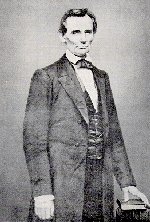
MR. LINCOLN'S REPLY.
MY FELLOW-CITIZENS: A very large portion of the
speech which Judge Douglas has addressed to you has previously been
delivered and put in print. I do not mean
that for a hit upon the Judge at all. If I
had not been interrupted, I was going to say that such an answer as I
was able to make to a very large portion of it, had already been more
than once made and published. There has
been an opportunity afforded to the public to see our respective views
upon the topics discussed in a large portion of the speech which he has
just delivered. I make these remarks for
the purpose of excusing myself for not passing over the entire ground
that the Judge has traversed. I however
desire to take up some of the points that he has attended to, and ask
your attention to them, and I shall follow him backwards upon some
notes which I have taken, reversing the order by beginning where he
concluded.
The Judge
has alluded to the Declaration of Independence, and insisted that
negroes are not included in that Declaration; and that it is a slander
upon the framers of that instrument, to suppose that negroes were meant
therein; and he asks you: Is it possible to believe that Mr. Jefferson,
who penned the immortal paper, could have supposed himself applying the
language of that instrument to the negro race, and yet held a portion
of that race in slavery? Would he not at
once have freed them? I only have to
remark upon this part of the Judge’s speech (and that, too, very
briefly, for I shall not detain myself, or you, upon that point for any
great length of time), that I believe the entire records of the world,
from the date of the Declaration of Independence up to within three years
ago, may be searched in vain for one single affirmation, from one
single man, that the negro was not included in the Declaration of
Independence; I think I may defy Judge Douglas to show that he ever
said so, that Washington
ever said so, that any President ever said so, that any member of
Congress ever said so, or that any living man upon the whole earth ever
said so, until the necessities of the present policy of the Democratic
party, in regard to slavery, had to invent that affirmation. And I will remind Judge Douglas and this
audience, that while Mr. Jefferson was the owner of slaves, as
undoubtedly he was, in speaking upon this very subject, he used the
strong language that “he trembled for his country when he remembered
that God was just;” and I will offer the highest premium in my power to
Judge Douglas if he will show that he, in all his life, ever uttered a
sentiment at all akin to that of Jefferson.
The next
thing to which I will ask your attention is the Judge’s comments upon
the fact, as he assumes it to be, that we cannot call our public
meetings as Republican meetings; and he instances Tazewell county as
one of the places where the friends of Lincoln have called a public
meeting and have not dared to name it a Republican meeting. He instances Monroe
county as another where Judge Trumbull and Jehu Baker addressed the
persons whom the Judge assumes to be the friends of Lincoln, calling
them the “Free Democracy.” I have the
honor to inform Judge Douglas that he spoke in that very county of Tazewell last Saturday, and I
was there on Tuesday last, and when he spoke there he spoke under a
call not venturing to use the word “Democrat.” [Turning
to Judge Douglas.] What think you of this?
So again,
there is another thing to which I would ask the Judge’s attention upon
this subject. In the contest of 1856 his
party delighted to call themselves together as the “National
Democracy,” but now, if there should be a notice put up any where for a
meeting of the “National Democracy,” Judge Douglas and his friends
would not come. They would not suppose
themselves invited. They
would understand that it was a call for those hateful postmasters whom
he talks about.
Now a few
words in regard to these extracts from speeches of mine, which Judge
Douglas has read to you, and which he supposes are in very great
contrast to each other. Those speeches
have been before the public for a considerable time, and if they have
any inconsistency in them, if there is any conflict in them, the public
have been able to detect it. When the
Judge says, in speaking on this subject, that I make speeches of one
sort for the people of the northern end of the State, and of a
different sort for the southern people, he assumes that I do not
understand that my speeches will be put in print and read north and
south. I knew all the while that the
speech that I made at Chicago, and the
one I made at Jonesboro and the one at Charleston, would
all be put in print and all the reading and intelligent men in the
community would see them and know all about my opinions.
And I have not supposed, and do not now suppose, that
there is any conflict whatever between them. But
the Judge will have it that if we do not confess that there is a Sort
of inequality between the white and black races, which justifies us in
making them slaves, we must, then, insist that there is a degree of
equality that requires us to make them our wives. Now,
I have all the while taken a broad distinction in regard to that
matter; and that is all there is in these different speeches which he
arrays here, and the entire reading of either of the speeches will show
that that distinction was made. Perhaps by
taking two parts of the same speech, he could have got up as much of a
conflict as the one he has found. I have
all the while maintained, that in so far as it should be insisted that
there was an equality between the white and black races that should
produce a perfect social and political equality, it was an
impossibility. This you have seen in my
printed speeches, and with it I have said, that in their right to
“life, liberty and the pursuit of happiness,” as proclaimed in that old
Declaration, the inferior races are our equals. And
these declarations I have constantly made in reference to the abstract
moral question, to contemplate and consider when we are legislating
about any new country which is not already cursed with the actual
presence of the evil—slavery. I have,
never manifested any impatience with the necessities that spring from
the actual presence of black people amongst us, and the actual
existence of slavery amongst us where it does already exist; but I have
insisted that, in legislating for new countries, where it does not
exist, there is no just rule other than that of moral and abstract
right! With reference to those new
countries, those maxims as to the right of a people to “life, liberty
and the pursuit of happiness,” were the just rules to be constantly
referred to. There is no misunderstanding
this, except by men interested to misunderstand it.
I take it that I have to address an intelligent and
reading community, who will peruse what I say, weigh it, and then judge
whether I advance improper or unsound views, or whether I advance
hypocritical, and deceptive, and contrary views in different portions
of the country. I believe myself to be
guilty of no such thing as the latter, though, of course, I cannot
claim that I am entirely free from all error in the opinions I advance.
The Judge
has also detained us awhile in regard to the distinction between his
party and our party. His he assumes to be
a national party—ours a sectional one. He
does this in asking the question whether this country has any interest
in the maintenance of the Republican party? He
assumes that our party is altogether sectional—that the party to which
he adheres is national; and the argument is, that no party can be a
rightful party—can be based upon rightful principles—unless it can
announce its principles every where. I
presume that Judge Douglas could not go into Russia and announce the
doctrine of our national Democracy; he could not denounce the doctrine
of kings and emperors and monarchies in Russia; and it may be true of
this country, that in some places we may not be able to proclaim a
doctrine as clearly true as the truth of Democracy, because there is a
section so directly opposed to it that they will not tolerate us in
doing so. Is it the true test of the
soundness of a doctrine, that in some places people won’t let you
proclaim it? Is that the way to test the
truth of any doctrine? Why, I understood
that at one time the people of Chicago
would not let Judge Douglas preach a certain favorite doctrine of his. I commend to his consideration the question,
whether he takes that as a test of the unsoundness of what he wanted to
preach.
There is
another thing to which I wish to ask attention for a little while on
this occasion. What has always been the
evidence brought forward to prove that the Republican party is a
sectional party? The main one was that in
the Southern portion of the Union the
people did not let the Republicans proclaim their doctrines amongst
them. That has been the main evidence
brought forward—that they had no supporters, or substantially none, in
the slave States. The South have not taken
hold of our principles as we announce them; nor does Judge Douglas now
grapple with those principles. We have a
Republican State Platform, laid down in Springfield in June last, stating our
position all the way through the questions before the country. We are now far advanced in this canvass. Judge Douglas and I have made perhaps forty
speeches apiece, and we have now for the fifth time met face to face in
debate, and up to this day I have not found either Judge Douglas or any
friend of his taking hold of the Republican platform or laying his
finger upon anything in it that is wrong. I
ask you all to recollect that. Judge
Douglas turns away from the platform of principles to the fact that he
can find people somewhere who will not allow us to announce those
principles. If he had great confidence
that our principles were wrong, he would take hold of them and
demonstrate them to be wrong. But he does
not do so. The only evidence he has of
their being wrong is in the fact that there are people who won’t allow
us to preach them. I ask again is that the
way to test the soundness of a doctrine?
I ask his
attention also to the fact that by the rule of nationality he is
himself fast becoming sectional. I ask his
attention to the fact that his speeches would not go as current now
south of the Ohio river as they have
formerly gone there. I ask his attention
to the fact that he felicitates himself to-day that all the Democrats
of the free States
are agreeing with him, while he omits to tell us that the Democrats of
any slave State agree with him. If he has
not thought of this, I commend to his consideration the evidence in his
own declaration, on this day, of his becoming sectional too. I see it rapidly approaching.
Whatever may be the result of this ephemeral contest
between Judge Douglas and myself, I see the day rapidly approaching
when his pill of sectionalism, which he has been thrusting down the
throats of Republicans for years past, will be crowded down his own
throat.
Now in
regard to what Judge Douglas said (in the beginning of his speech)
about the Compromise of 1850, containing the principle of the Nebraska
bill, although I have often presented my views upon that subject, yet
as I have not done so in this canvass, I will, if you please, detain
you a little with them. I have always
maintained, so far as I was able, that there was nothing of the
principle of the Nebraska
bill in the Compromise of 1850 at all—nothing whatever.
Where can you find the principle of the Nebraska bill
in that Compromise? If any where, in the
two pieces of the Compromise organizing the Territories of New Mexico
and Utah. It was expressly provided in these two acts,
that, when they came to be admitted into the Union,
they should be admitted with or without slavery, as they should choose,
by their own Constitutions. Nothing was
said in either of those acts as to what was to be done in relation to
slavery during the territorial existence of those Territories, while
Henry Clay constantly made the declaration (Judge Douglas recognizing
him as a leader) that, in his opinion, the old Mexican laws would
control that question during the territorial existence, and that these
old Mexican laws excluded slavery. How can
that be used as a principle for declaring that during the territorial
existence as well as at the time of framing the Constitution, the
people, if you please, might have slaves if they wanted them? I am not discussing the question whether it is
right or wrong; but how are the New Mexican and Utah
laws patterns for the Nebraska
bill? I maintain that the organization of Utah and New Mexico did not establish a
general principle at all. It had no
feature of establishing a general principle. The
acts to which I have referred were a part of a general system of
Compromises. They did not lay down what
was proposed as a regular policy for the Territories; only an agreement
in this particular case to do in that way, because other things were
done that were to be a compensation for it. They
were allowed to come in in that shape, because in another way it was
paid for—considering that as a part of that system of measures called
the Compromise of 1850, which finally included half a dozen acts. It
included the admission of California
as a free State, which was kept out
of the Union for half a year because
it had formed a free Constitution. It
included the settlement of the boundary of Texas, which had been
undefined before, which was in itself a slavery question; for, if you
pushed the line farther west, you made Texas larger, and made more
slave Territory; while, if you drew the line toward the east, you
narrowed the boundary and diminished the domain of slavery, and by so
much increased free Territory. It included
the abolition of the slave-trade in the District of Columbia.
It included the passage of a new Fugitive Slave law. All these things were put together, and though
passed in separate acts, were nevertheless in legislation (as the
speeches at the time will show), made to depend upon each other. Each got votes, with the understanding that
the other measures were to pass, and by this system of Compromise, in
that series of measures, those two bills —the New Mexico and Utah
bills—were passed; and I say for that reason they could not be taken as
models, framed upon their own intrinsic principle, for all future
Territories. And I have the evidence of
this in the fact that Judge Douglas, a year afterward, or more than a
year afterward, perhaps, when he first introduced bills for the purpose
of framing new Territories, did not attempt to follow these bills of New Mexico and Utah; and even when he introduced
this Nebraska
bill, I think you will discover that he did not exactly follow them. But I do not wish to dwell at great length
upon this branch of the discussion. My own
opinion is, that a thorough investigation will show most plainly that
the New Mexico and Utah bills were part of a system of Compromise,
and not designed as patterns for future territorial legislation; and
that this Nebraska
bill did not follow them as a pattern at all.
The Judge
tells, in proceeding, that he is opposed to making any odious
distinctions between free and slave States. I
am altogether unaware that the Republicans are in favor of making any
odious distinctions between the free and slave States.
But there still is a difference, I think, between Judge
Douglas and the Republicans in this. I
suppose that the real difference between Judge Douglas and his friends,
and the Republicans on the contrary, is, that the Judge is not in favor
of making any difference between slavery and liberty—that he is in
favor of eradicating, of pressing out of view, the questions of
preference in this country for free or slave institutions; and
consequently every sentiment he utters discards the idea that there is
any wrong in slavery. Every thing that
emanates from him or his coadjutors in their course of policy,
carefully excludes the thought that there is any thing wrong in slavery. Al! their
arguments, if you will consider them, will be seen to exclude the
thought that there is any thing whatever wrong in slavery.
If you will take the Judge’s speeches, and select the
short and pointed sentences expressed by him—as his declaration that he
“don’t care whether slavery is voted up or down”—you will see at once
that this is perfectly logical, if you do not admit that slavery is
wrong. If you do admit that it is wrong,
Judge Douglas cannot logically say he don’t care whether a wrong is
voted up or voted down. Judge Douglas
declares that if any community want slavery they have a right to have
it. He can say that logically, if he says
that there is no wrong in slavery; but if you admit that there is a
wrong in it, he cannot logically say that any body has a right to do
wrong. He insists that, upon the score of
equality, the owners of slaves and owners of property—of horses and
every other sort of property—should be alike and hold them alike in a
new Territory. That is perfectly logical,
if the two species of property are alike and are equally founded in
right. But if you admit that one of them
is wrong, you cannot institute any equality between right and wrong. And from this difference of sentiment—the
belief on the part of one that the institution is wrong, and a policy
springing from that belief which looks to the arrest of the enlargement
of that wrong; and this other sentiment, that it is no wrong, and a
policy sprung from that sentiment which will tolerate no idea of
preventing that wrong from growing larger, and looks to there never
being an end of it through all the existence of things,—arises the real
difference between Judge Douglas and his friends on the one hand, and
the Republicans on the other. Now, I
confess myself as belonging to that class in the country who
contemplate slavery as a moral, social and political evil, having due
regard for its actual existence amongst us and the difficulties of
getting rid of it in any satisfactory way, and to all the
Constitutional obligations which have been thrown about it; but,
nevertheless, desire a policy that looks to the prevention of it as a
wrong, and looks hopefully to the time when as a wrong it may come to
an end.
Judge
Douglas has again, for, I believe, the fifth time, if not the seventh,
in my presence, reiterated his charge of a conspiracy or combination
between the National Democrats and Republicans. What
evidence Judge Douglas has upon this subject I know not, inasmuch as he
never favors us with any. I have said upon
a former occasion, and I do not choose to suppress it now, that I have
no objection to the division in the Judge’s party.
He got it up himself. It was
all his and their work. He had, I think, a
great deal more to do with the steps that led to the Lecompton
Constitution than Mr. Buchanan had; though at last, when they reached
it, they quarreled over it, and their friends divided upon it. I am very free to confess to Judge Douglas
that I have no objection to the division; but I defy the Judge to show
any evidence that I have in any way promoted that division, unless he
insists on being a witness himself in merely saying so.
I can give all fair friends of Judge Douglas
here to understand exactly the view that Republicans take in regard to
that division. Don’t you remember how two
years ago the opponents of the Democratic party were divided between
Fremont and Fillmore? I guess you do. Any Democrat who remembers that division, will
remember also that he was at the time very glad of it, and then he will
be able to see all there is between the National Democrats and the
Republicans. What we now think of the two
divisions of Democrats, you then thought of the Fremont and Fillmore
divisions. That is all there is of it.
But, if the
Judge continues to put forward the declaration that there is an unholy
and unnatural alliance between the Republican and the National
Democrats, I now want to enter my protest against receiving him as an
entirely competent witness upon that subject. I
want to call to the Judge’s attention an attack he made upon me in the
first one of these debates, at Ottawa,
on the 21st of August. In order to fix
extreme Abolitionism upon me, Judge Douglas read a set of resolutions
which he declared had been passed by a Republican State Convention, in
October, 1854, at Springfield, Illinois, and
he declared I had taken part in that Convention. It
turned out that although a few men calling themselves an anti-Nebraska
State Convention had sat at Springfield
about that time, yet neither did I take any part in it, nor did it pass
the resolutions or any such resolutions as Judge Douglas read. So apparent had it become that the resolutions
which he read had not been passed at Springfield at all, nor by a State
Convention in which I had taken part, that seven days afterward, at Freeport, Judge
Douglas declared that he had been misled by Charles H.
Lanphier, editor of the State Register,
and Thomas L. Harris, member of Congress
in that District, and he promised in that speech that when he went to Springfield he
would investigate the matter. Since then
Judge Douglas has been to Springfield, and I presume has made the
investigation; but a month has passed since he has been there, and so
far as I know, he has made no report of the result of his investigation. I have waited as I think sufficient time for
the report of that investigation, and I have some curiosity to see and
hear it. A fraud—an absolute forgery was
committed, and the perpetration of it was traced to the three—Lanphier,
Harris and Douglas.
Whether it can be narrowed in any way so as to exonerate
any one of them, is what Judge Douglas’s report would probably show.
It is true
that the set of resolutions read by Judge Douglas were published in the
Illinois State Register on the l6th of October, 1854,
as being the resolutions of an anti-Nebraska Convention, which had sat
in that same month of October, at Springfield. But
it is also true that the publication in the Register
was a forgery then, and the question is still behind, which of the
three, if not all of them, committed that forgery? The
idea that it was done by mistake, is absurd. The
article in the Illinois State Register contains part
of the real proceedings of that Springfield Convention, showing that
the writer of the article had the real proceedings before him, and
purposely threw out the genuine resolutions passed by the Convention,
and fraudulently substituted the others. Lanphier
then, as now, was the editor of the Register, so that
there seems to be but little room for his escape. But
then it is to be borne in mind that Lanphier had less interest in the
object of that forgery than either of the other two.
The
main object of that forgery at that time was to beat Yates and elect
Harris to Congress, and that object was known to be exceedingly dear to
Judge Douglas at that time. Harris and Douglas were both in Springfield when
the Convention was in session, and although they both left before the
fraud appeared in the Register, subsequent events show
that they have both had their eyes fixed upon that Convention.
The fraud
having been apparently successful upon the occasion, both Harris and
Douglas have more than once since then been attempting to put it to new
uses. As the fisherman’s wife, whose
drowned husband was brought home with his body full of eel, said when
she was asked, ‘”What was to be done with him?” “Take the
eels out and set him again;” so Harris and Douglas have shown a
disposition to take the eels out of that stale fraud by which they
gained Harris’s election, and set the fraud again more than once. On the 9th of July, 1856, Douglas attempted a
repetition of it upon Trumbull on the
floor of the Senate of the United States, as will
appear from the appendix of the Congressional Globe of
that date.
On the 9th
of August, Harris attempted it again upon Norton in the House of
Representatives, as will appear by the same documents—the appendix to
the Congressional Globe of that date.
On the 21st of August last, all three—Lanphier, Douglas
and Harris—reattempted it upon me at Ottawa. It
has been clung to and played out again and again as an exceedingly high
trump by this blessed trio. And now that
it has been discovered publicly to be a fraud, we find that Judge
Douglas manifests no surprise at it at all. He
makes no complaint of Lanphier, who must have known it to be a fraud
from the beginning. He, Lanphier and
Harris, are just as cozy now, and just as active in the concoction of
new schemes as they were before the general discovery of this fraud. Now all this is very natural if they are all
alike guilty in that fraud, and it is very unnatural if any one of them
is innocent. Lanphier perhaps insists that
the rule of honor among thieves does not quite require him to take all
upon himself, and consequently my friend Judge Douglas finds it
difficult to make a satisfactory report upon his investigation. But meanwhile the three are agreed that each
is “a most honorable man.”
Judge
Douglas requires an indorsement of his truth and honor by a re-election
to the United States Senate, and he makes and reports against me and
against Judge Trumbull, day after day, charges which we know to be
utterly untrue, without for a moment seeming to think that this one
unexplained fraud, which he promised to investigate, will be the least
drawback to his claim to belief. Harris
ditto. He asks a re-election to the lower
House of Congress without seeming to remember at all that he is
involved in this dishonorable fraud! The
Illinois State Register, edited by Lanphier, then, as
now, the central organ of both Harris and Douglas, continues to din the
public ear with this assertion without seeming to suspect that these
assertions ate at all lacking in title to belief.
After all,
the question still recurs upon us, how did that fraud originally get
into the State Register? Lanphier
then, as now, was the editor of that paper. Lanphier
knows. Lanphier cannot be ignorant of how
and by whom it was originally concocted. Can
he be induced to tell, or if he has told, can Judge Douglas be induced
to tell how it originally was concocted? It
may be true that Lanphier insists that the two men for whose benefit it
was originally devised, shall at least bear their share of it! How that is, I do not know, and while it
remains unexplained, I hope to be pardoned if I insist that the mere
fact of Judge Douglas making charges against Trumbull and myself is not
quite sufficient evidence to establish them!
While we
were at Freeport,
in one of these joint discussions, I answered certain interrogatories
which Judge Douglas had propounded to me, and there in turn propounded
some to him, which he in a sort of way answered. The
third one of these interrogatories I have with me and wish now to make
some comments upon it. It was in these
words: “If the Supreme Court of the United States shall decide
that the States cannot exclude slavery from their limits, are you in
favor of acquiescing in, adhering to and following such decision, as a
rule of political action ?”
To this
interrogatory Judge Douglas made no answer in any just sense of the
word. He contented himself with sneering
at the thought that it was possible for the Supreme Court ever to make
such a decision. He sneered at me for
propounding the interrogatory. I had not
propounded it without some reflection, and I wish now to address to
this audience some remarks upon it.
In the
second clause of the sixth article, I believe it is, of the
Constitution of the United States, we find the following language:
“This Constitution and the laws of the United States which shall be
made in pursuance thereof; and all treaties made, or which shall be
made under the authority of the United States, shall be the supreme law
of the land; and the judges in every State shall be bound thereby, any
thing in the Constitution or laws of any State to the contrary
notwithstanding.”
The essence
of the Dred Scott case is compressed into the sentence which I will now
read: “Now, as we have already said in an earlier part of this opinion,
upon a different point, the right of property in a slave is distinctly
and expressly affirmed in the Constitution.” I
repeat it, “The right of property in a slave is distinctly
and expressly affirmed in the Constitution!” What
is it to be “affirmed” in the Constitution? Made firm in the Constitution—so made that it
cannot be separated from the Constitution without breaking the
Constitution—durable as the Constitution, and part of the Constitution. Now, remembering the provision of the
Constitution which I have read, affirming that that instrument is the
supreme law of the land; that the Judges of every State shall be bound
by it, any law or Constitution of any State to the contrary
notwithstanding; that the right of property in a slave is affirmed in
that Constitution, is made, formed into, and cannot be separated from
it without breaking it; durable as the instrument; part of the
instrument;—what follows as a short and even syllogistic argument from
it? I think it follows, and I submit to
the consideration of men capable of arguing, whether as I state it, in
syllogistic form, the argument has any fault in it?
Nothing in
the Constitution or laws of any State can destroy a right distinctly
and expressly affirmed in the Constitution of the United States.
The right of
property in a slave is distinctly and expressly affirmed in the
Constitution of the United
States.
Therefore,
nothing in the Constitution or laws of any State can destroy the right
of property in a slave.
I believe
that no fault can be pointed out in that argument; assuming the truth
of the premises, the conclusion, so far as I have capacity at all to
understand it, follows inevitably. There
is a fault in it as I think, but the fault is not in the reasoning; but
the falsehood in fact is a fault of the premises. I
believe that the right of property in a slave is not
distinctly and expressly affirmed in the Constitution, and Judge
Douglas thinks it is. I believe that the
Supreme Court and the advocates of that decision may search in vain for
the place in the Constitution where the right of a slave is distinctly
and expressly affirmed. I say, therefore,
that I think one of the premises is not true in fact.
But it is true with Judge Douglas. It
is true with the Supreme Court who pronounced it. They
are estopped from denying it, and being estopped from denying it, the
conclusion follows that the Constitution of the United States being the
supreme law, no constitution or law can interfere with it.
It being affirmed in the decision that the right of
property in a slave is distinctly and expressly affirmed in the
Constitution, the conclusion inevitably follows that no State law or
constitution can destroy that right. I
then say to Judge Douglas and to all others, that I think it will take
a better answer than a sneer to show that those who have said that the
right of property in a slave is distinctly and expressly affirmed in
the Constitution, are not prepared to show that no constitution or law
can destroy that right. I say I believe it
will take a far better argument than a mere sneer to show to the minds
of intelligent men that whoever has so said, is not prepared, whenever
public sentiment is so far advanced as to justify it.
to say the other. This is but
an opinion, and the opinion of one very humble man; but it is my
opinion that the Dred Scott decision, as it is, never would have been
made in its present form if the party that made it had not been
sustained previously by the elections. My
own opinion is, that the new Dred Scott decision, deciding against the
right of the people of the States to exclude slavery, will never he
made, if that party is not sustained by the elections.
I believe, further, that it is just as sure to be made as
tomorrow is to come, if that party shall be sustained.
I have said, upon a former occasion, and I repeat it now,
that the course of argument that Judge Douglas
makes use of upon this subject (I charge not his motives in this), is
preparing the public mind for that new Dred Scott decision. I have asked him again to point out to me the
reasons for his first adherence to the Dred Scott decision as it is. I have turned his attention to the fact that
General Jackson differed with him in regard to the political obligation
of a Supreme Court decision. I have asked
his attention to the fact that Jefferson
differed with him in regard to the political obligation of a Supreme
Court decision. Jefferson
said, that “Judges are as honest as other men. and
not more so.” And he said, substantially, that “whenever a free people
should give up in absolute submission to any department of government,
retaining for themselves no appeal from it, their liberties were gone.”
I have asked his attention to the
fact that the Cincinnati
platform, upon which he says he stands, disregards a time-honored
decision of the Supreme Court, in denying the power of Congress to
establish a National Bank. I have asked
his attention to the fact that he himself was one of the most active
instruments at one time in breaking down the Supreme Court of the State
of Illinois, because it had made a decision distasteful to him—a
struggle ending in the remarkable circumstance of his sitting down as
one of the new Judges who were to overslaugh that decision—getting his
title of Judge in that very way.
So far in
this controversy I can get no answer at all from Judge Douglas upon
these subjects. Not one can I get from
him, except that he swells himself up and says, “All of us who stand by
the decision of the Supreme Court are the friends of the Constitution;
all you fellows that dare question it in any way, are the enemies of
the Constitution.” Now, in this very devoted adherence to this
decision, in opposition to all the great political leaders whom he has
recognized as leaders—in opposition to his former self and history,
there is something very marked. And the
manner in which he adheres to it—not as being right upon the merits, as
he conceives (because he did not discuss that at all), but as being
absolutely obligatory upon every one simply because of the source from
whence it comes—as that which no man can gainsay, whatever it may
be—this is another marked feature of his adherence to that decision. It marks it in this respect, that it commits
him to the next decision, whenever it comes, as being as obligatory as
this one, since he does not investigate it, and won’t inquire whether
this opinion is right or wrong. So he
takes the next one without inquiring whether it is
right or wrong. He teaches men this
doctrine, and in so doing prepares the public mind to take the next
decision when it comes, without any inquiry. In
this I think I argue fairly (without questioning motives at all), that
Judge Douglas is most ingeniously and powerfully preparing the public
mind to take that decision when it comes; and not only so, but he is
doing it in various other ways. In these
general maxims about liberty—in his assertions that he “don’t care
whether slavery is voted up or voted down;” that “whoever wants slavery
has a right to have it;” that “upon principles of equality it should be
allowed to go every where;” that “there is no inconsistency between
free and slave institutions.” In this he is also preparing (whether
purposely or not) the way for making the institution of slavery
national! I repeat again, for I wish no
misunderstanding, that I do not charge that he means it so; but I call
upon your minds to inquire, if you were going to get the best
instrument you could, and then set it to work in the most ingenious
way, to prepare the public mind for this movement, operating in the
free States, where there is now an abhorrence of the institution of
slavery, could you find an instrument so capable of doing it as Judge
Douglas? or one employed in so apt a way
to do it?
I have said
once before, and I will repeat it now, that Mr. Clay, when he was once
answering an objection to the Colonization Society, that it had a
tendency to the ultimate emancipation of the slaves, said that “those
who would repress all tendencies to liberty and ultimate emancipation
must do more than put down the benevolent efforts of the Colonization
Society—they must go back to the era of our liberty and independence,
and muzzle the cannon that thunders its annual joyous return—they must
blot out the moral lights around us—they must penetrate the human soul,
and eradicate the light of reason and the love of liberty!” And I do think—I repeat, though I said it on a
former occasion—that Judge Douglas, and whoever like him teaches that
the negro has no share, humble though it may be, in the Declaration of
Independence, is going back to the era of our liberty and independence,
and, so far as in him lies, muzzling the cannon that thunders its
annual joyous return; that he is blowing out the moral lights around
us, when he contends that whoever wants slaves has a right to hold
them; that he is penetrating, so far as lies in his power, the human
soul, and eradicating the light of reason and the love of liberty, when
he is in every possible way preparing the public mind, by his vast
influence, for making the institution of slavery perpetual and national.
There is, my
friends, only one other point to which I will call your attention for
the remaining time that I have left me, and perhaps I shall not occupy
the entire time that I have, as that one point may not take me clear
through it.
Among the
interrogatories that Judge Douglas propounded to me at Freeport, there was one in about this language:
“Are you opposed to the acquisition of any further territory to the United States,
unless slavery shall first be prohibited therein?” I
answered as I thought, in this way, that I am not generally opposed to
the acquisition of additional territory, and that I would support a
proposition for the acquisition of additional territory, according as
my supporting it was or was not calculated to aggravate this slavery
question amongst us. I then proposed to
Judge Douglas another interrogatory, which was correlative to that:
“Are you in favor of acquiring additional territory in disregard of how
it may affect us upon the slavery question?” Judge
Douglas answered, that is, in his own way he answered it.
I believe that, although he took a good many words to
answer it, it was a little more fully answered than any other. The substance of his answer was, that this
country would continue to expand—that it would need additional
territory—that it was as absurd to suppose that we could continue upon
our present territory, enlarging in population as we are as it would be
to hoop a boy twelve years of age, and expect him to grow to man’s size
without bursting the hoops. I believe it
was something like that. Consequently he
was in favor of the acquisition of further territory, as fast as we
might need it, in disregard of how it might affect the slavery question. I do not say this as giving his exact
language, but he said so substantially, and he would leave the question
of slavery where the territory was acquired, to be settled by the
people of the acquired territory. [“That’s
the doctrine.”] Maybe it is; let us
consider that for a while. This will
probably, in the run of things, become one of the concrete
manifestations of this slavery question. If
Judge Douglas’s policy upon this question succeeds and gets fairly
settled down, until all opposition is crushed out, the next thing will
be a grab for the territory of poor Mexico, an invasion of the rich
lands of South America, then the adjoining islands will follow, each
one of which promises additional slave fields. And
this question is to be left to the people of those countries for
settlement. When
we shall get Mexico,
I don’t know whether the Judge will be in favor of the Mexican people
that we get with it settling that question for themselves and all
others; because we know the Judge has a great horror for mongrels and I
understand that the people of Mexico are most decidedly a
race of mongrels. I understand that there
is not more than one person there out of eight who is pure white, and I
suppose from the Judge’s previous declaration that when we get Mexico
or any considerable portion of it, that he will be in favor of these
mongrels settling the question, which would bring him somewhat into
collision with his horror of an inferior race.
It is to be
remembered, though, that this power of acquiring additional territory
is a power confided to the President and Senate of the United States. It is a power not under the control of the
representatives of the people any further than they, the President and
the Senate, can be considered the representatives of the people. Let me illustrate that by a case we have in
our history. When we acquired the
territory from Mexico in the Mexican war, the House of Representatives,
composed of the immediate representatives of the people, all the time
insisted that the territory thus to be acquired should be brought in
upon condition that slavery should be forever prohibited therein, upon
the terms and in the language that slavery had been prohibited from
coming into this country. That was
insisted upon constantly, and never failed to call forth an assurance
that any territory thus acquired should have that prohibition in it, so
far as the House of Representatives was concerned.
But at last the President and Senate acquired the
territory without asking the House of Representatives any thing about
it, and took it without that prohibition. They
have the power of acquiring territory without the immediate
representatives of the people being called upon to say any thing about
it, and thus furnishing a very apt and powerful means of bringing new
territory into the Union, and when it
is once brought into the country, involving us anew in this slavery
agitation. It is, therefore, as I think, a
very important question for the consideration of the American people,
whether the policy of bringing in additional territory, without
considering at all how it will operate upon the safety of the Union in reference to this one great disturbing
element in our national politics, shall be adopted as the policy of the
country. You will bear in mind that it is
to be acquired, according to the Judge’s view, as fast as it is needed,
and the indefinite part of this proposition is that we have only Judge
Douglas and his class of men to decide how fast it is needed. We have no clear and certain way of
determining or demonstrating how fast territory is needed by the
necessities of the country. Whoever wants
to go out fillibustering, then, thinks that more territory is needed. Whoever wants wider slave fields, feels sure
that some additional territory is needed as slave territory. Then it is as easy to show the necessity of
additional slave territory as it is to assert any thing that is
incapable of absolute demonstration. Whatever
motive a man or a set of men may have for making annexation of property
or territory, it is very easy to assert, but much less easy to
disprove, that it is necessary for the wants of the country.
And now it
only remains for me to say that I think it is a very grave question for
the people of this Union to consider whether, in view of the fact that
this slavery question has been the only one that has ever endangered
our Republican institutions—the only one that has ever threatened or
menaced a dissolution of the Union—that has ever disturbed us in such a
way as to make us fear for the perpetuity of our liberty—in view of
these facts, I think it is an exceedingly interesting and important
question for this people to consider, whether we shall engage in the
policy of acquiring additional territory, discarding altogether from
our consideration, while obtaining new territory, the question how it
may affect us in regard to this the only endangering element to our
liberties and national greatness. The
Judge’s view has been expressed. I, in my
answer to his question, have expressed mine. I
think it will become an important and practical question.
Our views are before the public I am willing and anxious
that they should consider them fully—that they should turn it about and
consider the importance of the question, and arrive at a just
conclusion as to whether it is or is not wise in the people of this
Union, in the acquisition of new territory, to consider whether it will
add to the disturbance that is existing amongst us—whether it will add
to the one and only danger that has ever threatened the perpetuity of
the Union or our own liberties. I think it
is extremely important that they shall decide, and rightly decide, that
question before entering upon that policy.
And now, my
friends, having said the little I wish to say upon this head, whether I
have occupied the whole of the remnant of my time or not, I believe I
could not enter upon any new topics so as to treat it fully without
transcending my time, I give way to Judge Douglas.
MR.
DOUGLAS'S REPLY.
GENTLEMEN: The highest compliment you
can pay me during the brief half hour that I have to conclude is by
observing a strict silence. I desire to be
heard rather than to be applauded.
The first
criticism that Mr. Lincoln makes on my speech was that it was in
substance what I have said every where else in the State where I have
addressed the people. I wish I could say
the same of his speech. Why, the reason I
complain of him is because he makes one speech north and another south. Because he has one set of sentiments for the
Abolition counties and another set for the counties opposed to
Abolitionism. My point of complaint
against him is that I cannot induce him to hold up the same standard,
to carry the same flag in all parts of the State. He
does not pretend, and no other man will, that I have one set of
principles for Galesburgh and another for Charleston. He
does not pretend that I hold to one doctrine in Chicago
and an opposite one in Jonesboro. I have proved that he has a different set of
principles for each of these localities. All
I asked of him was that he should deliver the speech that he has made
here to-day in Coles county instead of in old Knox.
It would have settled the question between us in that
doubtful county. Here I understand him to
reaffirm the doctrine of negro equality, and to assert that by the
Declaration of Independence the negro is declared equal to the white
man. He tells you to-day that the negro
was included in the Declaration of Independence when it asserted that
all men were created equal. [‘‘We believe
it.”] Very well.
Mr. Lincoln
asserts to-day as he did at Chicago, that the negro was included in
that clause of the Declaration of Independence which says that all men
were created equal and endowed by the Creator with certain inalienable
rights, among which are life, liberty, and the pursuit of happiness. If the negro was made his equal and mine, if
that equality was established by Divine law, and was the negro’s
inalienable right, how came he to say at Charleston to the Kentuckians
residing in that section of our State, that the negro was physically
inferior to the white man, belonged to an inferior race, and he was for
keeping him always in that inferior condition. I
wish you to bear these things in mind. At Charleston he
said that the negro belonged to an inferior race, and that he was for
keeping him in that inferior condition. There
he gave the people to understand that there was no moral question
involved, because the inferiority being established, it was only a
question of degree and not a question of right; here, to day, instead
of making it a question of degree, he makes it amoral question, says
that it is a great crime to hold the negro in that inferior condition. [“He’s
right.”] Is he right now or was he right
in Charleston? [“Both.”] He is
right then, sir, in your estimation, not because he is consistent, but
because he can trim his principles any way in any section, so as to
secure votes. All I desire of him is that
he will declare the same principles in the south that he does in the
north.
But did you
notice how he answered my position that a man should hold the same
doctrines throughout the length and breadth of this Republic? He said, “Would Judge Douglas go to Russia
and proclaim the same principles he does here?” I
would remind him that Russia is not under the
American Constitution. If Russia was a part of the American Republic,
under our Federal Constitution, and I was sworn to support the
Constitution, I would maintain the same doctrine in Russia that I do in Illinois. The slaveholding States are governed by the
same Federal Constitution as ourselves, and hence a man’s principles,
in order to be in harmony with the Constitution, must be the same in
the south as they are in the north, the same in the free States as
they are in the slave States. Whenever a
man advocates one set of principles in one section, and another set in
another section, his opinions are in violation of the spirit of the
Constitution which he has sworn to support. When
Mr. Lincoln went to Congress in 1847, and laying his hand upon the Holy
Evangelists, made a solemn vow in the presence of high Heaven that he
would be faithful to the Constitution—what did he mean?
the Constitution as he expounds it in Galesburgh, or the
Constitution as he expounds it in Charleston?
Mr. Lincoln
has devoted considerable time to the circumstance that at Ottawa I read
a series of resolutions as having been adopted at Springfield, in this
State, on the 4th or 5th of October, 1854, which happened not to have
been adopted there. He has used hard
names; has dared to talk about fraud, about forgery, and has insinuated
that there was a conspiracy between Mr. Lanphier, Mr. Harris, and
myself to perpetrate a forgery. Now, bear
in mind that he does not deny that these resolutions were adopted in a
majority of all the Republican counties of this State in that year; he
does not deny that they were declared to be the platform of this
Republican party in the first Congressional District, in the second, in
the third, and in many counties of the fourth, and that they thus
became the platform of his party in a majority of the counties upon
which he now relies for support; he does not deny the truthfulness of
the resolutions, but takes exception to the spot on which they were
adopted. He takes to himself great merit
because he thinks they were not adopted on the right spot for me to use
them against him, just as he was very severe in Congress upon the
Government of his country when he thought that he had discovered that
the Mexican war was not begun in the right spot, and was therefore
unjust. He
tries very hard to make out that there is something very extraordinary
in the place where the thing was done, and not in the thing itself. I never believed before that Abraham Lincoln
would be guilty of what he has done this day in regard to those
resolutions. In the first place, the
moment it was intimated to me that they had been adopted at Aurora and Rockford
instead of Springfield, I did not wait
for him to call my attention to the fact, but led off and explained in
my first meeting after the Ottawa
debate, what the mistake was, and how it had been made.
I supposed that for an honest man, conscious of his own
rectitude, that explanation would be sufficient. I
did not wait for him, after the mistake was made, to call my attention
to it, but frankly explained it at once as an honest man would. I also gave the authority on which I had
stated that these resolutions were adopted by the Springfield
Republican Convention. That I had seen
them quoted by Major Harris in a debate in Congress, as having been
adopted by the first Republican State Convention in Illinois, and that
I had written to him and asked him for the authority as to the time and
place of their adoption; that Major Harris being extremely ill, Charles
H. Lanphier had written to me for him,
that they were adopted at Springfield,
on the 5th of October, 1854, and had sent me a copy of the Springfield
paper containing them. I read them from
the newspaper just as Mr. Lincoln reads the proceedings of meetings
held years ago from the newspapers. After
giving that explanation, I did not think there was an honest man in the
State of Illinois who doubted that I had been led into the error, if it
was such, innocently, in the way I detailed; and I will now say that I
do not now believe that there is an honest man on the face of the globe
who will not regard with abhorrence and disgust Mr. Lincoln’s
insinuations of my complicity in that forgery, if it was a forgery. Does Mr. Lincoln wish to push these things to
the point of personal difficulties here? I
commenced this contest by treating him courteously and kindly; I always
spoke of him in words of respect, and in return he has sought, and is
now seeking, to divert public attention from the enormity of his
revolutionary principles by impeaching men’s sincerity and integrity,
and inviting personal quarrels.
I desired to
conduct this contest with him like a gentleman, but I spurn the
insinuation of complicity and fraud made upon the simple circumstance
of an editor of a newspaper having made a mistake as to the place where
a thing was done, but not as to the thing itself. These
resolutions were the platform of this Republican party of Mr. Lincoln’s
of that year. They were adopted in a
majority of the Republican counties in the State; and when I asked him
at Ottawa
whether they formed the platform upon which he stood, he did not
answer, and I could not get an answer out of him. He
then thought, as I thought, that those resolutions were adopted at the
Springfield Convention, but excused himself by saying that he was not
there when they were adopted, but had gone to Tazewell court in order
to avoid being present at the Convention. He
saw them published as having been adopted at Springfield, and so did I, and he
knew that if there was a mistake in regard to them, that I had nothing
under heaven to do with it. Besides, you
find that in all these northern counties where the Republican
candidates are running pledged to him, that the Conventions which
nominated them adopted that identical platform. One
cardinal point in that platform which he shrinks from is this—that
there shall be no more slave States admitted into the Union, even if the people want them. Lovejoy
stands pledged against the admission of any more slave States. [“Right, so do we.”] So
do you, you say. Farnsworth stands pledged
against the admission of any more slave States. Washburne
stands pledged the same way. The candidate
for the Legislature who is running on Lincoln’s ticket in Henderson and
Warren, stands committed by his vote in the Legislature to the same
thing, and I am informed, but do not know of the fact, that your
candidate here is also so pledged. [“Hurra
for him, good.”] Now, you Republicans all
hurra for him, and for the doctrine of “no more slave States,” and yet Lincoln tells
you that his conscience will not permit him to sanction that doctrine. And complains because the resolutions I read
at Ottawa
made him, as a member of the party, responsible for sanctioning the
doctrine of no more slave States. You are
one way, you confess, and he is or pretends to be the other, and yet
you are both governed by principle in supporting one
another. If it be true, as I have shown it
is, that the whole Republican party in the northern part of the State
stands committed to the doctrine of no more slave States, and that this
same doctrine is repudiated by the Republicans in the other part of the
State, I wonder whether Mr. Lincoln and his party do not present the
case which he cited from the Scriptures, of a house divided against
itself which cannot stand! I desire to
know what are Mr. Lincoln’s principles and the principles of his party? I hold, and the party with which I am
identified hold, that the people of each State, old and new, have the
right to decide the slavery question for themselves, and when I used
the remark that I did not care whether slavery was voted up or down, I
used it in the connection that I was for allowing Kansas to do just as
she pleased on the slavery question. I
said that I did not care whether they voted slavery up or down, because
they had the right to do as they pleased on the question, and therefore
my action would not be controlled by any such consideration. Why cannot Abraham Lincoln, and the party with
which he acts, speak out their principles so that they may be
understood? Why do they claim to be one
thing in one part of the State and another in the other part? Whenever I allude to the Abolition doctrines,
which he considers a slander to be charged with being in favor of, you
all indorse them, and hurra for them, not knowing that your candidate
is ashamed to acknowledge them.
I have a few
words to say upon the Dred Scott decision, which has troubled the brain
of Mr. Lincoln
so much. He insists that that decision
would carry slavery into the free
States, notwithstanding that the decision says
directly the opposite; and goes into a long argument to make you
believe that I am in favor of, and would sanction the doctrine that
would allow slaves to be brought here and held as slaves contrary to
our Constitution and laws. Mr. Lincoln
knew better when he asserted this; he knew that one newspaper, and so
far as is within my knowledge but one, ever asserted that doctrine, and
that I was the first man in either House of Congress that read that
article in debate, and denounced it on the floor of the Senate as
revolutionary. When the Washington Union, on the 17th of last November, published an article
to that effect, I branded it at once, and denounced it, and hence the Union has been pursuing me ever since.
Mr. Toombs, of Georgia,
replied to me, and said that there was not a man in any of the slave
States south of the Potomac river
that held any such doctrine. Mr. Lincoln
knows that there is not a member of the Supreme Court who holds that
doctrine; he knows that every one of them, as shown by their opinions,
holds the reverse. Why this attempt, then,
to bring the Supreme Court into disrepute among the people? It looks as if there was an effort being made
to destroy public confidence in the highest judicial tribunal on earth. Suppose he succeeds in destroying public
confidence in the court, so that the people will not respect its
decisions, but will feel at liberty to disregard them, and resist the
laws of the land, what will he have gained? He
will have changed the Government from one of laws into that of a mob,
in which the strong arm of violence will be substituted for the
decisions of the courts of justice. He
complains because I did not go into an argument reviewing Chief Justice
Taney’s opinion, and the other opinions of the different judges, to
determine whether their reasoning is right or wrong on the questions of
law. What use would that be?
He wants to take an appeal from the Supreme Court to this
meeting to determine whether the questions of law were decided properly. He is going to appeal from the Supreme Court
of the United States
to every town meeting in the hope that he can excite a prejudice
against that court, and on the wave of that prejudice ride into the
Senate of the United
States, when he could not get there on
his own principles, or his own merits. Suppose
he should succeed in getting into the Senate of the United States,
what then will he have to do with the decision of the Supreme Court in
the Dred Scott case? Can he reverse that
decision when he gets there? Can he act
upon it? Has the Senate any right to
reverse it or revise it? He will not
pretend that it has. Then why drag the
matter into this contest, unless for the purpose of making a false
issue, by which he can direct public attention from the real issue.
He has cited
General Jackson in justification of the war he is making on the
decision of the court. Mr. Lincoln
misunderstands the history of the country, if he believes there is any
parallel in the two cases. It is true that
the Supreme Court once decided that if a Bank of the United States was
a necessary fiscal agent of the Government, it was Constitutional, and
if not, that it was unconstitutional, and also, that whether or not it
was necessary for that purpose, was a political question for Congress
and not a judicial one for the courts to determine.
Hence the court would not determine the bank
unconstitutional. Jackson respected the decision,
obeyed the law, executed it and carried it into effect during its
existence; but after the charter of the bank expired and a proposition
was made to create a new bank, General Jackson said, “it is unnecessary
and improper, and, therefore, I am against it on Constitutional grounds
as well as those of expediency.” Is
Congress bound to pass every act that is Constitutional?
Why, there are a thousand things that are Constitutional,
but yet are inexpedient and unnecessary, and you surely would not vote
for them merely because you had the right to? And
because General Jackson would not do a thing which he had a right to
do, but did not deem expedient or proper, Mr. Lincoln is going to justify himself
in doing that which he has no right to do. I
ask him, whether he is not bound to respect and obey the decisions of
the Supreme Court as well as me? The
Constitution has created that court to decide all Constitutional
questions in the last resort, and when such decisions have been made,
they become the law of the land, and you, and he, and myself, and every
other good citizen are bound by them. Yet,
he argues that I am bound by their decisions and he is not. He says that their decisions are binding on
Democrats, but not on Republicans. Are not
Republicans bound by the laws of the land as well as Democrats ? And when the court has fixed the construction
of the Constitution on the validity of a given law, is not their
decision binding upon Republicans as well as upon Democrats? Is it possible that you Republicans have the
right to raise your mobs and oppose the laws of the land and the
constituted authorities, and yet hold us Democrats bound to obey them? My time is within half a minute of expiring,
and all I have to say is, that I stand by the laws of the land. I stand by the Constitution as our fathers
made it, by the laws as they are enacted, and by the decisions of the
court upon all points within their jurisdiction as they are pronounced
by the highest tribunal on earth; and any man who resists these must
resort to mob law and violence to overturn the government of laws.
|