 |
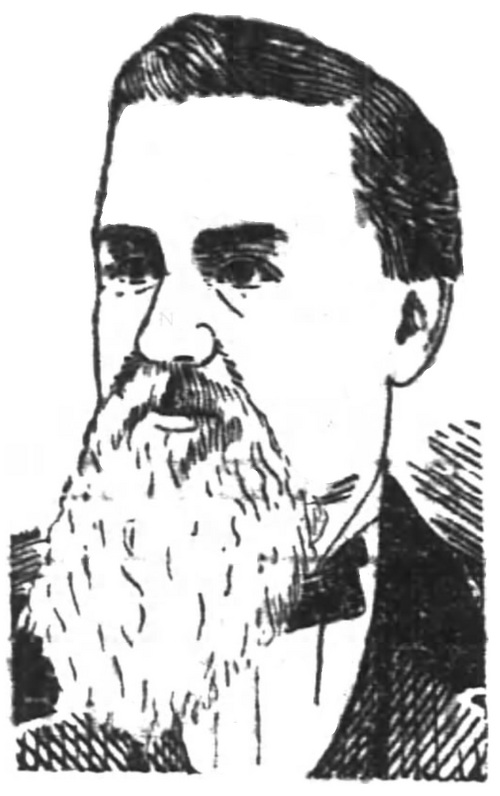
| Judge
Samuel Hall (late in life) |
| Not a lot is known about Samuel Hall; Hall was born in Port Chester District, South Carolina, on October 20, 1820, and died on August 20, 1887; he was buried in Albany, Georgia. He was brought to Georgia as a youth by his parents, Dr. Ezekiel Hall and Sarah Grove (Ashe) Hall. He was graduated from the University of Georgia in 1841, read law under Thomas R.R. Cobb, and practiced law in Knoxville (Georgia) and Oglethorpe, Georgia, before moving to Macon in 1850, from which he was elected as a delegate to the Georgia Secession Convention. After the war he was elected to the Georgia Supreme Court in 1882, before dying in 1887. Hall's speech to the North Carolina General Assembly is here. |
|
|
[Report
of Samuel Hall, Esq., Commissioner from Georgia to North Carolina.]
Oglethorpe, Ga., 13th
March, 1861.
Dear Sir:— Having
been honored by the Convention of the people of Georgia with the
appointment of Commissioner to North Carolina, to lay before the
Convention or Legislature of that State, if either should be in
session, and if not, before the Governor, the ordinance by which
Georgia seceded from the late government of the United States, and to
invite the cooperation of North Carolina, with her and other States
that had seceded or might secede, in the formation of a Southern
Confederacy, I took my departure early in February last, and reached
Raleigh on the eleventh of that month. On that day I waited upon
his
Excellency, John W. Ellis, the Governor of the State, and made
known to
him my appointment and the purpose of my mission. He received me
with
cordiality and entered into the purposes of this State with a
cheerfulness and spirit which convinced me that the people of his State
still held us in high regard and cherished for us sincere respect and
esteem. The Legislature being in session, his Excellency promptly
communicated to them my commission with the accompanying ordinance of
secession. In response to this communication the “General
Assembly,” by
a vote of both houses, appointed a joint committee to wait upon me, to
tender the privilege of the floor and invite me to address that
honorable body upon the subject of my mission. Every hospitality
was
offered and every attention was paid to your Commissioner.
Individually, I appropriated none of this to myself, but received it as
a mark of respect to my State.
Having
accepted the invitation extended to me to address the “General
Assembly,” I was, on Wednesday evening, the 13th February, introduced
to them by the chairman of their joint committee. Encouraged by
the
assurance given me in this introduction, that the Legislature and
people of North Carolina admitted and “knew that the wrongs of which we
complained were their wrongs,” “that the cause for which we were
battling and preparing, if need be, to sacrifice our lives, was their
cause,” that they recognized us as “their kindred” and “would never
turn a deaf ear to the voice that came up from us,” I proceeded to
deliver an address setting forth the causes which led to our
separation, justifying, according to the measure of my feeble ability,
the mode and measure of redress we had adopted, and vindicating the
right of secession as regular, lawful and constitutional; holding that
it should be therefore regarded as peaceable. Assuring North
Carolina
of the cordiality with which she would be welcomed to the embrace of
her ancient confederate and ally, I endeavored to persuade her that she
would find her true interest, prosperity and honor in uniting her
destiny with the “Confederate States of America.” That the affection of
the members of her Legislature and the large audience of her sons and
daughters that honored me with their presence, is still warm and strong
for their former sisters, whose safety and honor required them to
resume the powers delegated to a government which has failed to secure
the one or regard the other, I had still more flattering and
encouraging proof in the indignant and universal negative response made
to the question propounded, “whether they would see Federal troops
march from or through their State to coerce and attempt to subjugate
their Southern brethren.”
In
response to this address, I was charged by the General Assembly,
through their accredited organ, the Hon. Henry T. Clark,
Speaker of the
Senate, to bear this message to the people of Georgia:
“After
giving this momentous question our best and most anxious deliberation,
we have referred it to the sovereign people in convention
assembled. Their judgment and decision will form the guide of our
faith and the
rule of our conduct, and to that tribunal alone can we look for any
authorized response to the friendly counsels and suggestions of our
fellow suffering sister State. But without reference to the
amount of
our sympathy or the extent of our co-operation with her in her present
struggle, we will at least assure her that no hostile foot shall ever
march from or through our borders to assail her or hers.”
I
take the liberty of transmitting, through you, to the Convention, a
copy of the remarks I had the honor to submit on the occasion.
What
seemed to me the greatest obstacle to the immediate co-operation of
North Carolina with the “Confederate States,” was the belief
entertained by the larger number of her citizens that the “Peace
Conference,” (so called) then in session at Washington city, would
grant the demands for new guaranties in the Constitution made by
Virginia and North Carolina that their recommendation would be
sanctioned by the Congress of the United States, and adopted by the
requisite majority of the States remaining in the old Confederacy to
make it a part of the Constitution, and that upon this basis an entire
reconstruction of the Union would be affected.
In
combatting this view. I ventured the opinion that so far as the
action
of the “Peace Conference” and Congress was concerned, this confidence
would be disappointed; but even if it was fully met and sustained, it
would not be acceptable to the States that had seceded, that they had
no objection to the old Constitution, which, when properly interpreted
and fairly carried out. was adequate to secure all the objects
for
which it was formed; that there could be no more solemn or binding
covenants than those contained in that instrument, the fault was not in
the law but in its execution. We could not expect the Northern
people
to observe new compacts better them they had observed the old; that
they would have to be re-educated; their morals would have to be
reformed, and their very natures changed before we could again give
them our confidence; that so far as we were concerned the separation
was “final and irrevocable,” and the people of North Carolina were
therefore reduced to the necessity of choosing between an alliance with
the North or with the Confederate States of America. I was fully
justified in my statement as the disposition of our people to
reconstruct, by the declaration made by the able Commissioner sent by
the Legislature of North Carolina to the Southern Congress at
Montgomery, who reported from ample means of information,
contemporaneously with my arrival at Raleigh, that the persons in the
Confederate States, in favor of such a measure, constituted an
exceedingly meagre minority.
That
I was right as to the action of Congress and the “Peace Conference.”
subsequent events have fully established. I have delayed this
communication that I might lay before the Convention the result of the
election which took place in North Carolina on the 28th ult.
The
question submitted to the people by the act of the legislature was
whether they would call a Convention. Those voting for a
Convention
were generally understood to be in favor of separate State action as a
step preparatory to co-operation with their Southern sisters. The
short
time that elapsed between the passage of the act and the election
precluded the possibility of anything like a thorough canvass of the
State; in fact, it is only within the last ninety days that the subject
began to be agitated in public meetings. The friends of separate
State
action were then few, but now they number nearly fifty thousand.
Their
defeat in the recent election by a popular majority of less than one
thousand gives us no reason to feel discouraged. The election
occurred
on the day after the “Peace Conference” adjourned, and I am informed
from sources entitled to the highest credit, that the result was
brought about by dispatches sent to the central and western portions of
the State, announcing that the “Conference” had agreed upon a
satisfactory adjustment, which would certainly be adopted by
Congress. If such means were resorted to, we can only calculate
with greater
certainty upon the reaction which will occur in popular sentiment;
indeed it is now said that the reaction has already taken place, and
that the advocates of separate State action and an alliance with the
South have a decided majority of the suffrages of the State. A
delegate
to that Conference, who, prior to its meeting, was an ardent friend of
the Union, has, since his return, stated to his constituents that their
propositions for amendments to the Constitution, were, five distinct
times, voted down by large majorities, and that in lieu thereof (as is
apparent to every one at all acquainted with the scheme proposed) that
they were thereby prohibited from exercising the right they now have of
going into the territories north of 36 deg. 30 min. north
latitude with
their slaves, while their right to emigrate with that species of
property to the territories south of that line will depend upon the
interpretation placed upon the common law by judges deadly hostile to
their interests, insult is added to this certain exclusion by demanding
the recognition by the Southern States remaining in the old
confederacy, of free blacks as citizens of the Northern States which
they inhabit and by extending to them all the rights and privileges of
citizens of the several States; this plan has rendered the fugitive
slave law (already an insufficient protection to the rights of the
South) worse than a dead letter, by guaranteeing payment to the owner
of the slave out of the Federal treasury, whenever such a fugitive is
withheld from the custody of his master by the action of a Northern mob
or Northern State laws and tribunals; thus holding out a direct
inducement to the abolitionists to free the slaves of those people and
to compel them to use their own means, at least in part, and in great
part, too, to compensate themselves for their losses. This scheme
was
voted against by North Carolina, Virginia and Missouri in the
conference, and the delegate above alluded to has advised his
constituents that their only safety is in a Union with their Southern
sisters. I believe, from all that I can learn, that a very large
majority of them are agreed with him as to the character of this
concession, and that they only await an opportunity to give effect to
his sound and patriotic advice. Delay in this respect must result
in
material injury to the State in the loss of its slaveholding
population, with the property held by it, which will seek safety by
emigrating to and settling in the Southern Confederate States.
Under
these circumstances I cannot doubt that an opportunity will be afforded
at an early day to the people to vote again upon the subject, and when
the vote is taken, I have still less doubt of what will be the popular
verdict. I therefore confidently anticipate, in a very short
time, the
cooperation desired and invited by Georgia, and that we shall have the
happiness of welcoming with open arms and joyful hearts, our honored
and loved sister to our new and better Union.
I have the honor to
subscribe myself
Very respectfully,
Your obedient servant,
SAMUEL HALL.
To HON. GEORGE W. CRAWFORD, President Convention, Georgia. |